|
The Monthly Newsletter of the Council of Industry
November 24th, 2026
|
|
More than 400 Attendees Celebrate Hudson Valley Manufacturing at Annual Luncheon & Manufacturing Expo
|
|
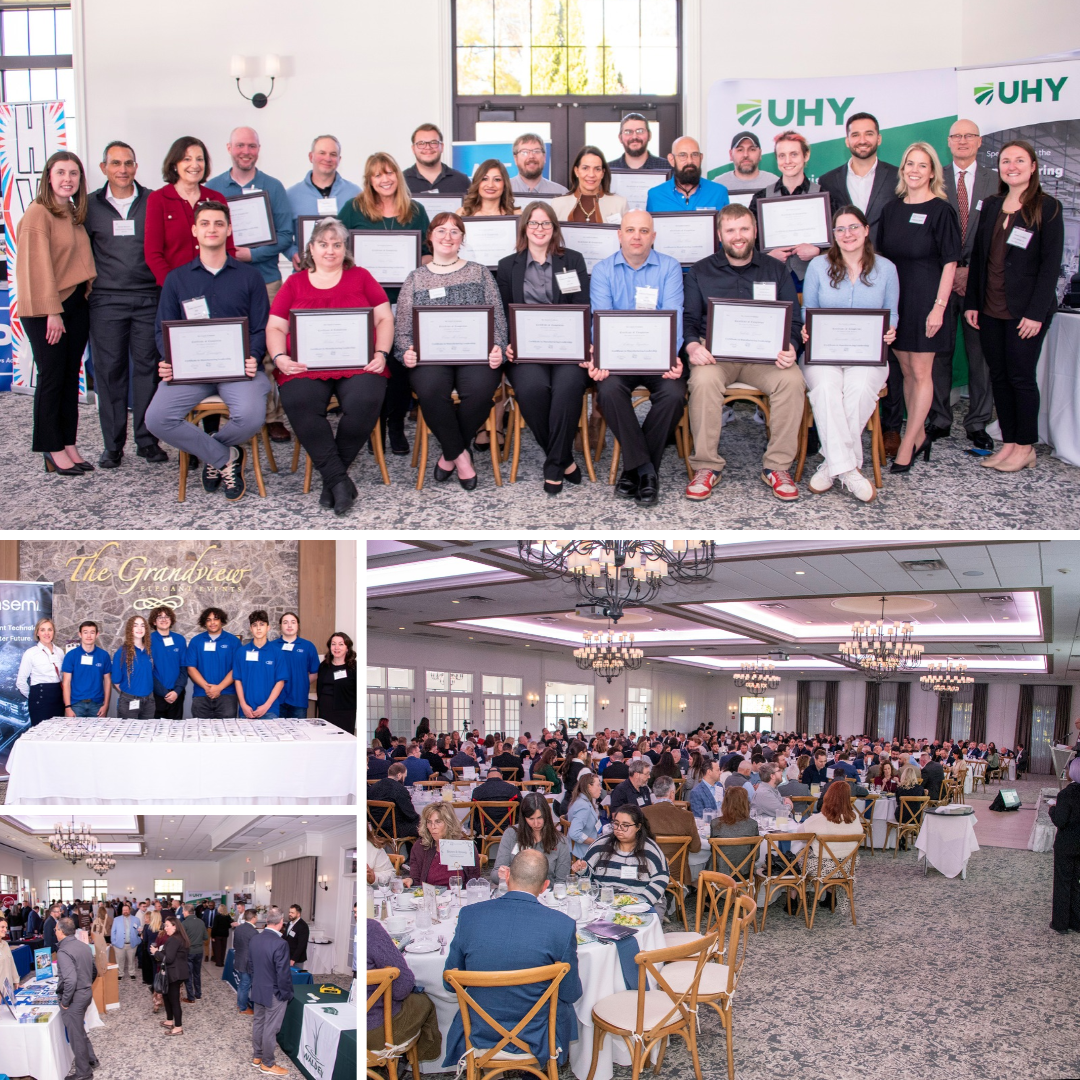
Thank you to everyone who joined us on Friday, November 20, at The Grandview in Poughkeepsie for the Council of Industry's 2026 Annual Luncheon & Manufacturing Expo! It was wonderful to bring together manufacturers, business leaders, and community partners from across the Hudson Valley for a day of connection, recognition, and conversations about the future of our region's manufacturing sector.
This year's program featured welcoming remarks from Dutchess County Executive Sue Serino, a conversation on what's next for manufacturing in the Hudson Valley, and a keynote address from IBM's Neal Moriarty exploring quantum computing and emerging technologies.
We were also proud to recognize the Winter and Spring 2026 graduates of our Certificate in Manufacturing Leadership program and announce the Council's new role as a designated Regional Manufacturing Extension Partnership (MEP) Center. The Manufacturing Expo provided an opportunity for attendees to connect with local businesses, explore their products and services, and strengthen relationships throughout our manufacturing community.
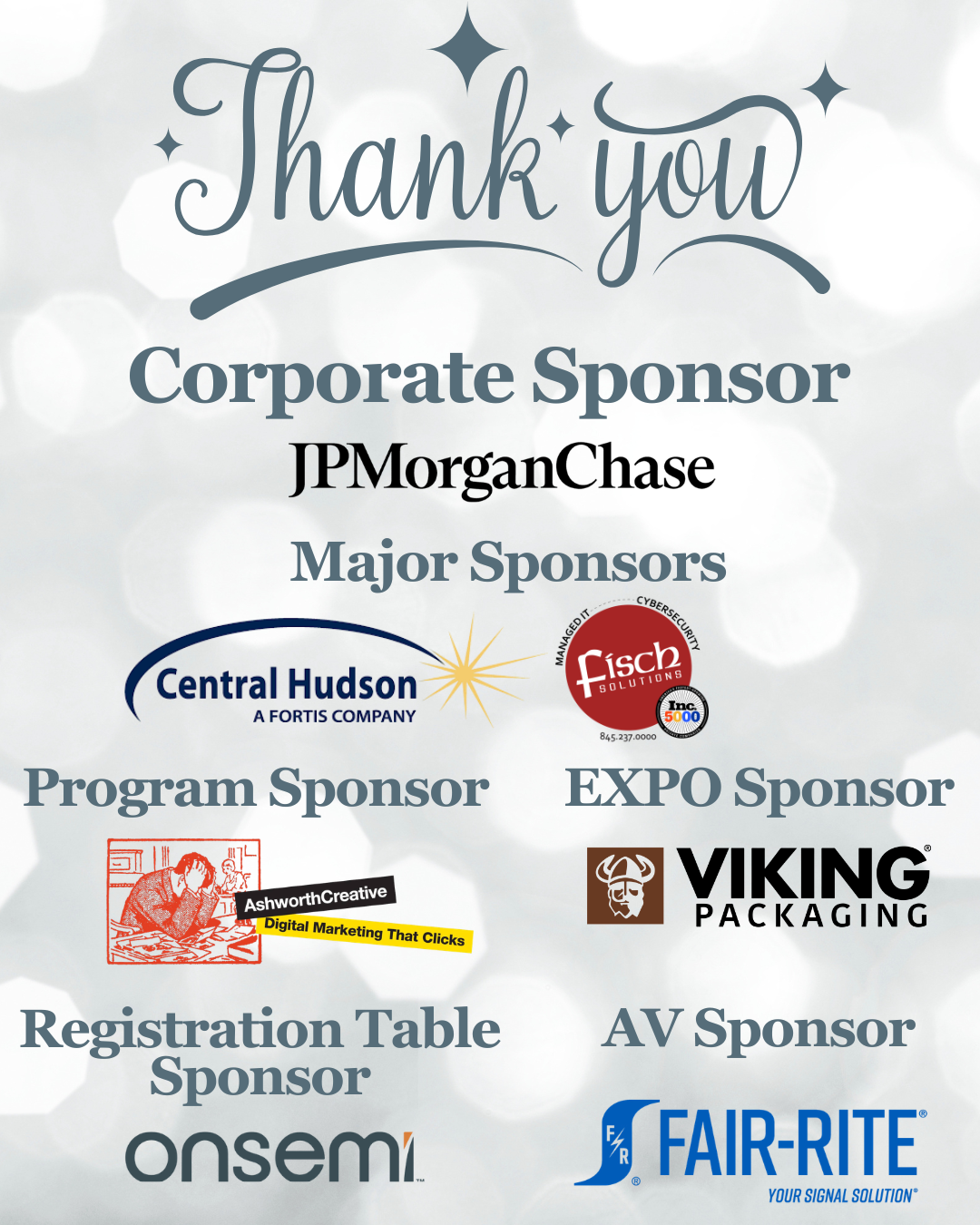
We are especially grateful to our sponsors, exhibitors, speakers, and members for their continued support and for helping make this year's event possible!
Take a closer look at this year's luncheon:
|
|
AI-Enhanced Introduction to Lean Six Sigma: Hands-On Training
|
|
|
Wednesday, January 20, 2027 | 8:30 AM – 4:00 PM | DCC @ Fishkill
Discover how Lean Six Sigma and Artificial Intelligence can work together to improve efficiency, reduce waste, and strengthen manufacturing operations. The Council of Industry is offering this full-day, interactive training designed to introduce participants to the fundamentals of Lean Six Sigma while exploring how AI can enhance problem-solving, streamline processes, and support continuous improvement initiatives.
Led by Lean Six Sigma Master Black Belt David Tooker, the session will combine classroom instruction with hands-on simulations, giving participants the opportunity to apply Lean principles in a practical setting.
Attendees will explore key concepts such as identifying and eliminating waste, improving workflow, reducing lead times, and enhancing quality and productivity. The training will also introduce ways AI tools can assist with process analysis, decision-making, and identifying opportunities for improvement.
Whether you're new to Lean Six Sigma or looking to strengthen your understanding of continuous improvement, this workshop offers valuable tools and strategies that can be applied across manufacturing operations and other business functions.
|
|
|
What the 2026 Midterm Elections Could Mean for Manufacturers & Distributors
|
|
|
Following the 2026 midterm elections, Democrats won majorities in both the U.S. House (237 seats) and Senate (54 seats), creating a divided government with President Donald Trump remaining in the White House. According to policy analysts, legal firms, and industry consultants, this shift in Washington introduces new legislative gridlock and oversight while leaving several core operating pressures intact for U.S. manufacturers.
Underlying economic pressures persist. Legal firm FBT Gibbons LLP emphasizes that despite the political realignment, manufacturers face the same core operational challenges heading into 2027: energy availability and costs, ongoing workforce shortages, artificial intelligence integration, and state-level regulations.
Executive tariff authority remains intact. According to Verdantix, while Democrats will control congressional committees starting in January 2027, President Trump retains wide discretion over trade policy and his veto power.
Continuity for existing tax incentives. RSM US points out that because the One Big Beautiful Bill Act of 2025 already made bonus depreciation permanent and allowed immediate expensing for domestic research and development, major manufacturing tax incentives are unlikely to be rewritten under a divided government.
Workforce and apprenticeship funding. Lakeview Consulting reports that workforce development and state-led apprenticeship programs remain strong congressional priorities, with federal grants continuing to target vulnerable or essential domestic industries.
Heightened congressional oversight. Both Edelman and RSM US report that incoming Democratic committee chairs will likely increase investigative scrutiny of the administration and federal agencies, including the Department of Commerce, the Office of the U.S. Trade Representative, the Environmental Protection Agency, and the Department of Energy.
Narrow bipartisan opportunities. Edelman and ML Strategies indicate that while broad partisan bills will stall, narrow bipartisan cooperation remains possible on affordability-driven issues, infrastructure, permitting reform, and domestic manufacturing competitiveness ahead of the 2028 election cycle.
Read more at Edelman
|
|
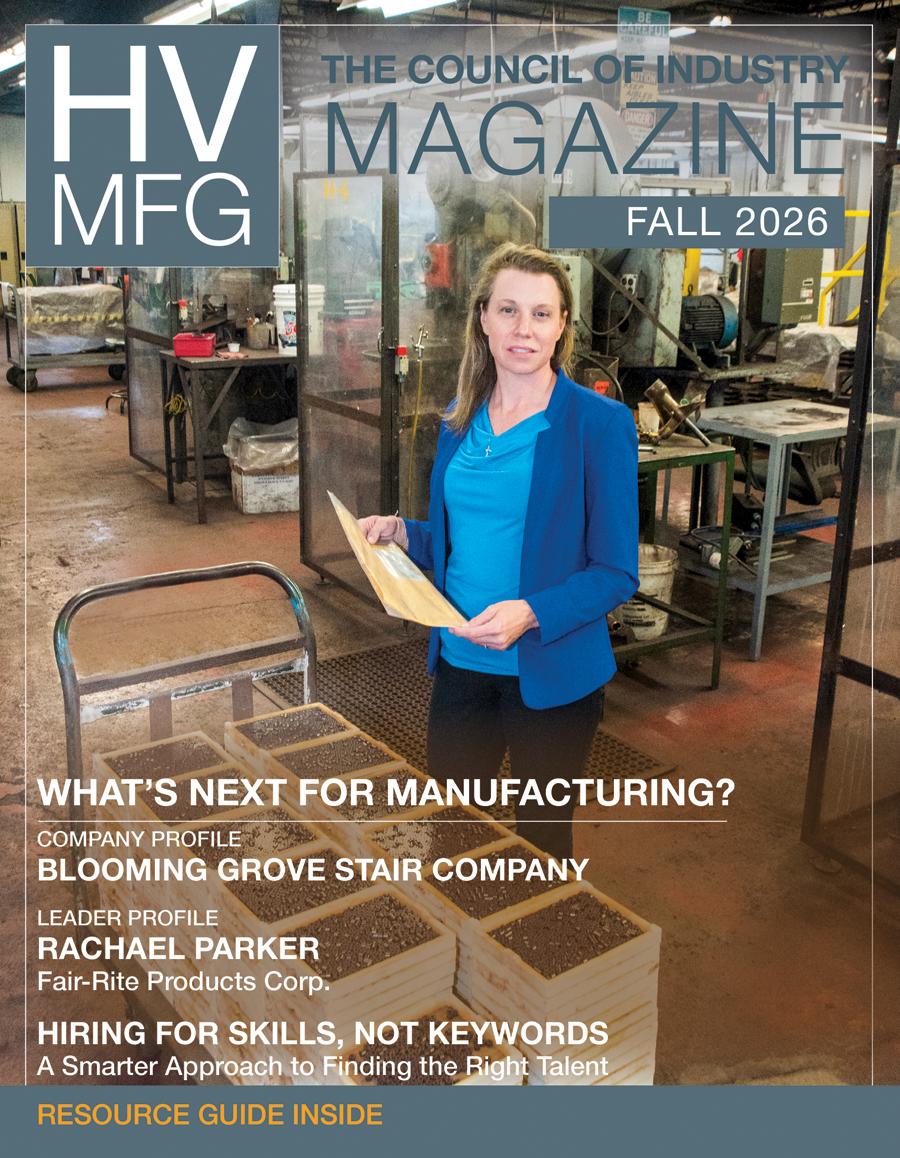
In Case You Missed it - The Fall 2026 edition of HV MFG is here!
|
|
What's Next For Manufacturing?
Manufacturers across the Hudson Valley are used to adapting through uncertainty. This edition of HV MFG looks at how they are investing in people, technology, and capabilities to prepare for what comes next.
As always we would like to express our sincere appreciation to the many organizations who placed advertisements in HV Mfg. Your support of Mid-Hudson manufacturing, the Council of Industry, and this publication is greatly appreciated.
Read the full version here.
|
|
|
Reminder: Registered Apprenticeship Tax Credit Applications Due December 31
|
|
|
New York State employers participating in a Registered Apprenticeship Program may be eligible for the Empire State Apprenticeship Tax Credit (ESATC), with tax credits starting at $2,000 per qualified apprentice. Additional incentives are available for employers who hire disadvantaged youth, provide mentorship and retain apprentices throughout their training.
Employers must submit an online application for each trade by December 31.
For more information, visit the NYSDOL website or contact Emma Olivet.
|
|
|
MEP Service Focus: Business Growth & Strategy
|
|
|
The Council of Industry’s Mid-Hudson MEP consults directly with manufacturers to understand their goals, assess growth opportunities, and develop a practical plan tailored to each company.
- Strategic planning — Set growth goals, agree on priorities, and define next steps.
- Market expansion — Evaluate new markets and opportunities for existing or new products.
- Customer diversification — Identify new customer segments and reduce reliance on a few major accounts.
- Sales and marketing strategy — Clarify what sets your business apart and how to reach the right customers.
- Technology and investment planning — Prioritize investments in equipment, facilities, and digital tools. Explore practical uses for AI in quoting, production scheduling, or quality inspection, and weigh the costs and expected benefits before investing.
Want to know more? Contact Harold King
|
|
|
The Council of Industry is partnering with Choice Words to help manufacturers throughout the Mid-Hudson region identify and pursue funding opportunities that can support innovation, investment and growth.
Among these opportunities is the CHIPS Incentives Program, administered by the National Institute of Standards and Technology, which supports the growth of the domestic semiconductor industry. Funding can be used for the construction, expansion or modernization of facilities involved in semiconductor materials and manufacturing equipment. Eligible applicants include private-sector businesses, nonprofit organizations and consortiums with the ability to finance and develop qualifying facilities. Awards are expected to exceed $20 million per project, with applications accepted on a rolling basis through October 2027.
The USDA Forest Service's Wood Innovations Program also offers funding to support projects that expand wood utilization, promote the use of wood in construction and strengthen wood energy markets. The program aims to support local economies, improve forest health and reduce wildfire risks. Eligible applicants include businesses, nonprofit organizations, educational institutions and government entities. Grants of up to $300,000 are available, with awards of up to $500,000 considered for projects demonstrating significant impacts on wood markets. A 1:1 match is required, and the next funding opportunity is anticipated to be announced in early 2027.
These are two funding resources that may help support manufacturing and economic development projects in our region. To learn more about these opportunities and explore potential eligibility, contact Briana Maloney at bmaloney@choicewordspr.com.
Click here to read more about these funding opportunities.
|
|
Upcoming CI Trainings & Events
|
|
Events
2027 Manufacturing Champions Awards Breakfast & Workforce Developers Expo, May 7th, West Hills Country Club
Training
Risk Management: Enviroment Health and Safety, (A CML Course) December 2, 8:30 - 4:30. SUNY Orange Newburgh.
Strategies for Motivation, Coaching and Managing Difficult People, (A CML Course) December 9, 8:30 - 4:30. SUNY Orange Newburgh.
|
|
Manufacturing Industry News
|
|
Leaders Meet the AI Moment by Synthesizing, Zooming Out, Reimagining
|
|
For centuries, we’ve been sold a seductive story: focus narrowly, master one thing and the world will reward you. It’s a story that has shaped the modern workplace, the industrial economy, and the careers of generations. And for a long time, it worked. Think of Henry Ford’s assembly line: each worker repeating one narrow task with ever-increasing efficiency. This system made perfect sense when the problems we faced were linear, predictable and slow-moving. Efficiency was king. Uniformity was rewarded. Why? Because in an age of assembly lines, predictable systems, and stable industries, specialization was the fuel that powered progress.
That assembly line framework no longer works in today’s complex, interconnected ecosystem. In fact, that framework serves to contract our brilliance rather than equip us for the messy, adaptive and nonlinear challenges we face—climate change, technological disruption, global health crises and fractured workplaces. These sorts of challenges don’t yield to one-track expertise. They require us to synthesize and embrace paradoxes. They require leaders who can zoom out, connect dots and reimagine the whole picture. Win AI machines handle what is narrow, repeatable and computational, humans are invited—perhaps required—to step more fully into what is integrative, creative and meaning-making. In that sense, AI doesn’t diminish human brilliance; it exposes where our deeper value has existed all along.
Read more at IndustryWeek
|
|
Aerospace, Defense Struggle To Bridge Gap Between Demand, Output
|
|
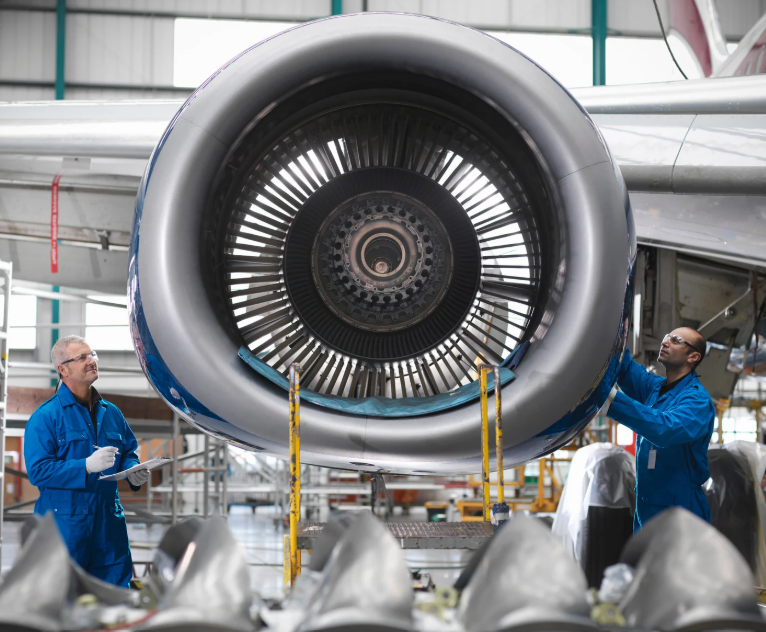
America’s aerospace and defense industry is struggling to convert unprecedented demand into production. The industry surpassed $1 trillion in annual revenue for the first time in 2025, while defense and commercial aerospace backlogs reached historic levels.
Yet a recent Aerospace Industries Association and PwC survey found a meaningful gap between demand and the industry’s ability to respond. While 85% of aerospace and defense executives believe their organizations can increase production by 25% within 18 months, confidence drops sharply as the required ramp approaches twice current output. Installed manufacturing capacity and qualified production capacity are two very different measures. Buying another machine tool, adding a metal additive manufacturing system or expanding a facility can increase theoretical capacity. None automatically increases the number of conforming parts available to a defense contractor.
For manufacturers, three priorities stand out. First, understand the true constraints inside existing operations before committing additional capital. Second, bring manufacturing, quality, cybersecurity and supply-chain expertise into programs earlier. And third, build the visibility and long-term supplier relationships necessary for critical partners to invest ahead of demand. Those actions can expand qualified capacity while larger investments in equipment, facilities and workforce come online.
Read more at SME’s Advanced Manufacturing
|
|
|
Manufacturing’s Hardest Hire Is The Person Running The Automation
|
|
|
Manufacturers today have more work than they’re able to take on, but hiring hasn’t kept pace. Headcount is part of it, but the bigger gap is what new employees need to know once they’re in the door. Industry has been here before, where jobs changed alongside their equipment. Machine operators, for example, who once loaded every part by hand, may now instead oversee a robot that does the loading. That operator still needs to know parts and processes, but now they also have to spot when the robot is off or not working and get it running again. AI and automation’s rise is bringing more jobs to the shop floor, yet there’s still a skills gap that exists to fill demand.
A shop can fill an open position and still not have the capabilities to address their production backlogs. The backlog only shrinks when the right skill is in that position. A typical response to a skills shortage is to raise wages. This can work, but only to a point. A quarter of manufacturers say that raising pay produced no meaningful improvement in hiring or retention. Even with stronger recruiting, backlogs can still grow faster than manufacturers can hire to clear them. A useful workforce plan for 2027 provides a clear view of which skills to own, which to develop internally, and which to bring in from elsewhere when the job calls for it. My advice for shops is to own the skills that define your business. That includes the capabilities a shop uses every day and the work that sets it apart. A company’s core processes, quality standards, and knowledge of customer requirements are worth competing for and retaining.
Read more at Smart Industry
Learn more about the Council of Industry’s Skills Based Hiring Resources
|
|
|
ERP Transformation Starts With Your Operating Model
|
|
|
The ERP conversation often starts with a vendor question: What should replace the system we use today? That is a reasonable question, but it is not the first one to ask. Start with the software and the project can quickly turn into a technology swap. Existing processes get mapped, familiar workarounds get rebuilt and years of custom code follow the company onto a newer platform. Replacing software does not automatically improve a plant. Instead, before choosing a new ERP, manufacturers need to sort out what should be common across the business, what truly sets the company apart and how the change will show up in day-to-day work on the floor.
A better starting point is to describe the business the company is trying to become, then identify the capabilities needed to get there. Manufacturing and operations leaders should drive that discussion. They can distinguish the processes that need to be consistent across plants from the capabilities that give the company an edge. They also can separate a local step that solves a real operating problem from one that exists only because the legacy system never offered a better option. Once those choices are clear, the team can decide what belongs in the ERP core, what belongs in an MES, quality or planning layer, and what should be retired. The order matters: capability first, then process, architecture and technology. Reverse that order and the business ends up bending its future operating model around a software decision that has already been made.
Read more at IndustryWeek
|
|
|
Manufacturing's Future Depends on Companies Most Americans Don’t Know
|
|
|
Some of the greatest names in the annals of American business are manufacturers: from General Motors, General Electric and General Mills to Caterpillar, Lockheed Martin and Boeing; from John Deere, Ford Motor Co. and Kraft Heinz to Tesla, Coca-Cola and Procter & Gamble. All iconic brands. And yet, while they built American manufacturing’s reputation around the world, the backbone of our factory sector has always rested with a different group of companies—the “industrial middle,” a group of primarily B2B manufacturers, ranging from roughly $30 million to $10 billion (using RSM’s definition), most of whose names are barely known by American consumers.
The cars we drive and airplanes we fly, the electronics we use and the electrical grid we rely on, the groceries that sustain us and packaged foods that nurture us, the homes and offices we live and work in—they wouldn’t exist without this American industrial core.We’re talking makers of precision machined components, metal fabrications and castings and forgings. Electronic assemblies, industrial automation systems and specialty chemicals. Packaging equipment, industrial software and controls, and tooling and molds.
In tribute to these companies, here are four important reasons why the B2B middle reflects the past, present and future of American manufacturing.
Read more at IndustryWeek
|
|
|
Economist ‘World Ahead’ Editor Tom Standage’s Ten Trends To Watch In 2027
|
|
|
Every November The Economist publishes The World Ahead, our annual guide to the coming year. Its editor, Tom Standage draw up a Top 10 list of themes to watch. On this year’s list are some things you might expect, such as the beginning of Donald Trump’s final chapter, aftershocks from the war in Iran, next year being the hottest ever (again), and growing concern about the risks and impacts of AI.
But there are also some more unexpected items. What is the Davidson window, for example, and what does it mean for Taiwan in 2027? How are slimming drugs reshaping not just consumers, but consumer behaviour, as the newly slender engage in “revenge shopping”? Why have those same drugs rejuvenated the field of longevity medicine? And strangest of all, why does “Star Wars”—which is coming back to cinemas 50 years after its original release—provide a surprisingly relevant guide to 2027?
Read more at The Economist
|
|
|
Boston Dynamics Will Begin Deploying Spot Robots Across Globalfoundries’ Global Manufacturing Network, Test Atlas Humanoids
|
|
|
Boston Dynamics and GlobalFoundries have expanded their collaboration to deploy Spot robots for autonomous inspection and data collection across GlobalFoundries’ global semiconductor fabs, according to a Nov. 17 news release. Spot deployments will expand across GlobalFoundries’ manufacturing sites in Malta, New York; Burlington, Vermont; Dresden, Germany; and Singapore, the companies said.
GlobalFoundries also will be Boston Dynamics’ first customer outside of the automotive industry to test humanoid robots as part of the latter company’s Atlas early adopter program and skills development workshop. The goal of the testing will be to evaluate how the robot can best be used, determine whether customers are ready to use it and train it to perform specific tasks, according to the news release.
Read more at Manfuacturing Dive
|
|
|
Quantum Computing’s First Real-World Payoff May Come In Energy, Not Drug Discovery
|
|
|
For years, the case for quantum computing has rested on ambitious promises, from discovering new drugs by simulating how molecules behave to optimizing supply chains and airline schedules. Many of the biggest aims are still likely to be years, if not decades, away. But quantum software, which uses algorithms designed to solve complex problems faster than conventional computers, is already being tested on a more immediate challenge: the energy transition, from keeping power grids stable to finding better materials for solar cells and hydrogen production.
Phasecraft, a quantum software company founded in Bristol, England, in 2019, is one of the firms putting the technology to work in energy. There are enormous opportunities to solve problems that are both important for energy security and commercially valuable, Ashley Montanaro, co-founder and CEO of Phasecraft, told CNBC.
Quantinuum, which was formed by the merger of Cambridge Quantum and Honeywell Quantum Solutions and listed on Nasdaq in June, is using the technology to model materials for hydrogen fuel cells for transportation. It is also working with partners on materials for carbon capture.
Another U.K. player, ORCA Computing, a spinout from the University of Oxford, has partnered with BP to better understand how a molecule’s physical, chemical and biological properties are governed. That could help explain how biofuels burn and how to make them burn more efficiently.
Read more at CNBC
|
|
|
Understanding the Basics of Energy Procurement
|
|
|
Energy procurement is a critical aspect of business operations, especially in competitive markets where every decision can impact your bottom line. Mastering the fundamentals is essential for making informed decisions that align with operational and financial objectives. By understanding the basics, businesses can optimize their energy strategy and achieve greater financial stability. In competitive markets, businesses have the flexibility to choose their energy suppliers and negotiate contracts that best meet their needs. Suppliers purchase electricity from the wholesale market and sell it to consumers in the retail market. This allows businesses to select from various energy contracts, which differ in pricing models, contract length and additional services. These contracts can be categorized into three main types:
Fixed Contracts: Lock in a set price per kilowatt-hour (kWh) for the duration of the agreement, providing budget certainty and protection against price volatility.
Variable Contracts: Prices fluctuate based on market conditions, offering lower prices when market rates drop and higher costs during peak periods.
Layered/Managed Contracts: Combine fixed and index pricing by layering purchases over time or managing the contract to adapt to market conditions, offering a balance between price stability and market responsiveness.
Choosing the right contract requires an understanding of a business’s energy consumption patterns, risk tolerance and financial goals. At Constellation, our energy professionals can provide valuable insights and help businesses navigate the complexities of energy procurement.
Read more at NRG
See NRG’s New York Energy Market Webinar
Learn more about the Council of Industry’s energy consortium (where you can lock in a fixed price to avoid price spikes)
|
|
|
Thanksgiving Turkeys Quiz: How Much Do You Know About These Failed Products?
|
|
|
Dig into this IndustryWeek trivia about manufactured-items-that missed-the-landing that the whole family can enjoy.
Read more at Industry Week
|
|
|
Insight Exchange: Expert-Led Video Series for Manufacturers
The Insight Exchange is a new video series from the Council of Industry, offering manufacturers expert insights and strategies—accessible anytime. Each session features industry professionals covering key topics like workforce development, regulatory updates, and emerging technologies.
|
|
|
The Council of Industry focuses on advancing manufacturing excellence, workforce innovation, advocacy, and strategically positioning its members within the Hudson Valley region and beyond. It is the premier manufacturers' association for Southeastern New York, representing over 160 member firms. Grow, Train, and Succeed with the Council of Industry.
|
|
|
If you’re part of a Council of Industry member company and not yet subscribed, email us. If you’re not a Council member, become one today
|
|
|
|
|