|
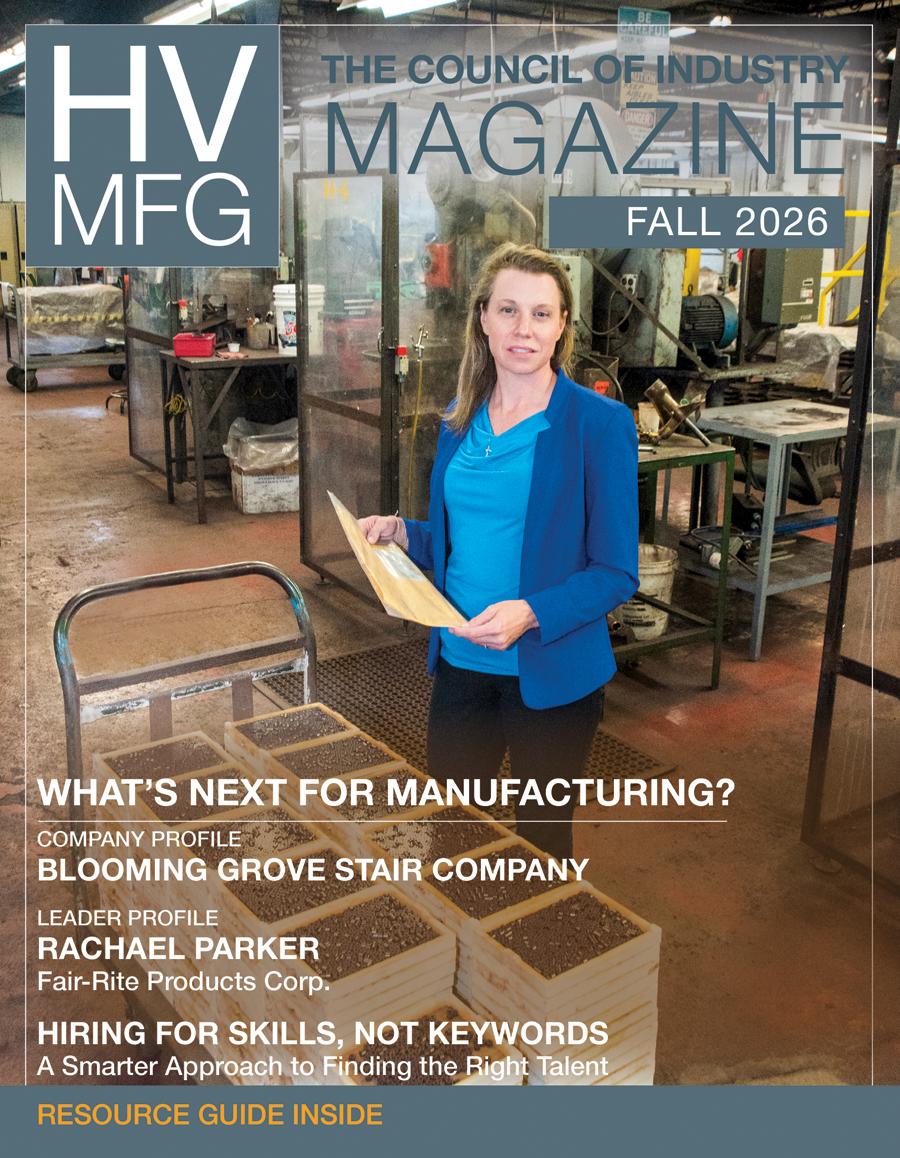
What's Next For Manufacturing? HV Mfg Fall Edition Attempts to Answer That Question
|
|
What's Next For Manufacturing?
Throughout this issue, we highlight how Hudson Valley manufacturers are investing in people, technology, and innovation to strengthen their businesses, remain competitive, and prepare for the future.
Our Leader Profile features Rachael Parker, President of Fair-Rite Products, who shares her leadership journey and how the company is building on more than 70 years of manufacturing success. Our Company Profile takes readers inside Blooming Grove Stair, where owners Jesse Kehoe and Paul Graham are combining traditional craftsmanship with modern technology to grow their business.
|
|
Also featured in this issue:
- Manufacturing 2030: Regional manufacturing leaders discuss automation, workforce challenges, capacity, and the future of the industry.
- Introducing the Mid-Hudson MEP Center: Learn how the Council of Industry is expanding resources and services to help manufacturers improve operations, adopt technology, and grow.
- Skills-Based Hiring: A fresh perspective on finding talent by focusing on skills rather than traditional qualifications.
- Industry & University Partnerships: How SUNY New Paltz is connecting manufacturers with research, expertise, and emerging talent.
- Succession Planning: Preparing for the future when the next generation isn't taking over the family business.
- Manufacturing News & Resources: Updates from across the Hudson Valley, along with our resource guide connecting manufacturers to valuable organizations and services.
Read the full version here.
|
|
Filling Fast: Annual Luncheon & Member Expo
|
|
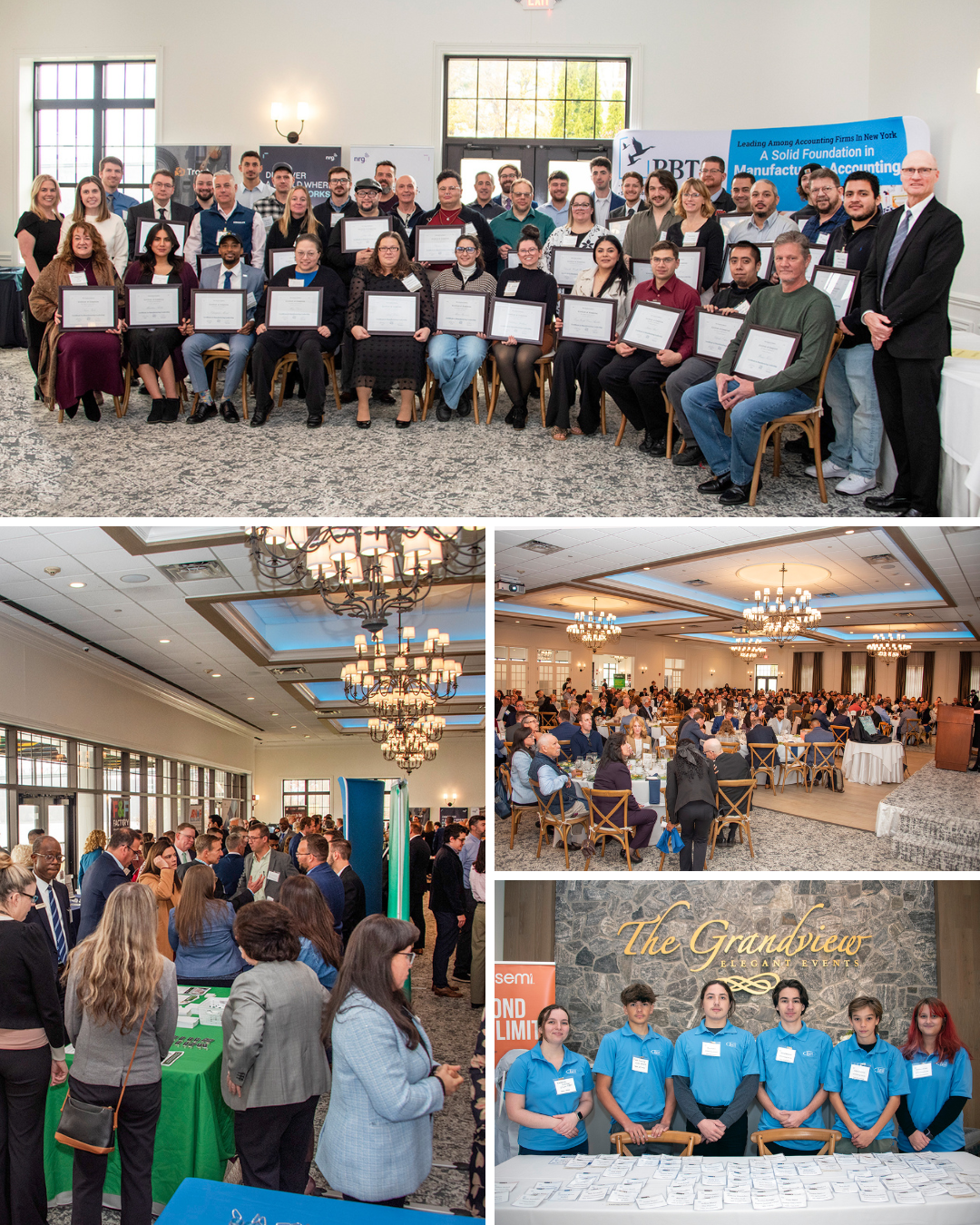
Join us on Friday, November 20, at The Grandview as we bring together manufacturers, suppliers, and industry partners from across the Hudson Valley to connect, celebrate our accomplishments, and support the continued success of local manufacturing.
This year's keynote will feature Neal Moriarty, Manager of IBM's Innovation Studio in Poughkeepsie and Senior Quantum Ambassador, who will give attendees an inside look at the rapidly evolving world of quantum computing and IBM’s work to advance the technology in Poughkeepsie.
We will also recognize the Winter & Spring 2026 graduates of the Certificate in Manufacturing Leadership Series, celebrating their commitment to strengthening their leadership skills and our manufacturing workforce.
|
|
|
Individual Course Registration Available for our Certificate in Manufacturing Leadership Series
|
|
|
You don’t have to attend the full series to strengthen your leadership skills!
Individual course registration is available for the Council of Industry’s Certificate in Manufacturing Leadership Series at SUNY Orange’s Newburgh Campus.
Choose the courses that best fit your professional development goals, with topics including leadership, communication, coaching, human resources, lean manufacturing, financial performance, workplace safety, and more.
Whether you’re developing a new supervisor or helping an experienced leader sharpen their skills, individual courses offer a flexible way to invest in your team.
|
|
Lean Overview and Simulation, (A CML Course) November 19, 8:30 - 4:30. SUNY Orange Newburgh.
Risk Management: Enviroment Health and Safety, (A CML Course) November 19, 8:30 - 4:30. SUNY Orange Newburgh.
Strategies for Motivation, Coaching and Managing Difficult People, (A CML Course) November 19, 8:30 - 4:30. SUNY Orange Newburgh.
Explore upcoming courses and register today
|
|
February 11th: Human Resource Sub Council Meeting
|
|
|
Connect with fellow HR professionals and manufacturing leaders at our quarterly HR Manufacturing Sub-Council meeting! Share ideas, discuss common challenges, and learn what's working at other Hudson Valley manufacturers. Bring your questions, experiences, and topics you'd like to explore.
Register Here
|
|
The Electro-Mechanical Technician (EMT) Trade is Rapidly Growing In Council of Industry Apprentice Program
|
|
|
Electro-mechanical and mechatronics technologists and technicians combine knowledge of mechanical technology with knowledge of electrical and electronic circuitry. They operate, test, and maintain unmanned, automated, robotic, or electro-mechanical equipment.
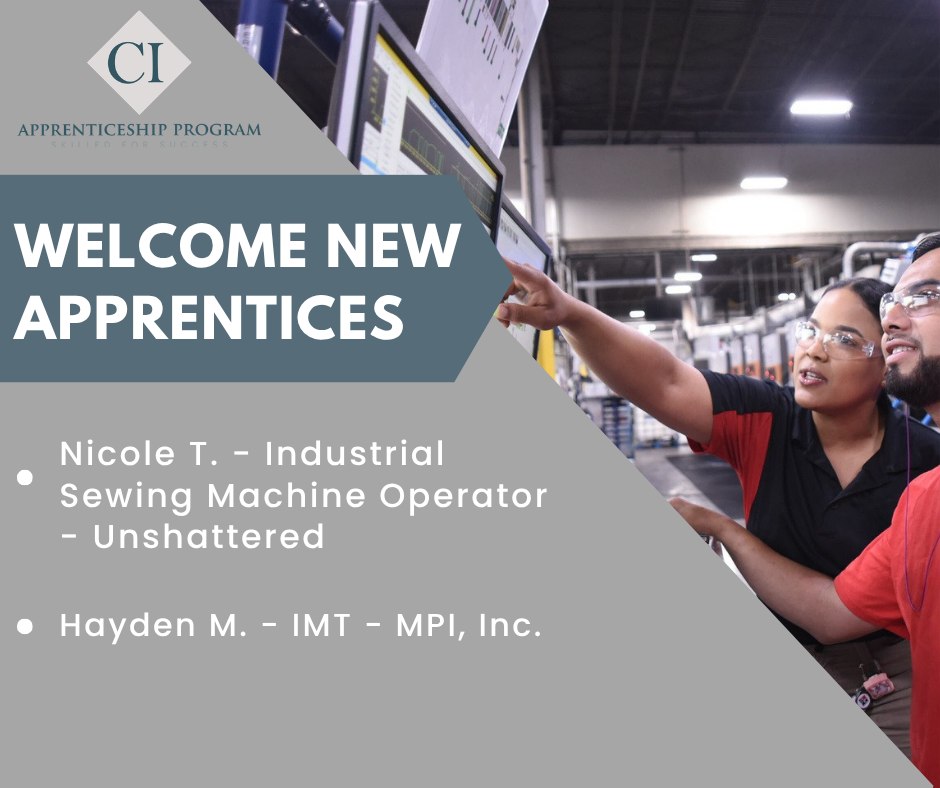
The Council of Industry sponsors 8 manufacturing trades through The Manufacturers Intermediary Apprenticeship Program (MIAP.) These are New York State Department of Labor approved trades ranging in length from 12 months to 4 years. These apprenticeships consist of two pieces: On-the-Job Training (OJT) and Related Instruction (RI).
OJT allows an apprentice to learn firsthand from a skilled craftsperson who will demonstrate and share their experience in the field
In RI, apprentices will learn the theory - and knowledge - based components of the craft. They must complete 144 hours of classroom or online training each year.
Work Processes (Skills learned on the Job) Approximate Hours for Electro-Mechanical Technician:
- Safety and Workplace Orientation: 250 hours
- Mechanical Repair: 2,000 hours
- Electrical Repair: 950 hours
- Electronic Repair: 1,900 hours
- Preventative Maintenance : 2,750 hours
- Miscellaneous: 150 hours
Total Hours: 8,000
Minimum of 144 Hours of Related Instruction (Classroom Learning) Required for Each Apprentice for Each Year:
- Safety & Health
- Engineering Drawings
- Mathematics
- Trade Theory and Science
- Computer Fundamentals
- Welding (if performed on-the-job)
- Working on High-Voltage Manufacturing Equipment
- Interpersonal Communications: oral and written
- Sexual Harassment Prevention
If you want to know more about the Quality Assurance Auditor trade and see if it might be right you’re your company contact Emma Olivet
Learn more about The Council of Industry’s Apprentice Program
|
|
|
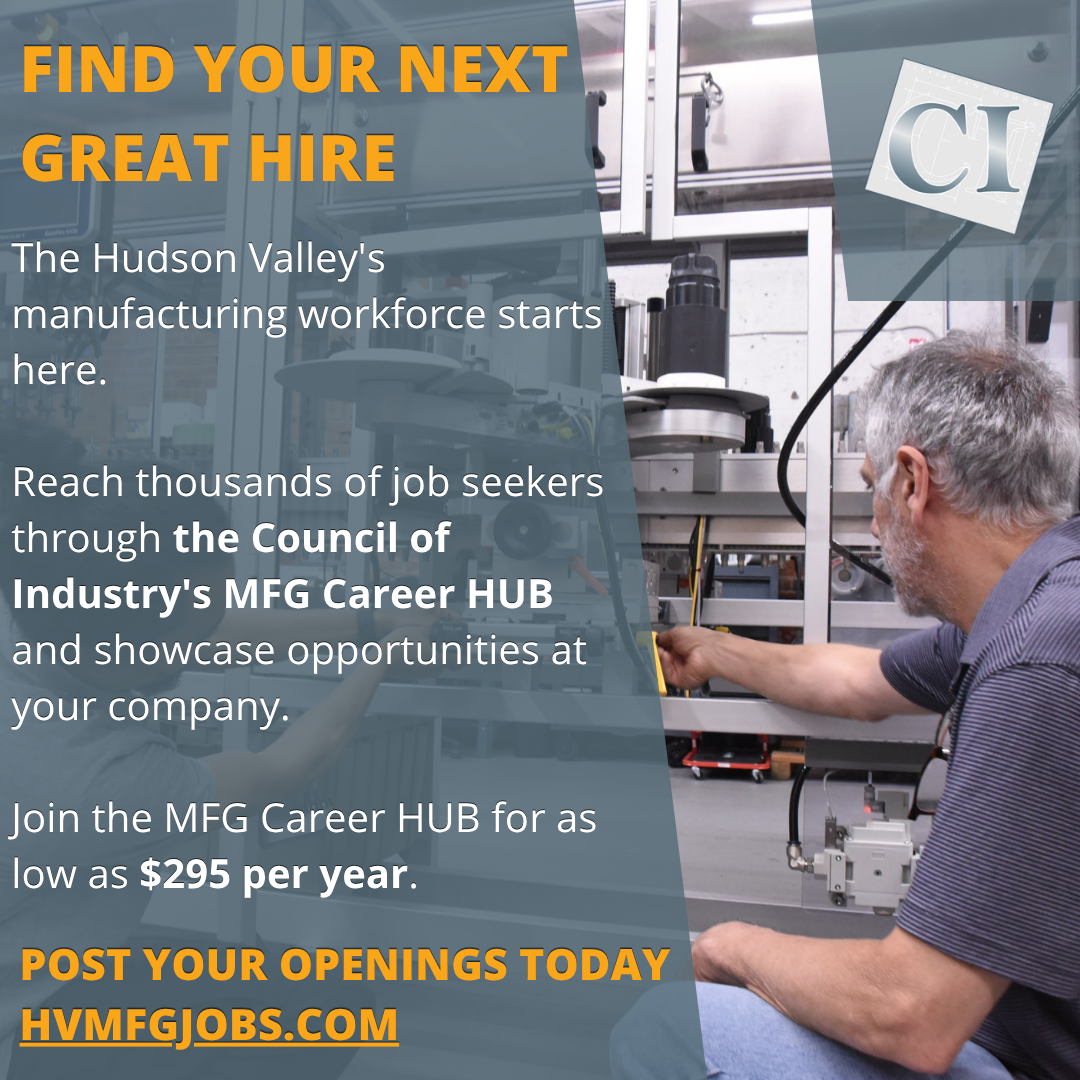
Subscribers to the Manufacturing Career Hub can view candidate resumes and contact information by searching the Candidate ID Number in the iCIMS platform.
Not yet a participant of the Career Hub? Contact Emma Olivet directly for additional candidate details or to learn more about the recruiting initiative.
|
|
|
Candidate ID: 29474
Position Interest: Manufacturing / Drafting / CNC
Level: Entry Level
Skills: Autodesk Inventor, AutoCAD, SigmaNEST, 3D Manufacturing Design, Sheet Metal Design, Laser Cutting Layouts, Bills of Materials, Machine Operation, Sonic Welding
Certifications: Haas Basic CNC Mill Operation, MSSC Certified Production Technician 4.0, SUNY Ulster Microcredentials in CNC Operation and CNC Programming
Education: Associate of Occupational Studies, Advanced Manufacturing, SUNY Ulster (GPA: 3.94); Additional coursework at SUNY New Paltz and Rochester Institute of Technology.
Availability: Open to Interviews
|
|
Candidate ID: 45940
Position Interest: Summer Internship in Mechanical Engineering / Manufacturing Engineering
Skills: SOLIDWORKS, MATLAB, AutoCAD, Fusion 360, Excel, Microsoft Project, Arduino, Simio; HAAS CNC Mill Operation, Manual Mill Operation, Manual Lathe Operation, Hand Tools, C++ Programming, PCB Components and Soldering
Certifications: HAAS Basic Mill Operator, HAAS Basic Lathe Operator, OSHA 10-Hour Safety
Education: Bachelor of Science, Mechanical Engineering, Binghamton University – Expected May 2029
Availability: Open to Interviews
|
|
|
News for HR and Workforce Professionals
|
|
|
iCIMS October Insights – Hiring Cools, Holiday Hiring Challenging
|
|
|
In the U.S., hiring fell -7% below the September 2025 baseline, the steepest drop of the year, while job openings cooled to 3% above baseline, down from 12% in July. Application volume slipped -8% below baseline as well. Earlier this year, the strain sat in a gap between metrics. This month, there is no gap: hiring, openings and application volume are all moving the same direction, and that direction is down.
- ICIMS Insights data shows the gap between frontline hiring for the holidays and the candidates available to fill those roles widening again this month, even as applicant per opening (APO) sits at its lowest point of the year.
- Challenger, Gray & Christmas points to part of why: retailers are planning their smallest seasonal hiring push since 2008, leaning more on existing staff and automation than net new seasonal headcount.
- The pipeline of talent applying to these roles is also shifting. A younger applicant pool is applying this September, echoed by national labor data showing more young workers employed and fewer of them still searching.
- There is a widening gap between frontline hiring and the candidates available to fill it.
Read the Report
Learn more about the Council of Industry’s Manufacturing Career Hub Driven By iCIMS
Check out the MIAP Apprentice Program
|
|
|
Partner Hiring Snapshot: October 2026
|
|
|
If you’re noticing fewer applicants to your job postings, you’re not alone. In a recent analysis of job postings and candidates on the Manufacturing Career HUB here at the Council of Industry, we’ve seen a sudden fall in applications across the board, too. So what’s going on? The decline in applications comes after a change in Indeed’s posting policy. In March of this year, Indeed stopped showing many job postings for free unless they’re sponsored, which cut the traffic reaching HUB postings. That’s why we’ve been seeing lower application volume than normal.
The good news: fewer candidates hasn’t meant fewer hires. Partners filled 30% of closed jobs in 2026, up from 21% in 2025. The biggest gap is in production and skilled-trades roles, now averaging 4–6 candidates per opening. We’re piloting a 90-day production hiring program with 2–3 partners to widen that pipeline. Interested? Contact Sameea Butt.
Learn more about the Council of Industry’s Skills Based Hiring service
|
|
|
What High-Performing CEOs Want From Their CHROs
|
|
For decades, HR leaders were expected to build strong leadership teams, develop talent, manage succession, and shape culture. Those responsibilities remain essential, but they are no longer sufficient. Today, leadership and talent are becoming companies’ most reliable source of competitive advantage. In that context, CEOs are asking more of their top people officers than at any point in the past: to simultaneously reinvent work with AI, redesign operating models, build new capabilities, accelerate transformation, navigate unprecedented workforce disruption, and deliver sustained growth all while maintaining employee trust and organizational resilience.
CEOs have been evolving what they want from CHROs. Based on analysis of 2,716 searches for CHROs, the number of skills that CEOs are looking for in their head of HR has climbed from roughly 8.6 in 2016 to nearly 13.0 in 2026. CEOs have also increased the span of control of their CHRO. In 2022, only 13% of CHROs had direct managerial responsibilities outside of HR. Now, that share has risen to 29%, including responsibility for functions such as enterprise transformation, communications, and workplace strategy. Perhaps most telling, 45% of Fortune 1000 CEOs have specifically tasked their head of HR to play a lead in the AI transformation of their organization.
The CHRO portfolio today reads less like an expert in traditional human resources and more like a business strategist responsible for corporate strategy, capital allocation, and operating-model design.
Read more at Heidrick & Struggles
|
|
Most Companies Are Planning Their Workforce Backward. Here’s A Better Way
|
|
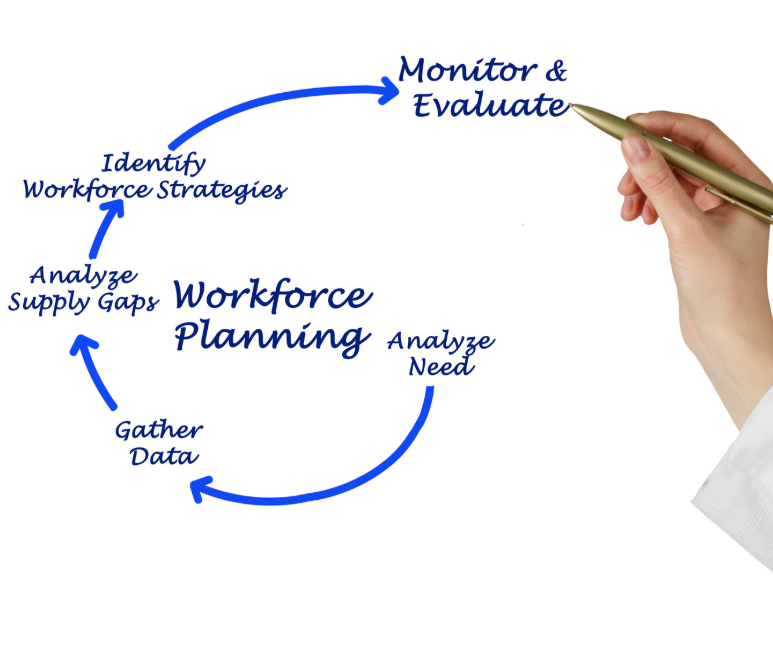
Every leadership team is wrestling with the same questions right now. How will AI impact our organization, and what type of workforce will we need in the future? These aren’t easy questions to answer. Only 19% of companies are effective at planning for their future workforce, according to a July 2026 survey by Gartner. These organizations understand how work will change, anticipate the impact of artificial intelligence, and act to realign the workforce with strategy. Without this type of planning, organizations create workforce gaps that threaten strategy execution. The problem isn’t a lack of workforce data or forecasting tools. It’s that most organizations start their workforce planning in the wrong place.
Most workforce planning starts bottom-up from the existing workforce. Leaders consider the roles, skills, and tasks that exist today, then ask how AI could reshape them. The underlying assumption is that if AI can automate or improve something, it eventually will. Progressive organizations flip this approach. Rather than starting with the workforce, they start with enterprise strategy. They ask the following questions:
- What work is most critical to executing our strategy?
- What are the funded AI investments in those areas?
- How will those investments change the work and workforce capabilities we need?
Once leaders answer those questions, they can discuss the future of roles, skills, and head count. Because they have worked top-down from the strategy and focused on the funded AI investments, they can feel much more confident in their outputs. This might seem like a subtle shift, but it fundamentally changes the planning process.
Read more at Fast Company
|
|
|
Gallup: U.S. Employee Engagement Below 30% for First Time in 15 Years
|
|
|
U.S. employee engagement fell to 29% in the third quarter of 2026, its lowest level since 2011 and down two percentage points from the previous quarter. The share of actively disengaged employees rose from 17% to 18%, while 53% were not engaged. The latest decline was sharpest among remote and hybrid employees, particularly those in organizations that have adopted artificial intelligence. Employees also reported less clarity about what is expected of them at work and were less likely to feel that someone at work cares about them as a person. These findings raise questions about whether communication and manager support are keeping pace with AI integration.
The Q3 findings reinforce the need for clear expectations, effective communication and manager support as organizations adopt AI. Leaders should focus on three priorities:
Clarify AI expectations by role. Employees need to understand how AI applies to their work, when they should use it and how their organization will evaluate their performance as AI changes their responsibilities.
Equip managers to support AI use, particularly those leading hybrid and remote employees. Gallup's research shows that active manager support has the strongest relationship with engagement among the AI-related factors studied. Managers translate organizational plans into clear expectations and discuss how changes affect employees’ daily work. This is especially important for hybrid and remote employees, who may have fewer opportunities for informal, in-person communication.
Track AI's impact alongside employee engagement. Measure how employees use AI and whether it is improving productivity, efficiency and creative problem-solving. Share examples of effective AI use to show employees how they can apply the technology in their own work.
Read more at Gallup
Learn more about the Council’s Certificate in Manfuacturing Leadership Training
|
|
|
AI At Work: Employees, Employers May Not Be On The Same Page
|
|
|
Employees may be wary about the future of artificial intelligence tool use at work, according to a Monday report from Dayforce. The majority of workers expressed their hope that their employers use the time saved by AI to improve their workflow and mitigate burnout. About a quarter said they expect that AI-saved time will improve work quality. However, 40% of respondents said they felt their employer would give them more to do if AI saved time on tasks at work. Moreover, 39% of respondents predicted that time saved at work would lead to either slower hiring or reduced head count. This last finding in particular is resonant given ongoing layoffs, potentially fueled by AI investments.
What does this mean for HR? If not deployed carefully, AI could disrupt leadership pipelines. This is a phenomenon that researchers — and HR professionals specifically — have acknowledged before. Notably, 50% of respondents in the Dayforce survey said they hoped that employers use time saved by AI to invest more time in learning and development.
Read more at HR Dive
|
|
Deloitte and MI Study Shows Potential for AI to Accelerate Manufacturing Skills Training
|
|
A new study from Deloitte and the Manufacturing Institute examines how artificial intelligence could help manufacturers address persistent workforce shortages by expanding the pool of qualified applicants, reimagining workflows and supplementing on-the-job training. The study focuses on in-demand manufacturing technician roles and how embedding AI into new workflows could help deliver critical knowledge, skills and guidance to a wider pool of workers in adjacent fields with similar skillsets.
The analysis identifies nearly 2 million technicians in adjacent industries whose broad skills may be transferable to manufacturing. These workers could represent an important source of talent for manufacturers seeking to broaden pathways into technician roles and strengthen their workforce pipeline, and AI could play a crucial role. “AI has the potential to change not only how manufacturing work gets done, but also how people prepare for and succeed in these critical roles,” said MI President Carolyn Lee. “This research points to an important opportunity to use technology to expand pathways into manufacturing, accelerate skills development and give workers new tools to complement the knowledge and judgment they bring to the job.
Read more at The Manufacturing Institute
|
|
As Candidate Fraud Rises, Trust Plummets
|
|
Last year, Checkr launched an inaugural survey on identity fraud in the hiring process, finding that 31% of hiring managers have personally interviewed a candidate who was later found to be using a fake identity. This year, that number climbed to 40%. Fraud in the hiring process is proliferating, the report finds, particularly as candidates increasingly leverage AI to help with the application and interview aspects of the candidate experience. In 2025, 59% of hiring managers suspected a candidate used AI to misrepresent themselves, up to 67% this year.
While employers are increasingly recognizing candidate fraud as a pressing issue, Checkr found, there is a significant "blind spot." Nearly two-thirds concentrate fraud prevention entirely in the pre-hire period—with only 6% prioritizing fraud risk during post-hire. "Pre-hire screening is essential, but the real exposure occurs once an employee is inside," researchers say. "During an interview, the worst a bad actor can do is waste an afternoon. Once on the payroll, that same person gains system logins, client contacts, sensitive IP and a regular paycheck." Nearly half of survey respondents said their organizations do not have any formal process for verifying employee identify after a hire; instead, they use informal checks, "one-off" onboarding reviews—or nothing.
Read more at HR Executive
|
|
EEOC Rescinds Guidance on Employers’ Use of Arrest and Conviction Records in Employment Decisions
|
|
On October 29, the EEOC announced that the agency has rescinded its 2012 guidance addressing the circumstances under which employers’ consideration of criminal history information may violate Title VII of the Civil Rights Act of 1964 (Title VII). EEOC Chair Andrea Lucas stated that rescission of the guidance “reaffirms the agency’s commitment to enforce Title VII consistent with the Constitution and the limits Congress placed on the EEOC’s authority.”
The rescission further clarifies the EEOC’s current enforcement posture regarding criminal background checks, particularly with respect to disparate impact claims challenging facially neutral screening policies that disproportionately exclude applicants based on protected characteristics. Rather than representing a significant change in enforcement practices, the rescission largely formalizes the agency’s existing approach, under which it has already deprioritized investigations and enforcement actions involving disparate impact theories. Importantly, employers will remain subject to the substantive requirements of Title VII, and courts will retain authority to evaluate discrimination claims involving criminal history screening under applicable law.
Read more at Morgan Lewis
|
|
|
The Council of Industry focuses on advancing manufacturing excellence, workforce innovation, advocacy, and strategically positioning its members within the Hudson Valley region and beyond. It is the premier manufacturers' association for Southeastern New York, representing over 160 member firms. Grow, Train, and Succeed with the Council of Industry.
Council of Industry - www.councilofindustry.org - (845) 565-1355
If you’re part of a Council of Industry member company and not yet subscribed, email us. If you’re not a Council member, become one today
|
|
|
|
|