|
The Monthly Newsletter of the Council of Industry
January 27th, 2026
|
|
|
Council of Industry Updates
What's Happening in Your Association
|
|
|
Member Benefit: Advocacy that Drives Real Change
|
|
|
The Council of Industry gives voice to our members to help foster a pro-growth business environment where manufactures can grow and prosper.
We listen to Hudson Valley manufacturers and champion your needs at every level of government. Our hands-on advocacy gives you a strong, unified voice so your business can thrive, strengthening the industry and building the local economy.
Some outcomes from our advocacy through the years include:
- Developed apprenticeship programs in partnership with New York State and local colleges, ensuring credentialed, modern workforce pathways for Hudson Valley manufacturers.
- Modernized New York State’s economic development power program to focus on manufacturing.
- Secured updates to outdated state training requirements by advocating for relevant, industry-driven skills and technologies.
- Secured a zero corporate franchise tax for manufacturing firms organized as “C” Corporations.
- Minimized the negative impacts of many laws related to labor, energy, regulation and tax.
On an ongoing basis we continue to provide manufacturers with a direct voice in legislative and regulatory discussions, influencing policies that impact business viability in New York State. We deliver timely, curated updates on critical state issues and regulations, empowering members to stay compliant and informed. And we facilitate regular outreach to elected officials, strengthening the collective impact of manufacturers on economic development decisions.
One such opportunity is Manufacturing Advocacy Day, the day during the Legislative Session when manufacturers from throughout our region and the state converge on Albany. As a collective voice, we will advocate on key state issues impacting the industry. Your participation is vital to shaping the policies and legislative that will drive our industry forward as we continue Building Tomorrow, Together.
Learn more about Manfuacturing Advocacy Day
|
|
|
Nominations Open for the 2026 Manufacturing Champions
|
|
|
The Council of Industry is seeking nominations for the 2026 Manufacturing Champions Award. The Manufacturing Champions Award is presented annually to individuals and/or organizations that work in the sector or provide direct support to the manufacturing sector in the Hudson Valley. The Awards will be presented at the Champion's Breakfast and Workforce Developers Expo on May 7th at West Hills Country Club in Middletown.
Nominations will be accepted through close of business February 20, 2026
The Manufacturing Champions Award is presented to individuals or organizations which have “Through vision, dedication and tireless involvement have worked in manufacturing, built a manufacturing business, or worked to overcome some of the many obstacles faced by manufacturers in the Hudson Valley and in so doing they have made it possible for manufacturers and their employees to prosper.”
Past champions include founders of manufacturing businesses, owners of manufacturing businesses, key employees, teachers and educators, economic development leaders, educational institutions, economic development organizations elected officials and agencies supporting the manufacturing workforce pipeline. Click here for a list of past champions.
|
|
|
Lean Six Sigma: Green Belt & Yellow Belt Being Offered this March
|
|
|
The Council of Industry is offering two Lean Six Sigma courses designed to help your team improve processes, reduce waste, and solve problems more effectively.
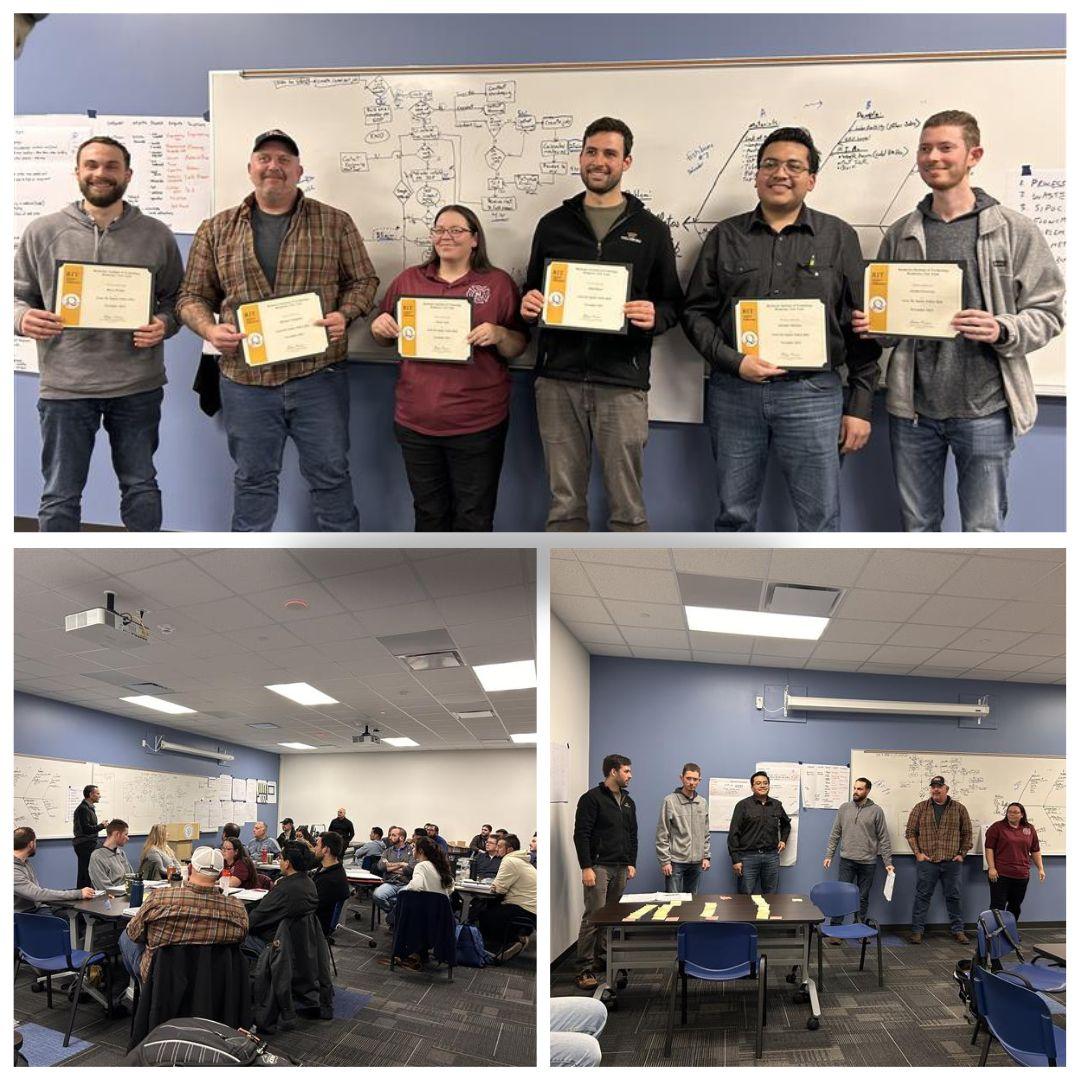
Lean Six Sigma: Yellow Belt - from March 10 to 12th - provides a strong foundation in Lean Six Sigma principles, giving participants practical tools they can apply immediately in their day-to-day work. It’s ideal for employees who want to better understand continuous improvement and contribute to team-based projects.
For those ready to go deeper, Lean Six Sigma: Green Belt - beginning March 2nd - builds advanced skills in data analysis, problem-solving, and project leadership. Participants complete real-world projects that often deliver measurable business impact.
Both courses are delivered by RIT’s Center for Quality and Applied Statistics (CQAS) Vin Buonomo, in partnership with Dutchess Community College.
|
|
|
HVMFG Enters 13th Year of Publication
|
|
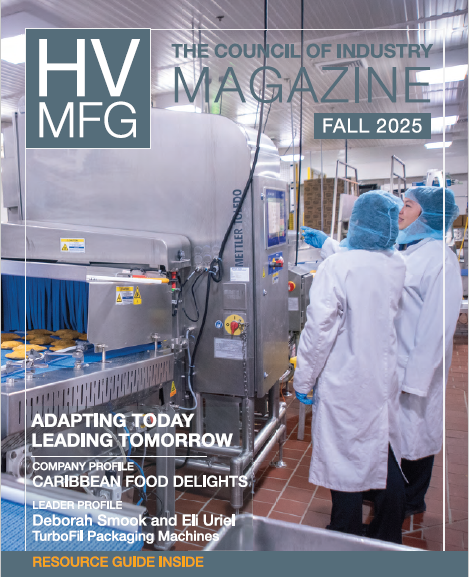
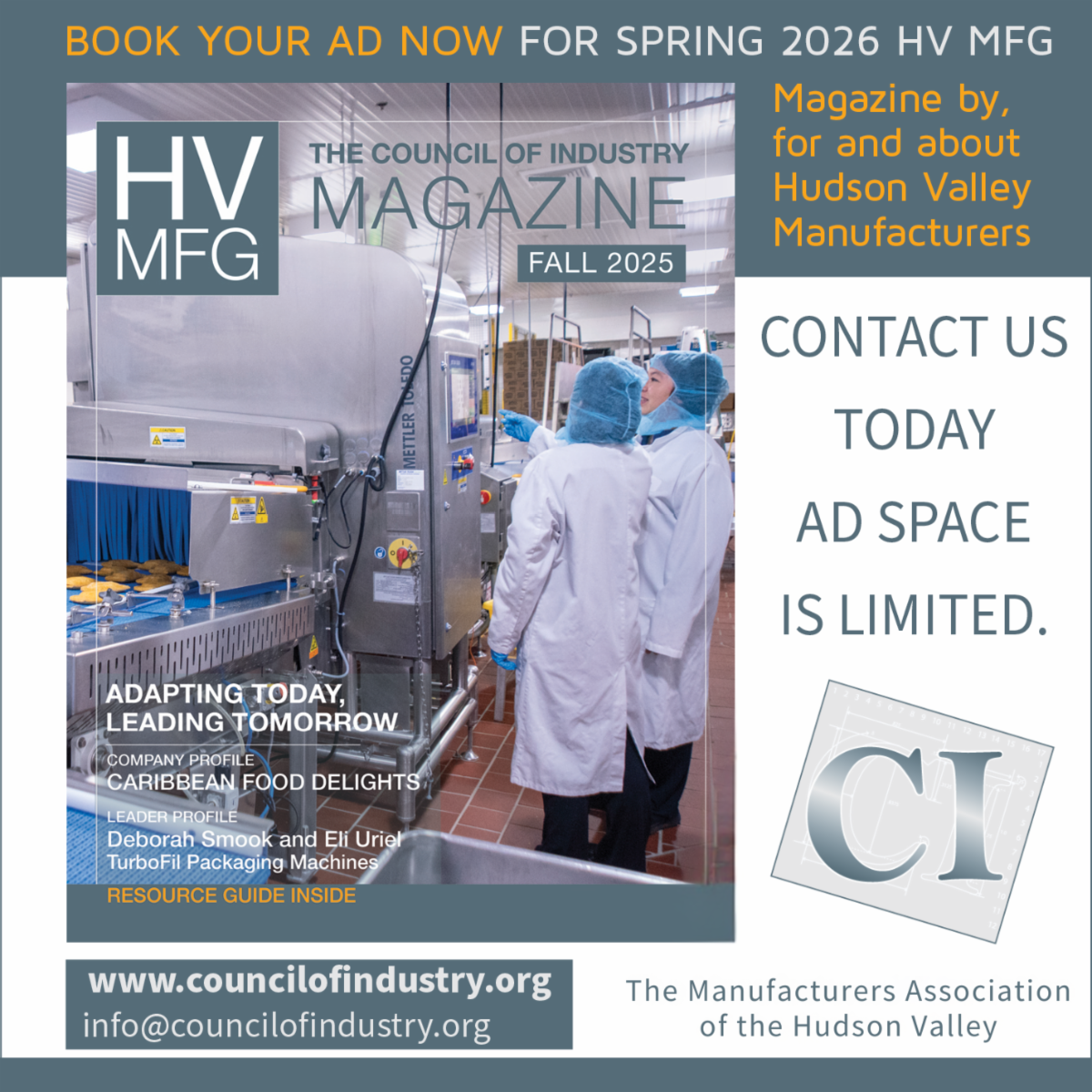
The HV Mfg, the Council of Industry's Magazine, is entering its 13th year of publication as we head into the Spring 2026 edition.
Since its founding, the HV Mfg has been by, for, and about Hudson Valley Manufacturers.
This magazine is essential to our mission of supporting the region's manufacturing community, along with spreading awareness to key decision makers in the manufacturing sector, education and government.
Harold King, President of the Council, said the twice-annual publication was created to show manufacturing in a new light, and that it exists across the region in all shapes and sizes.
"We began publishing HV Mfg in 2013 to confront some of the misperceptions about manufacturing in the region - namely that it was dark, dirty and dangerous," Harold King said. "We wanted to tell the story of modern Hudson Valley manufacturing - that it is high tech, innovative and global.
"The message is getting through and we continue to tell that story to elected officials, educators, other manufactures and the community at large."
The HV Mfg continues to be a trusted platform for sharing stories and staying visible within the Hudson Valley manufacturing community. It also a great way to make your business or organization visible to the region's stakeholders.
Click here to learn more about Advertising Opportunities in our Spring 2026 Issue
|
|
|
Insight Exchange: Expert-Led Video Series for Manufacturers
The Insight Exchange is a video series from the Council of Industry, offering member manufacturers expert insights and strategies—accessible anytime. Each session features industry professionals covering key topics like workforce development, regulatory updates, and emerging technologies.
|
|
Newest Episode: R&D Reimagined
How AI is reshaping R&D tax credits and helping manufacturers fund innovation more efficiently.
- Presented by Michael Galdieri, SPRX
This episode of Insight Exchange features senior director Michael Galdieri of SPRX, discussing how manufacturers can use AI to modernize the R&D tax credit process. The conversation explains how AI can reduce time-consuming documentation, improve accuracy and compliance, and help manufacturers capture more of the credits they are already entitled to by freeing up capital to reinvest in innovation and growth.
Key Topics Include:
- How manufacturers should be thinking about AI adoption today
- Using R&D tax credits to help fund AI and technology initiatives
- Why traditional R&D studies are outdated and how AI improves the process
- The IRS four-part test for qualifying R&D activities
- Project-by-project analysis vs. statistical sampling
- What to look for in an AI-driven R&D tax credit partner
|
|
Past episodes
Season 1:
Season 2:
|
|
Get Involved
Want to share your expertise? Contact Johnnieanne Hansen at info@councilofindustry.org to learn more.
|
|
Manufacturing Industry News
|
|
Supply Chains at the Crossroads: Key Lessons from 2025 and What Lies Ahead in 2026
|
|
The global supply chain proved its strategic importance again in 2025, as companies navigated ongoing uncertainty, shifting policy landscapes, technological disruptions, and an evolving view of risk. In the face of ongoing geopolitical conflicts and tariff fluctuations, proactive leaders were repositioning their operations with a focus on reliability and resilience while improving competitiveness. While many trends from 2025 will carry forward, 2026 promises to take these forces to new levels. The year ahead is shaping up to emphasize strategic resilience, technological integration, and deeper supply chain intelligence.
Flexibility, visibility, and redundancy as strategic initiatives - As businesses grapple with ongoing uncertainty, supply chains will continue to prioritize flexibility, not just at the operational level, but also as a core element of strategic planning.
AI and flexible automation will become requirements to be competitive - In 2026, the role of AI in supply chain planning is expected to accelerate even further than in 2025.
Tariff and trade policy risk will likely persist - Tariffs and trade policy uncertainty aren’t going away. Early indications suggest that tariff pressures could continue to raise costs and complicate sourcing decisions, particularly in metal-intensive and capital-goods sectors.
Talent and skill gaps will come into sharper focus - Supply chain leaders are increasingly acknowledging that digital supply chains require digital talent. As companies adopt AI and automated systems, the need for skilled practitioners, whether in data analytics, digital operations, or strategic sourcing, will grow.
Read more at Material Handling & Logistics
|
|
From Compliance To Prediction: How Data Is Redefining Industrial Safety
|
|
Industrial workplace safety is undergoing a fundamental shift. What was once driven largely by compliance checklists, periodic audits, and post-incident investigations is increasingly becoming a proactive, data-driven discipline. Safety product leaders from Global Industrial Company, a national distributor of industrial equipment and supplies, talked with Plant Services about technology’s central role in how manufacturers and industrial facilities identify risk, improve compliance, and prevent incidents before they occur.
“Employers are moving toward data-driven safety programs, using analytics and incident data to proactively identify hazards, improve audits, and predict risk,” says Heather Lake, director of product management at Global Industrial. This digital shift is also seen more broadly in how safety is planned, executed, and measured across industrial environments. Centralized digital platforms to manage safety data are replacing the work of tracking incidents, audits, and corrective actions through disconnected systems or manual processes.
Read more at Plant Services
Join the Council’s Health & Safety Sub-Council Meeting 2/12
|
|
|
AI Makes a Fundamental Shift
|
|
|
For two decades, manufacturing has been defined by a relentless pursuit of optimization. We automated assembly lines, digitized records and built predictive maintenance models, all in the service of marginal gains in efficiency. While this approach yielded significant returns, we have reached the ceiling of what traditional, rule-based automation can achieve. In 2026, the industry is undergoing a fundamental shift: moving beyond the "if-then" logic of the past toward a model of agentic enablement.
This isn't just a technical upgrade; it is a new industrial model where AI moves from a tool that recommends to an agent that achieves. This shift isn't about reducing headcount, but about amplifying human potential, transforming operators into “super-users: who are empowered by AI to solve more complex problems and drive higher value. Historically, manufacturers have been forced to lock up vast amounts of capital in finished goods, essentially "betting" on demand forecasts. Agentic AI fundamentally changes this math by allowing production to align dynamically with real-time customer intent.
Read more at IndustryWeek
|
|
|
Survey: Mixed Signals on AI In Investment Plans, Production Systems
|
|
|
Even as manufacturing looks into a new year and AI has begun to penetrate production systems and investment plans, significant challenges—such as a shrinking and underskilled labor force and underinvestment and a lack of commitment and understanding by corporate leadership—held digital transformation back in many organizations in 2025, Smart Industry’s weekslong fall and winter State of Initiative survey revealed.
The clearest indication going into this year, at least when it comes to digital transformation? Almost 46% of respondents in the fall, when asked to characterize those efforts within their organizations, called them “problematic but ongoing.” However, almost 60% (59.6%) believed digital tranformation to be vital and agreed that transformation will have a high impact on their organizations. And a third (33.33% exactly) reported they’d identified applications and are making investments when asked about their progress on transformation. Only about 29% of respondents said such efforts at their companies had been “somewhat successful” while just 4.6% characterized them in the most optimistic language as "highly successful." So there is forward motion on digital transformation.
Read more at Smart Industry
|
|
|
Process Modeling Is The First Step To Lean Six Sigma Success
|
|
|
Organizations often implement Lean Six Sigma to improve business processes, run more efficiently and reduce costs. Getting a handle on processes can bring order to the chaos. The Lean Six Sigma method calls upon organizations to define, measure, analyze, improve and control (DMAIC), laying the foundation for a successful Lean Six Sigma process improvement project. The first step, “define”, involves thoroughly understanding processes. To do that, an organization should model processes exactly how they exist today. This is not a future state or wish list exercise. Documenting the current state helps all team members work together to define a common understanding of the process from start to finish.
Basic diagramming tools help define an initial business process and provide a good path to getting processes off of sticky notes and into a digital format. However, if company-wide collaboration and real-time change management are important, a dedicated process modeling tool may be the better choice. Simple diagramming tools often don’t include the ability to add data to activities such as role; time; cost; and information about suppliers, inputs, process, outputs and customers (SIPOC), which is what turns a static process map into a dynamic, data-rich process model that allows for continuous improvement. By moving to a dedicated process modeling software organizations can input data to turn process maps into process models while implementing version control, keeping teams in sync and standardizing an effective process modeling solution across the organization.
Read More at IBM
Learn more about our Green Belt Course
Learn more about our Yellow Belt Course
|
|
|
What Are the Robots Doing Now?
|
|
Technological trends are converging as automation expands its presence in manufacturing, and according to a global research group the emergence of new technologies will motivate the next wave of industrial automation. The International Federation of Robotics - which noted that the global market value of industrial robot installations recently hit $16.7 billion, a record - identified five factors that will drive investments in automation this year.
1. AI proliferates - Automation devices (i.e., robots) that work independently thanks to artificial intelligence to work independently are becoming more common.
2. Versatility rises - Every manufacturer is being made aware of the increasing importance of versatility - among personnel, with machinery, and in technology. Demand for versatile robots is accelerating, directly reflecting a technological convergence of information technology (IT) and operational technology (OT).
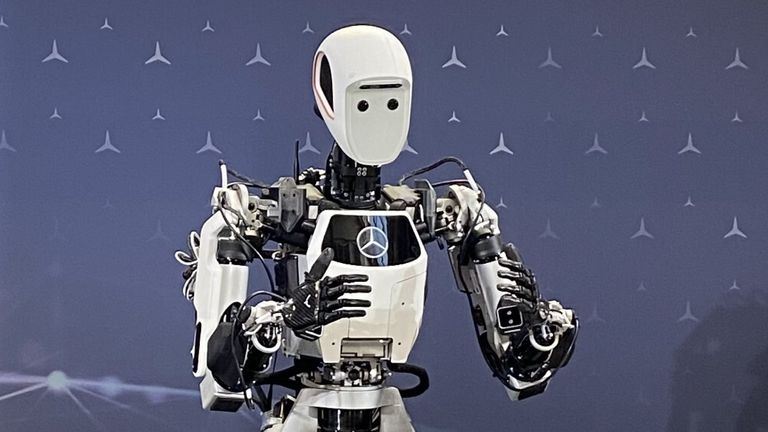
3. Rise of the humanoids - Machines designed to resemble human bodies, built to operate in human surroundings, and to interact with human tools, are developing quickly. These humanoid robots combine artificial intelligence, sensors, and actuators to perform tasks, walk, and interact with “socially” workers.
4. Safe and secure - With increasing frequency, in manufacturing and service centers robots are being put to work alongside humans, so devices operating safely is essential for robot suppliers.
5. Filling open positions - The skills gap is a shortage of expertise in manufacturing, but it’s also a labor shortage. Employers worldwide struggle to find people with specialized skills, and to retain them once they’re found. Manufacturers’ one effective response is adopting automation and robotics.
Read more(and view a slide show) at Foundry Magazine
|
|
|
Future-Ready Workers Triple In One Year—But Employers Aren’t Keeping Up
|
|
|
HR leaders have heard the call to reskill their workforces for AI, and apparently so have employees. New research shows that the share of workers considered “future-ready” has more than tripled in just one year. New data from the Adecco Group shows that 37% of workers globally now meet the criteria for being future-ready in 2025, based on a survey of 37,500 workers across 31 countries. This is up from just 11% in 2024.
The research reveals a workforce increasingly comfortable with technological upheaval. Nearly 9 in 10 workers (87%) say they are willing to be flexible and adaptable to adjust to the rise of AI in the workplace, a significant increase from 2024. More telling, 71% of workers report their knowledge of AI has already surpassed the training their employers offer, suggesting a troubling gap between employee capabilities and organizational support.
Read more at HR Executive
|
|
|
Deep Freeze Sends U.S. Natural-Gas Prices Soaring
|
|
|
U.S. natural-gas futures topped $7 for the first time since 2022 as a massive winter storm swept across the country, driving up heating demand and threatening supply. Futures for February delivery settled up 29% Monday on the New York Mercantile Exchange at $6.800 per million British thermal units after hitting an intraday high of $7.439. The contract, which expires Wednesday, last traded above $6 in 2014. March futures rose 8% to $3.898 per million Btu.
The winter storm is estimated to have knocked offline 12% of US natural gas production, just as demand for the heating and power-plant fuel jumped. The big freeze has strained electricity grids and crippled transportation, grounding thousands of flights.
Read more at Yahoo Finance
Learn more about the Council of Industry’s energy consortium (where you can lock in a fixed price to avoid price spikes)
|
|
|
State Take Over Of Central Hudson Not In Manufacturer’s Interest
|
|
|
A coalition of officials, activists and community groups led by Assembly Member Sarahana Shrestha, are trying take over Central Hudson. The “Hudson Valley Power Coalition”(HVPA) recently released a report claiming that replacing the utility with a public authority was feasible and could result in customer savings within the first year of operation. It is mistaken.
HVPA’s report places the cost of a government takeover of Central Hudson at just $3.48 billion, but is uses outdated 2024 data and flawed valuation methods. A more comprehensive assessment shows an acquisition cost closer to $6–$7.6 billion, based on accepted regulatory benchmarks and recent transactions. HVPA’s cost analysis assumes an overnight acquisition in 2026, and operating costs that only grow with inflation. In reality, costs for operating and maintaining a utility are rising faster than inflation. Reducing energy bills is not the only goal; the coalition wants the state’s energy system to be more responsive to its residential customers and focus on addressing climate concerns.
There is little doubt that such a takeover will lead to higher electric and natural gas costs for industrial users.
Learn more about the proposed takeover
|
|
|
LEGO and Crocs Just Turned a Plastic Brick Into High-Fashion Footwear
|
|
|
The LEGO Group has teamed up with Crocs to produce a series of novelty giant LEGO Brick-themed clogs. The deal is for a multi-year collaboration with the product being debuted at the Paris Fashion Week by artist Tommy Cash. Styled to resemble a stack of flat LEGO brick pieces, these new clogs will be available for purchase from the middle of February 2026. According to LEGO’s dedicated webpage on the new Crocs, they come in a range of sizes from Men’s size 5 (women’s size W7) to Men’s size 13 (women’s size 15). They won’t be cheap, however, with prices currently sitting at $199.99 in the US, £199.99 in the UK, and €199.99 in Europe.
“Accompanying this unique pair of collector clogs is a LEGO minifigure with 4 pairs of their own LEGO Brick Clogs. Think of them as your partner for anywhere your creativity takes you,” LEGO explains. If you are a LEGO fan, then this new product is probably a no-brainer purchase. According to reports, even more LEGO-inspired footwear styles are planned for spring 2026. Some regions will get hands-on in-store events to drive hype and social media content. “The LEGO Group’s boundless imagination makes them the perfect match to Crocs’ wonderfully unordinary spirit,” explained Carly Gomez, Chief Marketing Officer at Crocs.
Read more at Interesting Engineering
|
|
|
The Council of Industry focuses on advancing manufacturing excellence, workforce innovation, advocacy, and strategically positioning its members within the Hudson Valley region and beyond. It is the premier manufacturers' association for Southeastern New York, representing over 160 member firms. Grow, Train, and Succeed with the Council of Industry.
|
|
|
If you’re part of a Council of Industry member company and not yet subscribed, email us. If you’re not a Council member, become one today
|
|
|
|
|