|
The Monthly Newsletter of the Council of Industry
October 21st, 2026
|
|
|
Manufacturing Month Celebrations Continue
|
|
Manufacturing Day, celebrated on October 2, offered an opportunity to introduce the next generation to the people, companies, and career paths that make up the Hudson Valley’s manufacturing sector. Throughout October, the Council of Industry has helped bring that mission to life by connecting local schools with manufacturers for facility tours and firsthand learning experiences.
Facility tours have given students a closer look at manufacturing in their own communities:
- Students from Marlboro High School and Monticello High School visited Sono-Tek in Milton.
- Dutchess BOCES and DCC Mechatronics Lab students and parents toured MPI and Dorsey Metrology in Poughkeepsie.
- Students from John G. Borden Middle School explored Fair-Rite Corporation in Wallkill.
Later this month, Orange-Ulster BOCES students will continue the celebration with tours of President Container and Blaser Swisslube.
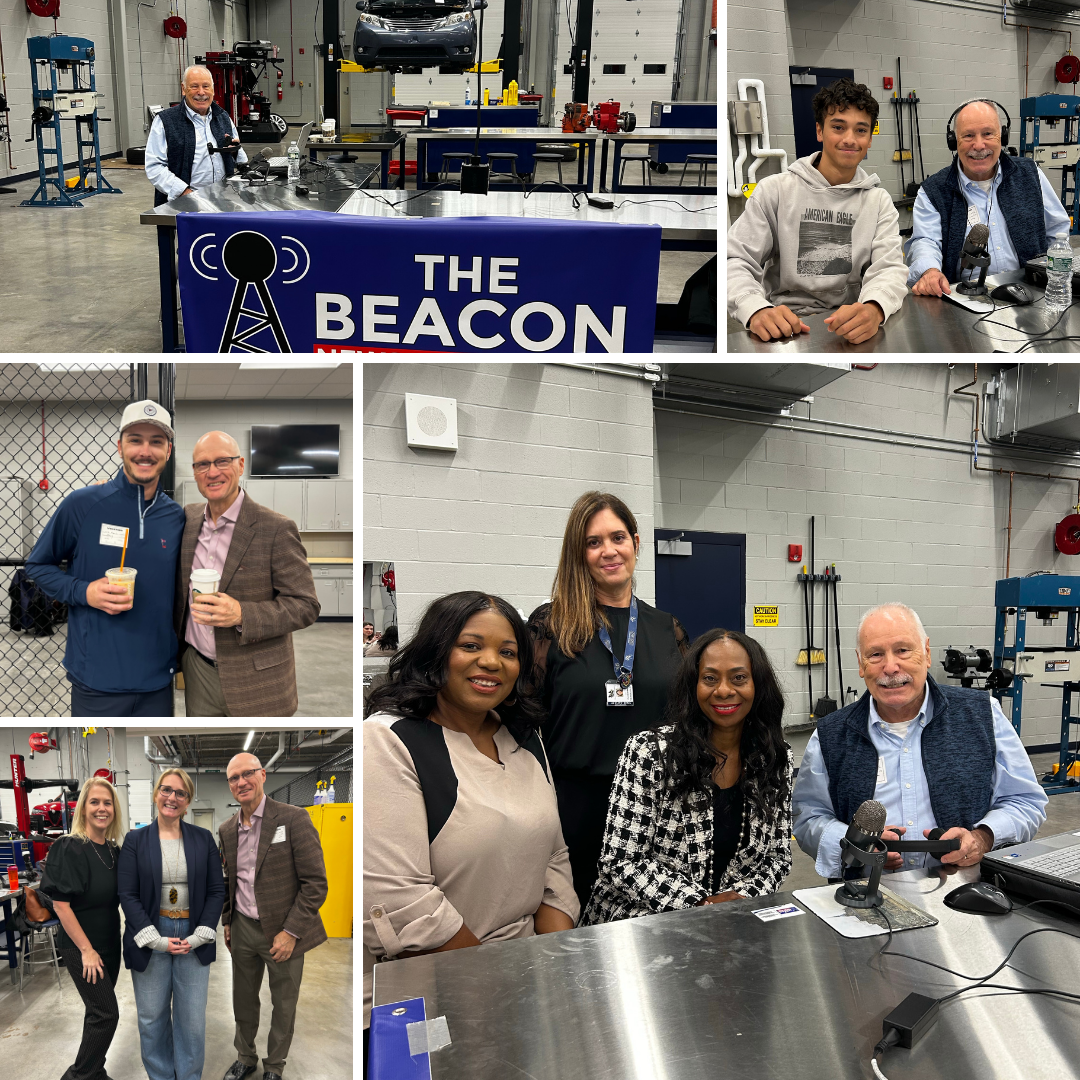
On October 16, Newburgh Free Academy’s new Career and Technical Education Center hosted a special Hudson Valley Focus LIVE broadcast. Hosted by Tom Sipos, the program brought together students, educators, and local manufacturing leaders to highlight manufacturing, workforce development, and career opportunities across the region. Thank you to everyone who participated and helped showcase the importance of connecting education and industry.
Thank you to our participating manufacturers and educators for making these experiences possible. By opening your doors and sharing your knowledge, you help students connect what they are learning in school with the opportunities available throughout our region.
There is still time to get involved! The Council of Industry can help manufacturers and schools coordinate tours throughout October and beyond. Whether you are interested in hosting students or arranging a visit, contact us to make the connection.
|
|
|
Annual Luncheon November 20th Filling Fast! Keynote From IBM’s Neal Moriarty on Quantum Computing
|
|
|
The Council of Industry’s 2026 Annual Luncheon & Manufacturing Expo will bring together manufacturers, suppliers, and industry partners from across the Hudson Valley to connect, celebrate our accomplishments, and support the continued success of local manufacturing.
The Manufacturing Expo will showcase the talent, capabilities, and contributions of our member companies and the businesses that support them. It’s an opportunity to learn more about what is made here, recognize the people behind our region’s manufacturing success, and strengthen the local relationships that help our industry grow. By connecting with fellow members and exploring opportunities to work together, attendees can help keep our manufacturing community strong.
Following the Expo, keynote speaker Neal Moriarty, IBM Innovation Studio Leader, will give attendees an inside look at the rapidly evolving world of quantum computing and IBM’s work to advance the technology in Poughkeepsie.
Home to the IBM Quantum Data Center, IBM’s Poughkeepsie site plays an important role in the company’s quantum computing efforts. Moriarty will discuss where the technology stands today, where it is headed, and what manufacturers should be watching as its capabilities continue to develop.
The program will also recognize the Winter & Spring 2026 graduates of the Certificate in Manufacturing Leadership Series, celebrating their commitment to strengthening their leadership skills and our manufacturing workforce.
Join us on Friday, November 20, at The Grandview in Poughkeepsie to celebrate and support Hudson Valley manufacturing. Explore the Manufacturing Expo, connect with fellow members, and hear about innovation happening right here in our region.
|
|
|
Sponsorship Opportunities are available! Click here to learn more
|
|
|
CNC Demo Day @ DCC Fishkill's Mechatronics Lab this Friday
|
|
|
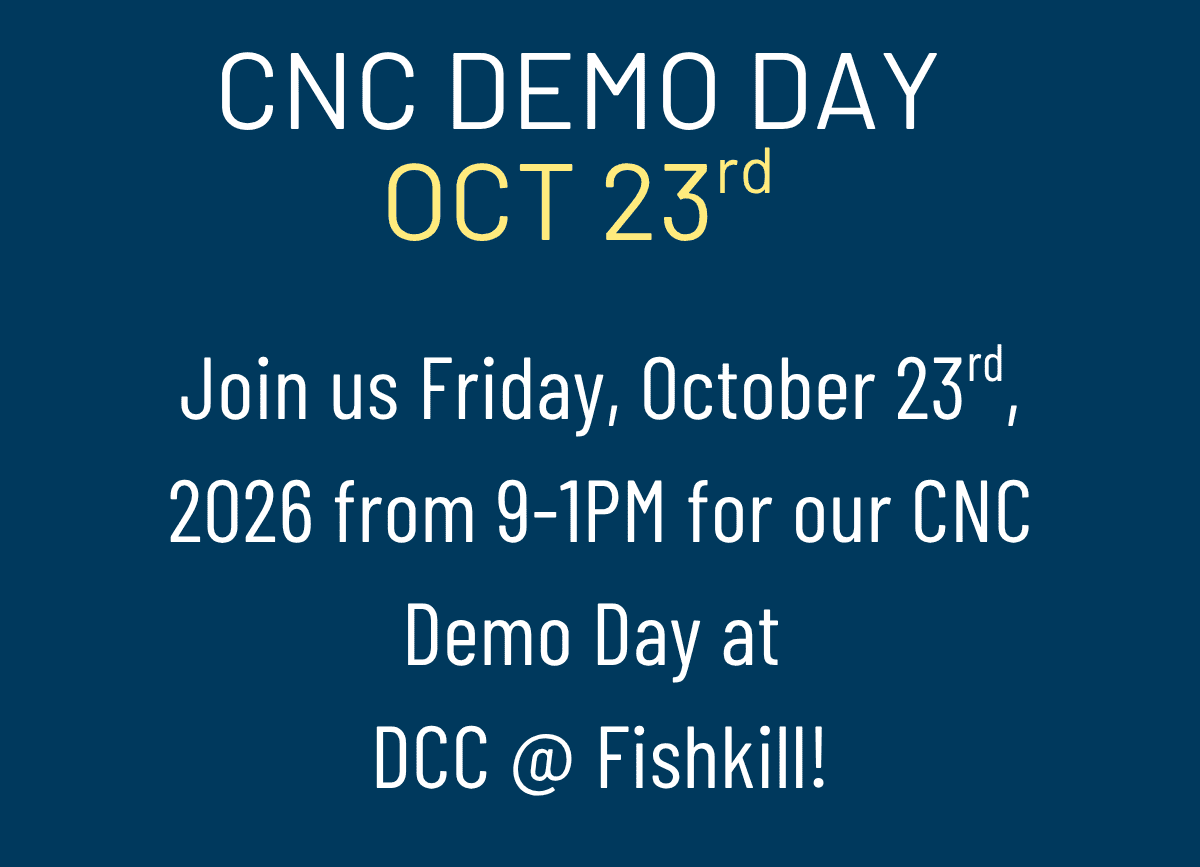
Join DCC's Mechatronics Lab for its upcoming CNC Demo Day on October 23rd! Come explore the latest CNC Operator and Advanced CNC Curriculum.
Meet CNC Instructor Mr. Giovanni Campos. Gio is the owner of Protospark, which is a rapid CNC prototyping company. He also comes with years of teaching experience from the Brooklyn Navy Yard.
This session is a fantastic opportunity to connect with instructors, learn about current program offerings, and explore DCC Fishkill's Mechatronics Lab!
|
|
|
Fall 2026 HVMFG Coming Soon!
|
|
|
The Fall issue of HV Mfg, the Council of Industry’s magazine by, for, and about Hudson Valley manufacturers, is almost here! Published twice a year, the magazine shares the stories of local manufacturers and the people and organizations that support them.
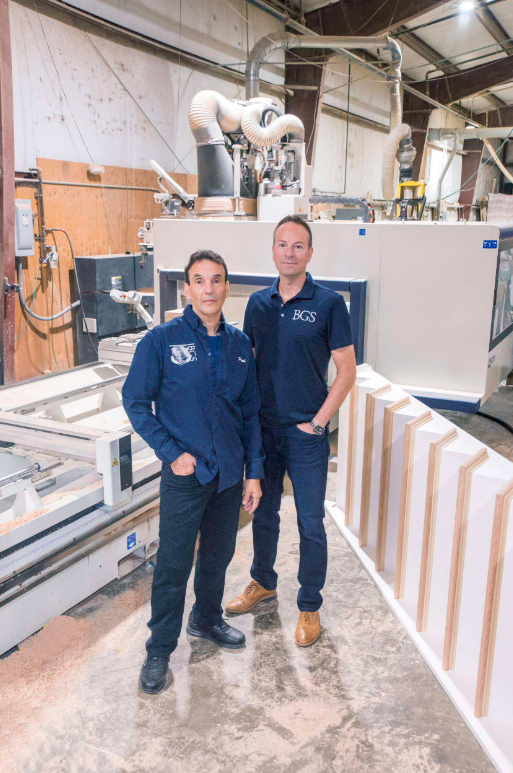
This issue features Rachael Parker of Fair-Rite Products in our Leader Profile and a closer look at Blooming Grove Stair Company in our Company Profile. Our roundtable brings manufacturing leaders together to discuss the factory of 2030, while other articles explore skills-based hiring, SUNY New Paltz’s role in local economic development, and more.
As in every fall issue, you’ll also find our Manufacturing Resource Guide, connecting readers with programs, services, and organizations here in the Hudson Valley.
Thank you to our sponsors who purchased an ad in the magazine. Your support helps us tell these stories and share them with more than 3,000 readers in manufacturing, education, and government through our print and digital editions.
|
|
A New Chapter for Council of Industry Emails
|
|
|
Email is one of the ways we keep our members connected to the people, programs, and opportunities shaping manufacturing across the Hudson Valley. We’re moving to a new email platform to support the next phase of that communication.
In the coming weeks, our emails may look a little different, and you may see them arrive from Council of Industry (info@councilofindustry.org). Please add this address to your contacts so our updates are easy to find.
Next month, we’ll begin sharing a refreshed lineup of newsletters and email updates. We look forward to bringing you useful news and information from across the Council and our manufacturing community.
|
|
|
LSS Yellow Belt Concludes With Project Presentations
|
|
|
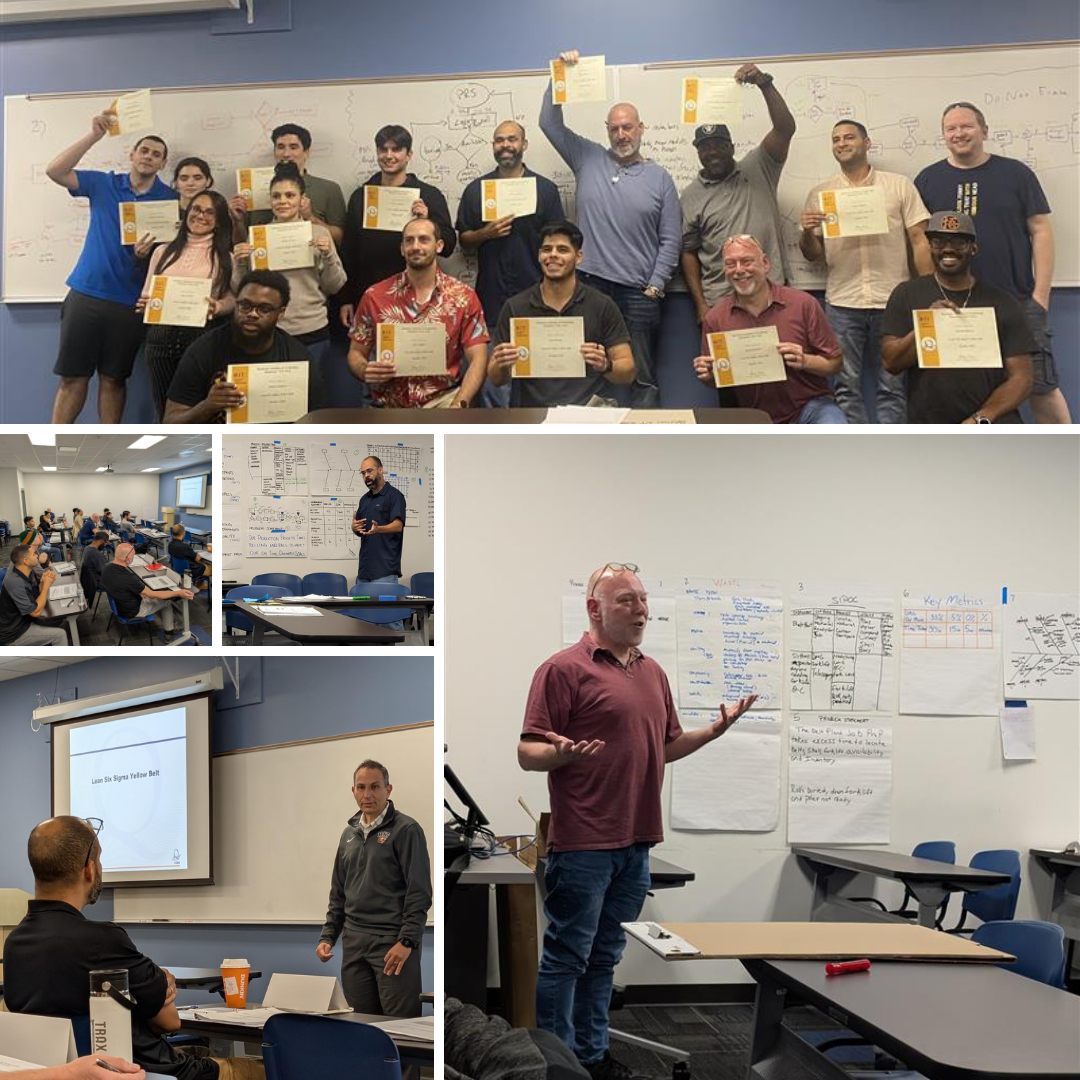
More than 15 participants from over five Hudson Valley manufacturing companies completed the Council of Industry’s Lean Six Sigma: Yellow Belt training, held October 13–15. The three-day program brought together employees from across the region to explore ways to improve processes, address workplace challenges, and support continuous improvement within their organizations.
Throughout the training, participants connected what they were learning to challenges in their own workplaces. By sharing experiences and learning from one another, they explored different approaches to common manufacturing issues and considered how those approaches could benefit their teams. This exchange of ideas gave participants the opportunity to learn alongside peers facing similar challenges and bring fresh perspectives back to their companies.
Participants return to their workplaces with practical tools to evaluate everyday processes and identify opportunities for improvement. Developing these skills helps employees take an active role in strengthening operations while supporting a culture of teamwork and problem-solving.
Congratulations to everyone who completed the program, and thank you to the companies that invested the time and resources to support their participation. The Council of Industry also thanks Dutchess Community College and Rochester Institute of Technology instructor Vinnie Buonomo for their partnership in making this training possible and helping strengthen the Hudson Valley’s manufacturing workforce.
Want to learn more? Contact Emma Olivet
|
|
|
Certificate in Manufacturing Leadership Series in Newburgh Starts - Individual Course Registration Available!
|
|
|
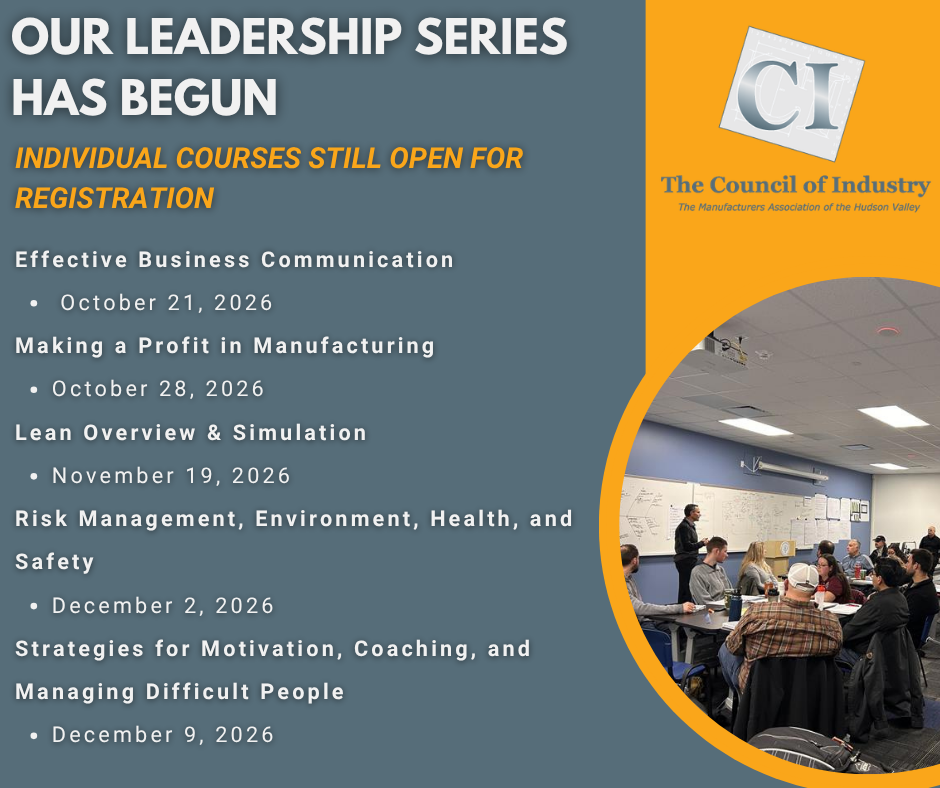
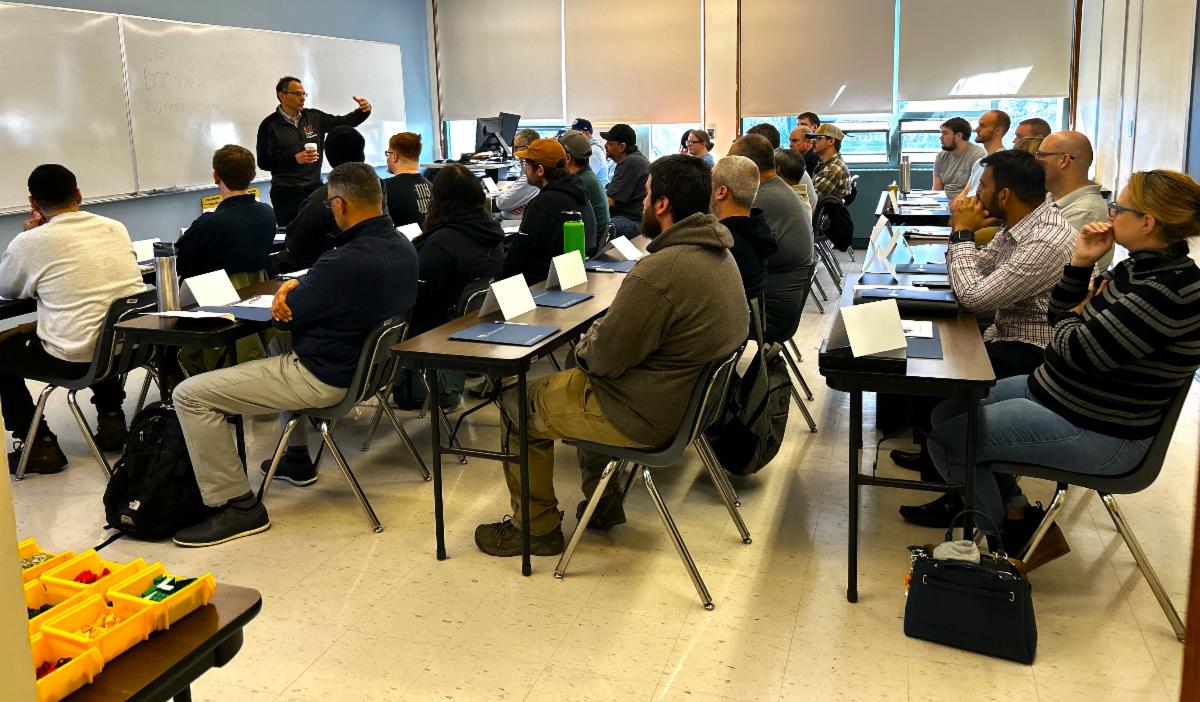
The Council of Industry’s Certificate in Manufacturing Leadership Series is underway, bringing together current and emerging manufacturing leaders from across the Hudson Valley to strengthen the skills they need to lead effectively.
While registration for the full series has closed, individual courses are still open for registration, making it easy to participate in the classes that are most relevant to you or your team.
Courses focus on practical skills that can be put to work right away - from communication and team building to problem-solving, decision-making and managing people.
Whether you’re developing a new supervisor, supporting an emerging leader or looking to strengthen your own management skills, individual classes offer a great opportunity to continue learning alongside others in the region’s manufacturing community.
Explore the remaining courses and register for the classes that fit your professional development goals.
|
|
|
Featured MEP Service: Customized Training
|
|
The Council of Industry has long been a leader in consortium-based training for Mid-Hudson manufacturers. Our model of bringing a small numbers of employees from multiple companies together benefits from the diverse experiences of the participants and has proven to be very cost effective.
While we will continue to deliver training via this model we now also have the resources to deliver customized training to individual manufacturers as well.
Through collaboration with our education and consulting partners we can deliver a wide range of training courses including, but not limited to:
- Leadership
- Lean
- Project Management
- Blueprint reading
- SolidWorks and other design software
- Supply chain management
- And more!
Want to know more? Contact Harold King
|
|
The Council of Industry is partnering with Choice Words to help manufacturers throughout the Mid-Hudson region identify and pursue funding opportunities that can support innovation, investment and growth.
Among these opportunities is Empire State Development’s Global NY Fund Grant Program, which helps small- and medium-sized New York businesses begin exporting or expand their international sales. Grants of up to $25,000 are available on a reimbursable basis, with a 50% match required. Funding can support participation in trade shows and missions, market customization, export workshops and product adaptations to meet foreign regulatory requirements. Eligible businesses must have 500 or fewer employees and meet the program’s New York production or local producer requirements.
The Autodesk Foundation also provides funding opportunities for innovators developing solutions in energy and materials, health and resilience, and workforce development. Its focus includes technologies that reduce greenhouse gas emissions, strengthen communities vulnerable to climate change and prepare workers for careers in manufacturing and construction. Funding may reach up to $1 million, with initial startup investments focused on seed- or Series A-stage companies. Organizations interested in being considered can begin by completing the Foundation’s online Discovery Form.
These are two of the funding resources that may help support manufacturing and economic development projects in our region. To learn more about these opportunities and explore potential eligibility, contact Briana Maloney at bmaloney@choicewordspr.com.
Click here to read more about these funding opportunities
|
|
New York State Innovation Summit being held in Buffalo October 27th
|
|
New York has a long history of ingenuity, from air conditioning and the pacemaker to groundbreaking advances in aerospace, and that spirit of innovation continues across the state today.
Manufacturers and industry partners are invited to be part of the 2026 New York State Innovation Summit, hosted by FuzeHub on October 27–28 in Buffalo, NY. The multi-day event brings together manufacturers, technology leaders, researchers and innovators to explore cutting-edge technologies, make valuable connections and highlight the ideas shaping New York’s future. Attendees can participate in the Summit, showcase their own innovations as exhibitors, or support New York’s manufacturing and technology ecosystem as sponsors.
This year’s program will also feature breakout sessions exploring emerging opportunities, including “New York State’s Place in the New Space Economy,” bringing together leaders from industry and academia to discuss the state’s growing role in commercial space and aerospace innovation.
Learn more and register for the 2026 New York State Innovation Summit.
|
|
Upcoming CI Trainings & Events
|
|
Events
New York State Innovation Summit - Tuesday, October 27th, 8:00 AM - 4:00 PM, Buffalo Niagara Convention Center
Training
Making a Profit in Manufacturing, (A CML Course) October 28, 8:30 - 4:30. SUNY Orange Newburgh.
Lean Overview and Simulation, (A CML Course) November 19, 8:30 - 4:30. SUNY Orange Newburgh.
Risk Management: Enviroment Health and Safety, (A CML Course) December 2, 8:30 - 4:30. SUNY Orange Newburgh.
Strategies for Motivation, Coaching and Managing Difficult People, (A CML Course) December 9, 8:30 - 4:30. SUNY Orange Newburgh.
|
|
Manufacturing Industry News
|
|
Predictable Defense Funding Matters To Hudson Valley Manufacturers
|
|
Manufacturers plan years ahead. Decisions about equipment, hiring, apprenticeships, materials, and production capacity depend on having some confidence in the work ahead. That is why timely passage of the Fiscal Year 2027 National Defense Authorization Act and predictable, full-year defense funding matter to the Hudson Valley. Congress should complete the FY27 NDAA in a timely manner and follow it with full-year defense appropriations that provide manufacturers with the stability necessary to plan and invest.
Major defense contractors such as Northrop Grumman and RTX rely on networks of smaller and mid-sized manufacturers to provide specialized components, technologies, and production capabilities for programs including the E-2D Advanced Hawkeye, IBCS, and Sentinel. For those suppliers, uncertainty has real consequences. Companies need time to purchase equipment, train employees, secure materials, qualify production processes, and expand capacity. Delays or prolonged uncertainty in Washington can make those investments more difficult. Consistent federal defense policy and funding help those businesses retain skilled workers, invest in new capabilities, train the next generation, and continue contributing to both our regional economy and America’s military readiness.
Read the OP-Ed
See a draft letter to send to your Federal Representatives
|
|
Can AI Amplify a Shrinking Skilled Workforce?
|
|
Walk a factory floor in America today, and you will not find the crisis you have been reading about. There are no robots replacing workers. Instead, stations that should be staffed aren’t, lines are running below capacity, veteran operators are carrying the load of three. The headline fear that AI is coming for manufacturing jobs is more than just wrong. It is dangerous because it distracts us from the real emergency. So let us retire the myth. AI is not emptying our factories. What is emptying them is a generation of skilled machinists, maintenance technicians and line leads retiring faster than they can be replaced, taking decades of know-how out the door with them. Too few young people are coming in behind them, after decades of being told the future lay somewhere other than the plant floor.
Here is the part the C-suite must sit with: You cannot hire your way out of this. The workers are not waiting in a queue; the math is not “mathing.” The only honest path forward is to make the people you already have dramatically more effective—and that is exactly where AI belongs. Not AI as a science project. Not another dashboard. AI that shows up in execution—absorbing the crushing volume of daily decisions that tariffs, supply shocks and volatility now demand, and giving frontline teams clarity instead of chaos.
Read more at IndustryWeek
|
|
|
Manufacturers Face Two Traps In Organizational Design As AI Makes Expensive Information Cheap
|
|
|
For much of modern business history, information was expensive. Someone had to collect, organize, reconcile, analyze and summarize it—and then determine who needed to see it. That helped shape the organizations we have today. Hierarchy has always served more than an authority function. It has also acted as an information-processing system.
Frontline information moved upward through several levels, becoming more condensed and interpreted along the way. Decisions and direction then moved back down through many of the same channels. Decisions and direction then moved back down through many of the same channels. Staff groups gathered and analyzed information that operating leaders could not easily access themselves, while meetings brought fragmented information, expertise and decision-makers together.
Artificial intelligence dramatically compresses that cycle. AI can retrieve information, compare sources, identify patterns, synthesize large amounts of material, generate analyses and develop an initial recommendation in a fraction of the time those activities once required. If structures were built partly to manage scarce information, expensive analysis and difficult coordination, leaders should reconsider them as those constraints change. The challenge is determining what should change, what should remain and how to redesign the system without removing capabilities the organization still depends upon.
Read more IndustryWeek
|
|
|
The 9-Step Roadmap to Reshoring Success
|
|
|
One of our main goals at the Reshoring Initiative is to get manufacturers to stop asking, “Where is labor the cheapest?” and start asking, “Where is total profitability highest?” Many offshore decisions have been made—and still are being made—using incomplete cost models. We advocate that companies shift their thinking from “offshoring is cheaper" to “local reduces the total cost of ownership (TCO).” Building on these insights, the following nine steps provide a practical framework for achieving reshoring success. Let’s dig in.
Step 1: Identify your imported products that have problems or risks.
Step 2: Use TCO to evaluate the suggested products. The choice of where to manufacture is no longer based on cheap labor or price alone but rather on a TCO comparison, followed by investment considerations that improve throughput and narrow or close the cost gap.
Step 3: If TCO is within 10%, evaluate automation to improve domestic TCO. Calculate the productivity improvements needed to get domestic TCO favorable.
Step 4: Align workforce with any operational changes. Tech-enabled workers will need to work well in tandem with new automated technologies.
Step 5: Develop a future-ready manufacturing workforce. A global transformation is underway. A demographic shift is happening due to an aging population, accelerating advanced technology adoption, supply chain restructuring and reshoring due to geopolitics and uncertainty, and an ongoing critical skills shortage.
Step 6: Build a skilled workforce pipeline—recruit, attract and retain workers. A giant wave of retirements is expected to leave up to 1.9 million manufacturing jobs unfilled over the next decade, even before the increased demands of continued reshoring.
Step 7: Help your customers decide to reshore. - Use TCO to help your B2B customers reevaluate their offshoring and order from you what they have offshored.
Step 8: Tie it all together with leanshoring principles. Leanshoring is the operating philosophy that enables other success factors to ensure that domestic production is both competitive and sustainable.
Step 9: Publicize your reshoring successes.
Read more at IndustryWeek
|
|
|
What recent PLC attacks reveal about the state of OT cybersecurity
|
|
|
The recent series of attacks on the internet-connected programmable logic controllers within U.S. critical infrastructure garnered extensive media coverage. If these incidents reveal anything about the current state of OT cybersecurity, it’s that the industry is operating in a transitional period. Awareness is significantly higher than it was 10 years ago. Most operators understand that cybersecurity is important. The challenge is execution.
According to reports, the attackers were able to discover and infiltrate internet-connected industrial control systems. These types of concerns have surfaced many times in the form of cybersecurity advisories issued over the last decade. When considering PLCs and other industrial systems that are accessible via the internet, the emphasis tends to be placed on the assets in question. However, many OT incidents occur because of authorized remote access points which were initially created for legitimate reasons.
Read more at Smart Industry
|
|
|
The EU's Packaging and Packaging Waste Regulation: Complex, Demanding and Far from Complete
|
|
|
The PPWR (Regulation (EU) 2025/40) is the new EU legal framework for packaging and packaging waste. It entered into force on 11 February 2025. From 12 August 2026 the first key compliance obligations applied to packaging placed on the EU market. The PPWR applies to all packaging made available on the EU market, irrespective of material, sector or content. It covers paper, cardboard, plastics, metal, glass and other materials, as well as industrial, commercial, service and household packaging – in practice, almost everything that is packaged.
In addition, there are new definitions and roles along the supply chain, such as manufacturer, producer and economic operator. A company may hold several roles at the same time, thereby triggering several obligations in parallel. PPWR compliance is complex because companies must simultaneously clarify legal roles, prepare technical requirements, manage national procedures and monitor future EU legal acts. Companies should not wait until every delegated act, every guidance document or every national portal is finalised. It makes sense to determine roles, identify obligations, collect supply-chain information, monitor developments and document decisions carefully. This does not make the PPWR simple – but it does make it somewhat more manageable.
Read more at European Coatings
|
|
|
5 Trends Defining Consumer Electronics Supply Chains
|
|
|
Driven by heavy investment in artificial intelligence applications and the data centers that serve them, memory prices have skyrocketed by as much as 400% in the last two years, per Omdia research. The crunch is creating a feeling of “desperation” among electronics makers, according to Willy Shih, the Robert and Jane Cizik Baker Foundation professor of management practice in business administration at Harvard Business School. Here’s a look at five key trends in the sector.
1. Welcome to the long-term planning renaissance - Today’s market is pushing consumer electronics manufacturers to double down on long-term planning to more accurately control the flow of goods, experts told Supply Chain Dive. To strengthen long-term strategizing companies are making more investments in advancing planning systems or revisiting the operating model from prior investments in software packages from vendors such as Kinaxis, Blue Yonder and SAP.
2. High costs are impacting product mix, design - Over the last 18 months, the consumer electronics industry has largely tried to absorb the elevated costs brought on by tariffs and memory shortages, according to Masters. However, many have exhausted their mitigation efforts and are passing those costs onto consumers.
3. Supplier relationships are becoming more integrated - Strengthening collaboration with key memory suppliers can be a differentiator in competing for supply.
4. Expanding the supply base is more of a priority - While memory supply scarcity continues to grab headlines, the crunch is also being felt for other components that AI data center infrastructure and electronics manufacturing require.
5. Component scarcity is driving logistics decisions - Freight cost is no longer the primary factor in setting logistics strategies for consumer electronics manufacturers. With memory and other inputs now so difficult to obtain, companies are more willing to pay for more expensive shipping modes to ensure quick delivery.
Read more at Supply Chain Dive
|
|
|
Robot Brain Combines Sight, Touch And Sound To Help Humanoids Handle Real Chores
|
|
|
NEURA Robotics has introduced Neuron AI, a robot foundation model designed to help robots understand and interact with their surroundings using multiple sensory inputs. The system combines visual perception with touch, sound, language, robot-state information, and memory to support a range of tasks. Neuron AI is a robot foundation model designed to combine visual perception, touch, sound, language, and memory to help robots perform complex tasks.
The German robotics company described the system as a Perception-Language-Action (PLA) model that processes sensory information and translates it into physical actions. The architecture is designed to support multiple robot platforms, allowing skills to adapt to different applications rather than being developed separately for each machine. Neuron AI integrates several information sources, including 3D vision, tactile and force measurements, audio, robot-state data, and language. According to NEURA, the model aligns these inputs over time to help robots interpret their surroundings and maintain context as tasks progress.
Read more at Interesting Engineering
|
|
|
US Nuclear Fusion Reactor To Test Custom Exhaust For Negative Triangularity Plasma
|
|
|
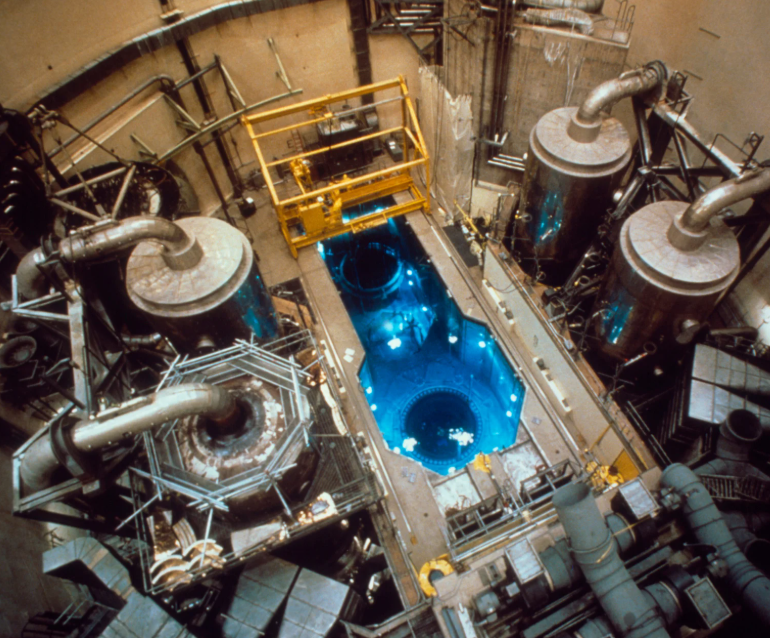
The DIII-D National Fusion Facility in California is teaming up with Japanese engineering firm Kyoto Fusioneering. Together, they will build and test a specialised exhaust system designed to handle the ferocious heat produced inside a fusion reactor. The system will be installed directly into DIII-D’s tokamak, a testbed device funded by the US Department of Energy. Nuclear fusion generates clean power by fusing light atoms together, the same process that fuels the sun. Most research takes place inside donut-shaped magnetic chambers known as tokamaks. However, containing matter heated to over 100 million degrees Celsius poses a serious risk to machine walls.
“Negative triangularity, or plasma in a reverse ‘D’ shape, is a potentially transformative operational approach for tokamaks, donut-shaped fusion devices that contain plasma with magnetic fields,” explained Kyoto Fusioneering. This alternative geometry offers an elegant physical advantage. It dampens unstable heat bursts and radiates excess thermal energy away smoothly before it can strike reactor walls. Yet despite its promise, nobody has tested the configuration with an industrial-grade exhaust system capable of handling its unique particle flows.
Read more at Interesting Engineering
|
|
|
Capped Pricing vs. Fixed Pricing: Which Is Right for You This Season?
|
|
|
If you haven't yet committed to a fuel delivery plan for the season, now is a good time to understand your options. With prices moving more than usual this year, choosing the right pricing structure can make a real difference in how predictable your winter heating costs are. In a typical year, oil prices tend to move gradually, giving customers time to plan. This year has been different, with sharper swings over shorter periods. That kind of environment is exactly when a pricing plan can offer the most value, whether that means protection from spikes or simply knowing your number in advance.
Capped Pricing. With a capped price plan, we set a ceiling for what you'll pay per gallon, tied directly to the current NYMEX pricing index. If the market rises, your price never goes above that ceiling. If the market falls, you pay the lower price. Because your cap is tied to a public index, you can track it yourself throughout the season.
· Best for: Customers who want downside protection but also want to know the highest price it will ever go.
· Trade-off: Your price can still move within the range below your cap, so it's not a fixed number.
Fixed Pricing. With a fixed price plan, your per-gallon price is locked in for the season, regardless of how the market moves. You'll pay the same price for every gallon, whether the market rises or falls.
· Best for: Customers who want maximum predictability and prefer a single, known number for the entire season.
· Trade-off: Your price stays the same even if the market drops, so you're trading potential savings for certainty.
Which one is right for you? It often comes down to how much certainty you want versus how much flexibility you're comfortable with. If you want a firm number to budget around no matter what happens in the market, fixed pricing may be the better fit. If you'd like protection from price spikes while still having a chance to benefit from a market dip, capped pricing may make more sense.
Read more at energo
See NRG’s New York Energy Market Webinar
Learn more about the Council of Industry’s energy consortium (where you can lock in a fixed price to avoid price spikes)
|
|
|
Needle-Free Flu Vaccines? Scientists Say Dental Floss Could Deliver Immunity
|
|
|
Scientists have been working on a new way to deliver vaccines without using needles. Instead of getting a shot in the arm, what if you could just floss?It sounds bizarre, but that's the idea behind a study recently published in Nature Biomedical Engineering, where researchers explored whether vaccine-laced dental floss could trigger a strong immune response. Researchers found that the gingival sulcus—the little crevice between your teeth and gums—is actually a leaky barrier. And in this case, leaky is good. It means your body might absorb a vaccine applied directly to that area, triggering both mucosal and systemic immune responses.
To test the idea, scientists started with 50 mice. For four weeks, they gently flossed each mouse's gums three times using strands coated with vaccine material. (Yes, someone's actual job was to floss mice.) After those three rounds, the mice were exposed to a lethal dose of the flu. Every vaccinated mouse survived. The ones that didn't get the floss-based vaccine didn't make it. The flossed mice showed all the telltale signs of a strong immune response: antibodies turned up in their saliva, stool, and even their bone marrow—which is a good indicator of long-term protection. They also had a boost in T cells (which help protect the body from infections) in key areas like their lungs and spleens. For a delivery method that's as simple as rubbing something on your gums, those are some serious results.
Read more at New Equipment Digest
|
|
|
Insight Exchange: Expert-Led Video Series for Manufacturers
The Insight Exchange is a new video series from the Council of Industry, offering manufacturers expert insights and strategies—accessible anytime. Each session features industry professionals covering key topics like workforce development, regulatory updates, and emerging technologies.
|
|
|
In this episode of Insight Exchange, Steve Gross, Orange County Director of Economic Development and Foreign Trade Zone Administrator, provides an overview of Orange County Foreign Trade Zone No. 37 and how manufacturers and other businesses can use the program to reduce the costs associated with importing goods and materials.
He explains how foreign trade zones work, why they have become increasingly relevant amid changing tariffs, and the potential benefits for companies, including duty elimination, reduction and deferral, as well as streamlined customs and direct delivery options.
The discussion also covers which businesses may benefit most from participating in a foreign trade zone, the costs and requirements involved, and how the program can be scaled to accommodate different operations.
About Orange County Economic Development
The Orange County Office of Economic Development works with our economic development and community partners to smartly grow our economy to create employment opportunities and jobs for all. We stand with our business community by promoting and supporting commerce and industry.
Under the guidance of County Executive Steven M. Neuhaus, the Economic Development Office works to attract, retain and expand commercial and industrial tax bases. The Office supports business attraction efforts, business assistance, bridges the gap between business and government, facilitates entrepreneurial development, film and video location, tourism and international trade promotion.
Learn More
Orange County Economic Development: www.orangecountyny.gov/812/Economic-Development
For more info, visit www.councilofindustry.org
|
|
|
The Council of Industry focuses on advancing manufacturing excellence, workforce innovation, advocacy, and strategically positioning its members within the Hudson Valley region and beyond. It is the premier manufacturers' association for Southeastern New York, representing over 160 member firms. Grow, Train, and Succeed with the Council of Industry.
|
|
|
If you’re part of a Council of Industry member company and not yet subscribed, email us. If you’re not a Council member, become one today
|
|
|
|
|