Member Briefing December 16, 2025

Posted By: Harold King Daily Briefing,

Empire State Manufacturing Survey: Manufacturing activity edged lower in December, Optimism Grows

Manufacturing activity edged lower in New York State after increasing over the prior two months, according to the December survey. The general business conditions index dropped twenty-three points to -3.9, turning negative after reaching its highest level in a year last month.

  • New orders held steady, with about a third of firms reporting an increase and about a third reporting a decrease
  • Shipments were modestly lower, with the index dropping twenty-three points to -5.7.
  • The inventories index came in at 4.0, pointing to a small increase in inventories. The delivery times index fell below zero to -5.9,
  • The unfilled orders index decreased to -14.9, its lowest level since January 2024, indicating quicker delivery times and fewer unfilled orders.
  • The supply availability index edged up but remained negative at -6.9, suggesting worsening supply availability.
  • The index for number of employees ticked up to 7.3, its sixth positive reading in seven months, while the average workweek index edged down to 3.5, suggesting a modest increase in employment levels and a small increase in hours worked.
  • The prices paid index dropped eleven points to 37.6— its lowest level since January— and the prices received index dropped four points to 19.8.
  • The index for future business conditions rose seventeen points to 35.7, its highest level since January, suggesting firms have become more optimistic that conditions will improve over the next six months.
  • The indexes for future new orders and shipments both reached their highest levels of the year.
  • The capital expenditures index came in at 6.9, pointing to a small increase in capital spending plans.

Read more at The NY Fed

Industrial Markets Entering More Sustainable Phase

A new survey from Colliers, The Markets That Move, looked at the top 25 industrial markets, which generate roughly two-thirds of new demand, supply and construction pipeline, found that with supply and demand moving back into balance the sector is entering a more sustainable phase — setting the stage for the next wave of expansion. Here's a look at some specific aspects of this growth. (excerpted from report)

  • Inventory Growth - After peaking at 5.9% year-over-year growth in Q4 2023, inventory growth cooled to 1.1%, while the largest 25 markets posted a slightly higher rate of 1.3%.On average, the top 25 markets added 7.6M SF of industrial space over the past year.
  • New Supply - New supply totaled 285.3M SF in the U.S. over the past four quarters, a 41% drop from the 485.2M SF delivered in the previous four quarters. The top 25 markets accounted for 67% of that volume, adding 192.1M SF, also down 41% year-over-year.
  • Construction - Industrial space under construction declined to 270M SF, 62% below the 2022 peak of 711M SF and the lowest level since Q3 2018. The top 25 markets accounted for 171M SF, or 64% of the national pipeline. Construction activity fell year-over-year in 16 of the 25 largest markets.
  • Vacancy - The U.S. industrial vacancy rate rose 71 basis points over the past year to 7.4%; however, it increased by only four basis points in Q3, the slowest quarterly rise since 2022.
  • Demand - Industrial net absorption totaled 171M SF over the past four quarters, down 1.4% from the prior year. The top 25 markets contributed 110M SF of that demand — an increase of 4.6% year-over-year.

Read more at Material Handling & Logistics

BLS: Employment Cost Index Up 3.5% Year on Year In September

Compensation costs for civilian workers increased 0.8% in the three months ending in September and are up 3.5% over the year. Wages and salaries grew 0.8% in September, while benefit costs rose by the same amount. Manufacturing compensation costs advanced 0.8% in the three months ending in September and are up 3.4% in the past 12 months, with manufacturing wages up 3.6% and benefits up 2.9%.

Private industry compensation costs increased 0.8% from June and 3.5% over the year, with both wages and benefits up 0.8% over the past three months. Inflation-adjusted compensation costs for private industry grew 0.6% from September 2024. Within private industry, union workers saw 4.5% growth in compensation costs, while nonunion workers had a 3.5% increase over the year. State and local government workers experienced a 3.6% increase in compensation costs from September 2024, with wages up 3.5% and benefits up 3.8%.

Read more at the BLS 

Middle East

Ukraine

Other Headlines

Advertisement

Certificate in Manufacturing Leadership

Your ad here! Contact Harold King to learn more

Republican Leaders Eye A Wednesday Health Care Vote In The House Before Congress Leaves Town For The Rest Of The Year

GOP leaders are eyeing a Wednesday vote on a package of conservative-friendly health policies they released last Friday. The proposal — a narrowly-focused attempt at striking consensus in a divided GOP conference — doesn’t include an extension of Affordable Care Act tax credits that lapse on Dec. 31. Instead, leadership is expected to throw a bone to anxious rank-and-file members by giving them the chance to vote on an amendment that would continue the subsidies — a vote that’s almost guaranteed to fail.

Moderate Republicans in the House and Senate are privately strategizing about how to pull off an unlikely last-minute deal to avert a health care price shock that could have big ramifications for the midterms. A number of vulnerable Republicans have argued they will lose their seats if the ACA subsidies aren’t extended. The Obamacare amendment that GOP moderates are set to offer this week is expected to be a two-year extension of the subsidies with an income cap and other changes — a plan modeled after a proposal from Reps. Brian Fitzpatrick (R-Pa.) and Jared Golden (D-Maine).

Read more at Politico

Wright Seeks ‘Broad-Based’ Reform Of 55-Year-Old Environmental Law To Speed Permitting

Energy Secretary Chris Wright joined the call for Congress to pass meaningful reforms to the federal environmental approval process required to build energy and infrastructure projects, specifically encouraging reforms to the National Environmental Policy Act. Better known as NEPA, the 55-year-old law requires all federal agencies to consider and review the environmental effects of proposed projects requiring federal permits, including pipelines, highways, transmission lines, and much more.

Critics of the law have long insisted that NEPA does more harm than good by acting as red tape, opening the door for extensive legal challenges and slowing domestic infrastructure development. Wright echoed this concern on Monday at the American Leadership in Energy Innovation Summit, calling NEPA a “massive problem.” He said when NEPA was passed in 1970, its primary purpose was to serve as a “check,” requiring projects touching federal lands or federal funds to review what the effect on the environment could be. House GOP leaders are eyeing a Thursday morning vote on bipartisan legislation that would aim to speed up energy project permitting. Republicans are working to shore up their votes, with resistant hard-liners arguing the bill would undermine President Donald Trump’s authority to block offshore wind energy projects.

Read more at the Washington Examiner

$900 Billion NDAA: What Is In, What Was Left Out of Major Defense Spending Bill

The $900 billion National Defense Authorization Act (NDAA) for Fiscal Year 2026 passed the House of Representatives on Wednesday in bipartisan fashion. The final version includes and also left out key provisions after months of negotiations by lawmakers on Capitol Hill. The 3,086-page bill passed the House on a 312-112 vote (115 Democrats, 197 Republicans voted in favor) with Republicans and Democrats finding enough common ground to forward the legislation to the Senate—where it is expected to pass the GOP-controlled chamber and then be signed by President Donald Trump.

A GOP-issued summary of the legislation says the NDAA authorizes $291 billion for maintenance and operations; $234 billion for military personnel and health care; $162 billion for procurement; $146 billion for research and development; $34 billion for nuclear defense programs; and $20 billion for military construction and family housing. Lawmakers say the FY 2026 bill overall will save taxpayers nearly $20 billion, including $40.5 million from eliminating DEI activities; $1.6 billion in cuts to climate change-related spending; $1.2 billion from retiring obsolete aircraft and ships; $6.8 billion from reductions in “unnecessary Pentagon bureaucracy”; $5.5 billion in cuts to consulting and service contracts; and $3.7 billion in cuts to inefficient defense programs.

Read more at Military.com

Nearly 3 Million People Have Caught The Flu. New York is Among the Places Where The Virus Is Hitting Hardest.

The country saw an 8% increase in people testing positive for the flu virus last week, according to the CDC. An estimated 2.9 million people have gotten sick so far this season and about 1,200 people have died. Several states have also moved up into the CDC’s higher tiers for flu activity level. As of Dec. 6, the latest available national data show that Colorado, New Jersey, New York, and Louisiana are experiencing “high” transmission of the virus. New York City, which reports as a separate jurisdiction from the rest of the state, moved into the most severe category for “very high” flu activity.

Much of this season’s flu activity is being driven by a new variant of influenza called subclade K. The subclade is a type of H3N2 influenza, which has historically caused more hospitalizations and deaths. It’s not too late to boost your protection against the virus. “CDC recommends that every 6 months and older who has not yet been vaccinated this season get an annual influenza (flu) vaccine,” the agency said Friday.

Read more at the Hill

Upcoming Council Programs

Events

Manufacturing Champions Award Breakfast - Friday May 8, 2026 -7:45 - 10:00 AM. The DoubleTree Poughkeepsie.

Networks

HR Sub Council Meeting Topic TBD, January 14, 2026, 8:15 - 11:00. Selux Corporation, Highland.

Health & Safety Sub Council Meeting Topic TBD, February 12, 2026, 8:30 - 10:30. Location TBD

Insight Exchange On Demand Webinars

Webinars and Seminars

Check back soon

Training

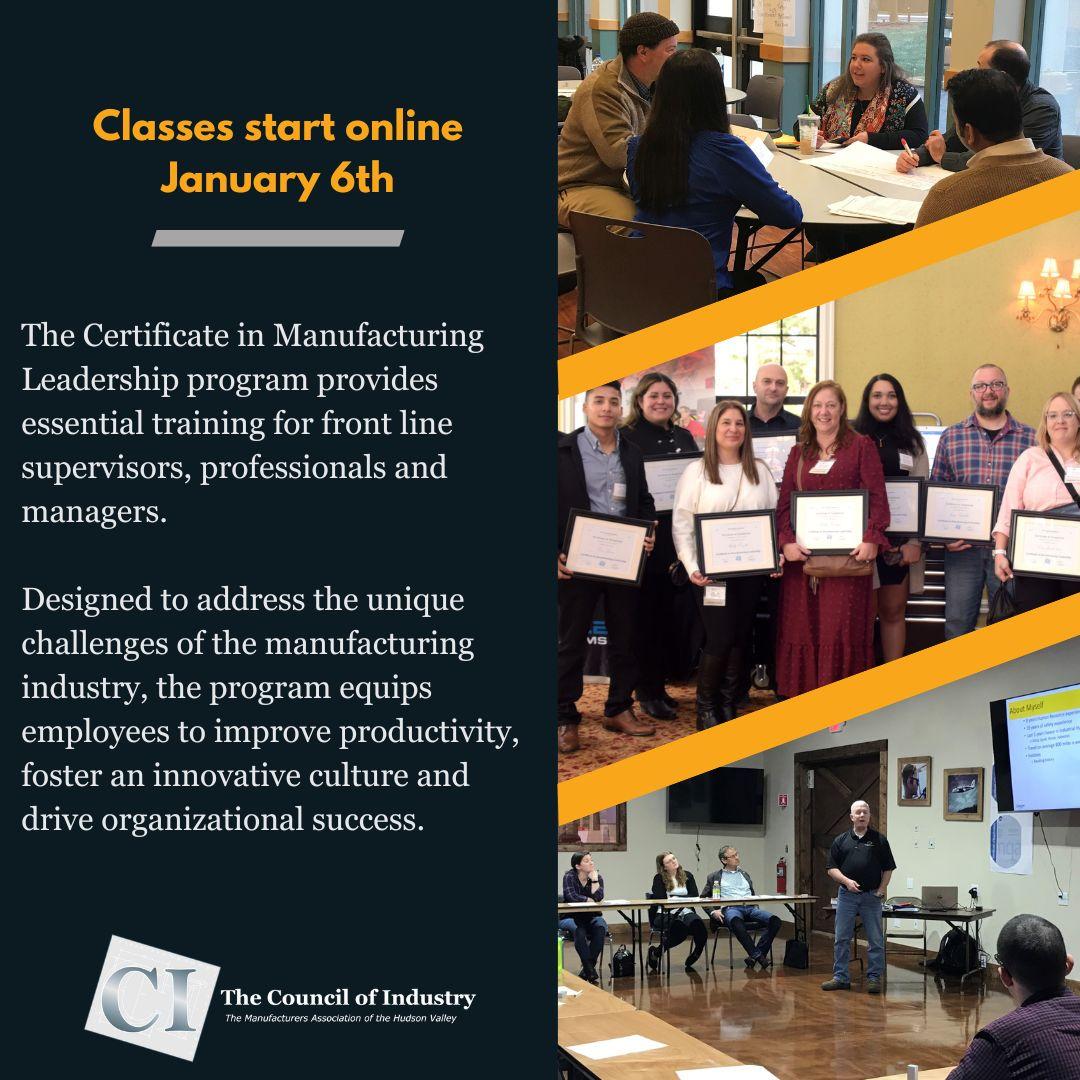
Certificate in Manufacturing Leadership Program Winter Session, Virtual. Supervisor Training Program for Hudson Valley Manufacturers. 7 Courses (15 half day sessions) January 6 - March 11 Via Zoom.

Lean Six Sigma Green Belt This program combines online coursework, with live Zoom sessions, to deliver a flexible and effective learning experience in Lean Six Sigma methodologies. Most Mondays March 2 - June 8 Via Zoom.

(Special Info session for those who are 'Green Belt curious' February 23rd)

Lean Six Sigma: Yellow Belt - Yellow Belt is an approach to process improvement that merges the complementary concepts and tools from both Six Sigma and Lean approaches. 3 Full days - March 9,10 & 11 - DCC Fishkill.

Trade Wars

IBM Expanding Quantum Program In Poughkeepsie

By 2033, IBM plans to build the world’s first-ever large-scale and fault-tolerant quantum computers at its Poughkeepsie facility. This long-term commitment to the Hudson Valley represents IBM’s most significant investment at the Poughkeepsie facility in recent memory. The Starling and Bluejay projects, announced earlier this year, outline the roadmap IBM will follow, aiming to lead to quantum computing systems far more powerful than current technology.

Jamie Garcia, director of strategic growth and quantum partnerships at IBM Quantum, provided insight on the forces that drove IBM’s $1 billion investment in quantum services. “IBM has built the world’s largest ecosystem of quantum explorers, adopters, and users, with over 300 IBM Quantum Network members, including enterprises such as Vanguard, HSBC, and E.ON, as well as government agencies and universities,” said Garcia. “Some of the early applications we see driving demand include drug development, materials discovery, chemistry, and optimization.” The Poughkeepsie facility operates on what IBM describes as the highest number of available utility-scale quantum computers at a single location globally, while also housing the world’s first quantum data center. IBM’s quantum work spans throughout the Hudson Valley from its research headquarters in Yorktown Heights to a fabrication facility in Albany, where quantum processor components are manufactured.

Read more at Mid-Hudson News

$689 Million Rare Earth Magnet, Copper Manufacturing Facility Coming To Virginia

The South Korean company LS Cable and System plans to build a manufacturing facility in Chesapeake. The complex will house three different businesses: Copper rod production from copper recycling, magnet wire manufacturing and rare-earth magnet production. The company’s $689 million investment is expected to create 430 jobs. The announcement comes as the United States and other countries are trying to decrease reliance on China, which manufactures the bulk of rare earth magnets but has in recent months suspended their export. The magnets are used in products such as drones and cars.

LS Cable and System leaders hope the company will break ground on the facility mid next year and be fully operational by late 2027. Three yet-to-be-named subsidiaries of LS Cable and System will operate the copper businesses. “The U.S. has a lot of scrap copper, and typically scrap copper was exported,” said LS Cable and System president and CEO Bon-Kyu Koo. “But what the U.S. government currently is looking for is to actually stabilize the copper supply chains. What will happen is we’re going to be getting 100% scrap copper from the U.S.”

Read more at The Virginian-Pilot

Defense Contract Management Agency Showcases New Strategic Plan

The Defense Contract Management Agency Acting Director Sonya Ebright has recently announced the agency’s new Strategic Plan. The plan covers fiscal years 2026 to 2030, and comprises four lines of effort crafted to define the combat support agency’s strategic goals and rigorously align them to War Department and Presidential directives. A companion Annual Performance Plan will be used to further outline the plan’s objectives, and provide measurement, tracking and reporting criteria.

  • Line of Effort 1: Strengthen the Defense Industrial Base through modernized technical surveillance, quality product delivery and data driven decisions to enable warfighter lethality.
  • Line of Effort 2: Deliver agile, transparent, and efficient acquisition life-cycle processes to improve stakeholder outcomes.
  • Line of Effort 3: Drive enhanced value and affordability through modern, adaptive, and responsive cost and pricing capabilities to increase return on investment.
  • Line of Effort 4: Develop talent and align resources, infrastructure, and technology to meet evolving operational demands.

Read more at Homeland Security Today

Ford, SK to End U.S. EV Battery Partnership

Ford Motor and SK Group are ending their joint effort to produce electric-vehicle batteries in the U.S., the latest fallout in the auto industry's retreat from EVs.SK On, the South Korean conglomerate's battery unit, said it will take sole ownership of the joint venture's battery plant in Tennessee. It will supply batteries to Ford and also produce stationary batteries for energy storage customers such as utilities and data centers. The Ford-SK partnership, called BlueOval SK, was announced in 2021 with a plan to spend $11 billion on the plants.

Ford will take sole ownership of two side-by-side battery plants that the joint venture built in Kentucky, SK On said. One of those plants has been mothballed, with no equipment installed. The other plant began production this year but is operating well below its designed capacity. Ford Chief Executive Jim Farley has said the company planned too much EV capacity and is pulling back now that President Trump and Congress have ditched fuel economy penalties and removed California's ability to set its own, stricter emissions rules.

Read more at the WSJ

GE Aerospace To Supply Engines for Two U.S. Navy Destroyers

GE Aerospace’s Marine Engines & Systems division has secured orders for eight LM2500 marine gas turbine engines to equip the US Navy’s next two Flight III Arleigh Burke-class guided-missile destroyers. The engines will be installed on the future USS Intrepid (DDG 145) and USS Robert Kerrey (DDG 146). According to GE Aerospace, each destroyer uses four LM2500 engines for propulsion. GE Aerospace Marine Engines & Systems business sales and marketing vice president Mark Musheno said: “The LM2500 has been the engine of choice for the US Navy’s destroyer fleet for decades, and we’re proud to continue that legacy as the Navy builds toward its 390-ship goal.

The LM2500 engine series has been deployed in naval service since 1969. Over time, GE Aerospace has introduced variants such as the LM2500+ and LM2500+G4. The engine features a gas generator, power turbine, attached fuel and lube oil pumps, and a fuel control and speed governing system, among others. It is compatible with various vessels such as patrol boats, frigates, corvettes, destroyers, cruisers, cargo and auxiliary ships, and aircraft carriers. To date, more than 700 LM2500 gas turbines have been supplied to the US Navy for surface combatants like frigates and destroyers.

Read more at Naval Technology

Ford Retreats From EVs, Takes $19.5 Billion Charge, Ends F-150 Lightning

Ford Motor (F.N), opens new tab said on Monday it will take a $19.5 billion writedown and is killing several electric-vehicle models, in the most dramatic example yet of the auto industry's retreat from battery-powered models in response to the Trump administration's policies and weakening EV demand. The Dearborn, Michigan-based company said it will stop making the F-150 Lightning in its electric vehicle form, but will pivot to producing an extended-range electric model, a version of a hybrid vehicle called an EREV, which uses a gas-powered generator to recharge the battery. The company is also scrapping a next-generation electric truck, codenamed the T3, as well as planned electric commercial vans.

Ford’s shift reflects the auto industry’s response to waning demand for battery-powered models, after car companies plowed hundreds of billions of dollars into EV investments early this decade. Instead, Ford said it will pivot hard into gas and hybrid models, and eventually hire thousands of workers, even though there will be some layoffs at a jointly owned Tennessee battery plant in the near term. The company expects its global mix of hybrids, extended-range EVs and pure EVs to reach 50% by 2030, from 17% today. The automaker also raised its 2025 guidance for adjusted earnings before taxes and interest, to about $7 billion, up from a previous range of $6 billion to $6.5 billion.

Read more at Reuters

SpaceX Could Be Preparing for a Huge IPO. Here's What to Know.

Musk’s SpaceX is reportedly hearing pitches this week from investment banks interested in advising on what could be the largest initial public offering in history. That news advanced reports that the space exploration company was considering going public from last week, when Bloomberg said SpaceX is targeting a mid-to-late 2026 IPO that would raise $30 billion and value the company at about $1.5 trillion, among the biggest companies in the S&P 500.

If SpaceX hits its IPO targets, it would surpass Saudi Aramco, the Saudi state-owned oil company, as the largest debut in history. Aramco raised about $29 billion when it went public in 2019. (SpaceX is reportedly in the process of buying insider shares at a price that values it at $800 billion, double its valuation from this summer.) Musk last week called “accurate” a report that SpaceX was considering going public to fund efforts to develop orbital data center technology. SpaceX has reportedly floated the idea of using Starlink satellites to host AI workloads as part of its recent pitch to investors.

Read more at Investopedia

EVIO Launches Hybrid-Electric Aircraft Program With 450 Pre-Orders

Montreal, Canada-based EVIO Inc. made its public debut with the launch of its EVIO 810 hybrid-electric regional aircraft, having secured conditional purchase agreements and options for 450 aircraft, targeted to enter into service by the early 2030s. EVIO benefits from investment and technical support from Boeing, and the company is collaborating with RTX’s Pratt & Whitney Canada to develop propulsion technology for the aircraft.

EVIO has been developing its clean-sheet design for several years, targeting the 50- to 100-seat market with a new level of efficiency and lower emissions, as well as offering unique cargo and defense capabilities. The EVIO 810’s performance and versatility will be enabled by a highly innovative hybrid-electric propulsion architecture. In 2023, EVIO received conditional purchase agreements for 250 of its hybrid-electric aircraft from two major airlines, with options for an additional 200 aircraft. The company has matured its “strong hybrid-electric design” – meaning the aircraft will be capable of both all-electric and hybrid-electric flight.

Read more at Aerospace manufacturing & Design

Quote of the Day

"It's such a fine line between stupid, and uh... clever."

Nigel Tufnel - A character in the Rock Mocumentary 'This is Spinal Tap.' The Film was Directed by Rob Reiner who died yesterday aged 78.

If you’re part of a Council of Industry member company and not yet subscribed, email usIf you’re not a Council member, become one today.

Facebook  Instagram  LinkedIn  X  Youtube