|
The HR Newsletter of the Council of Industry
September 8th, 2026
|
|
|
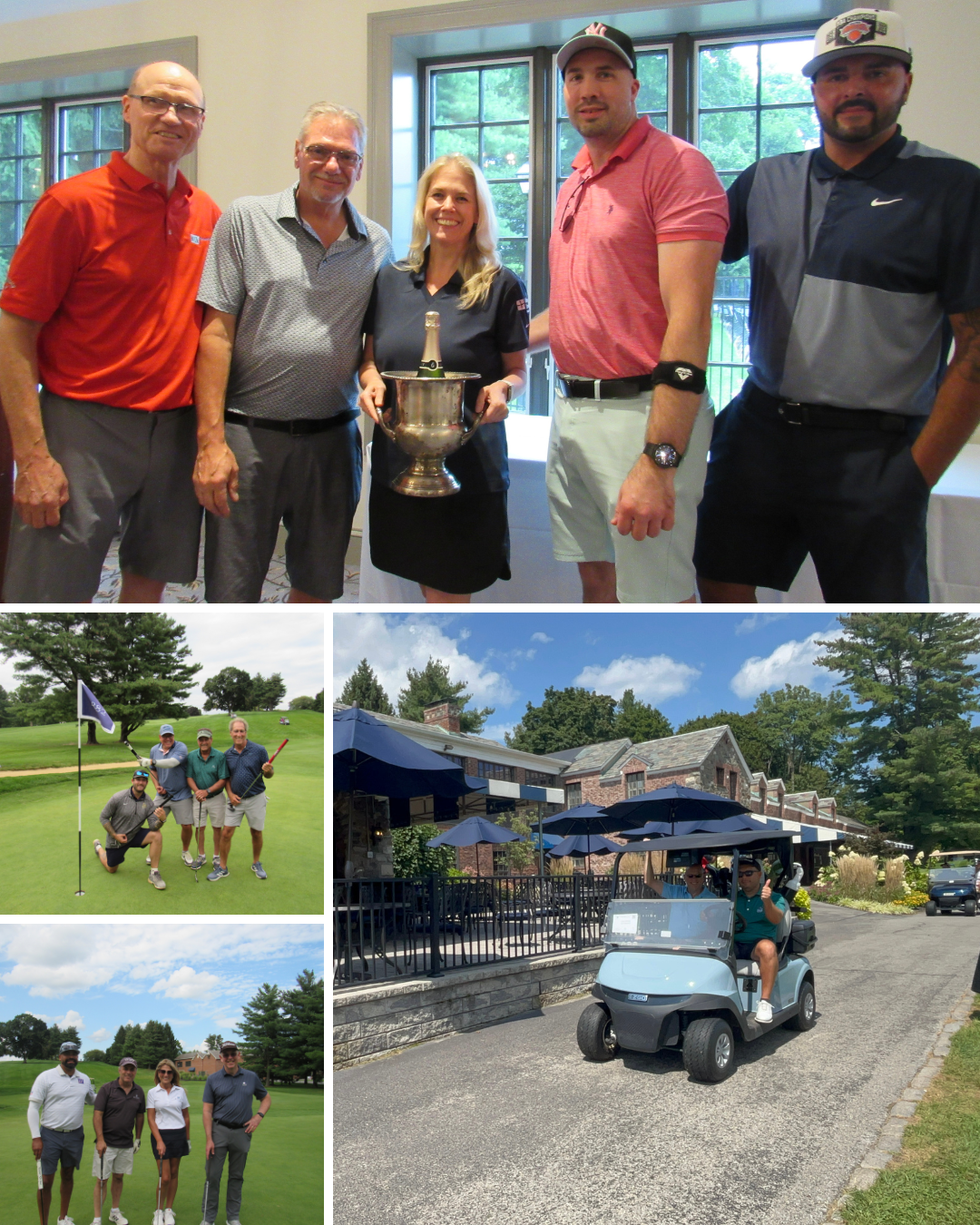
Thank you to everyone who joined us Monday, August 24th, for our 2026 Annual Golf Outing at The Powelton Club!
It was a great day of golf, networking, and connecting with members and friends from across the Hudson Valley manufacturing community.
Congratulations to our Scramble Winners, IBM, and Best Ball Winners, President Container Group, as well as all of our other contest and prize winners from the day!
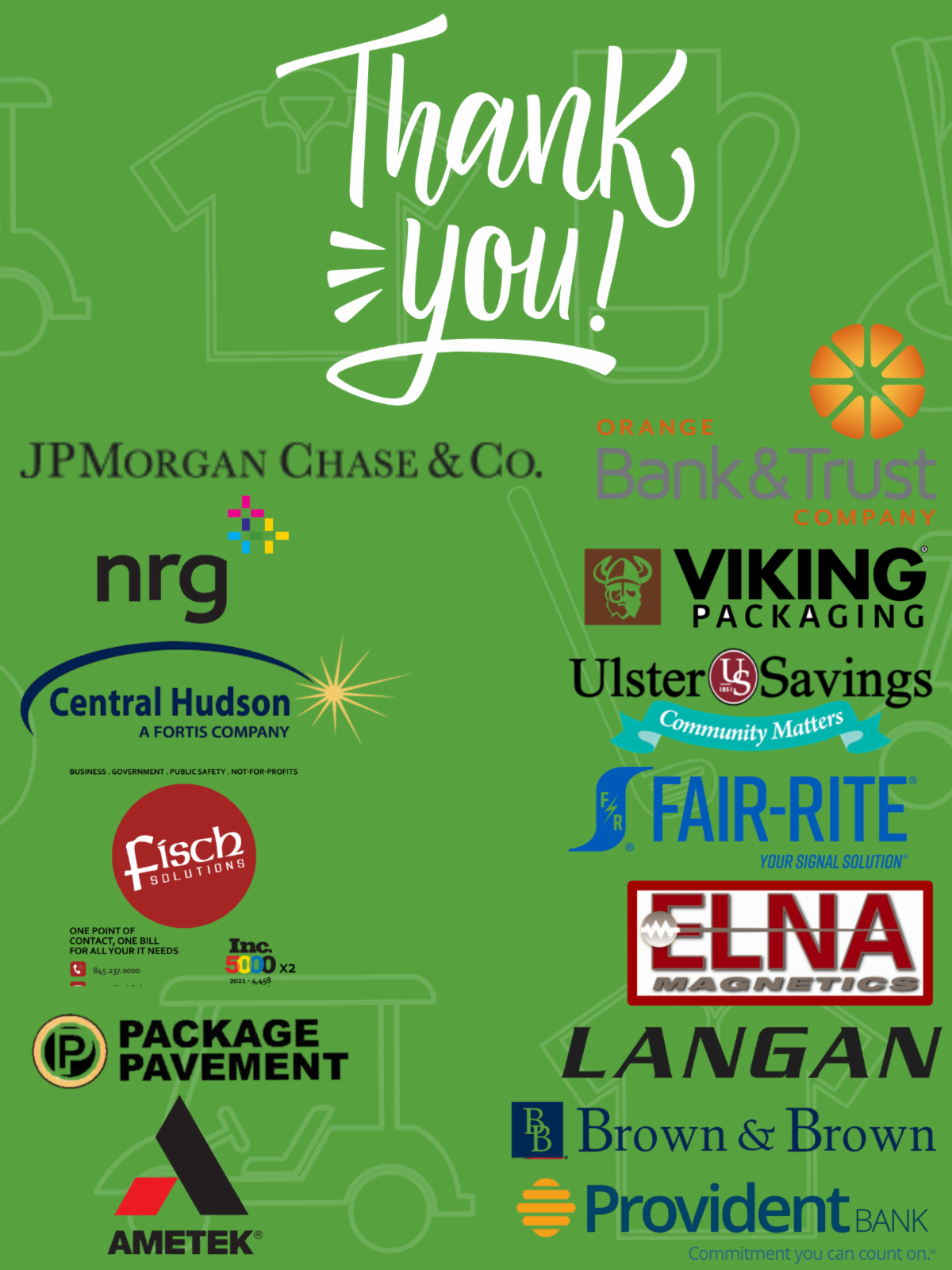
A special thank you to our sponsors for their continued support and to all of our golfers and attendees, along with the Powelton Club, who helped make this year’s outing a success.
See our recap of the day here
|
|
|
Council of Industry Launches Workforce and Talent Solutions Pilot
|
|
|
The Council of Industry has engaged Built by Skill to help launch a new Workforce and Talent Solutions Pilot to help Hudson Valley manufacturers strengthen their hiring practices and address workforce challenges.
Participating companies will receive a customized workforce assessment and hiring action plan. Support may include reviewing job descriptions, identifying critical skill needs, reducing key-person risk, improving recruiting and candidate-engagement practices, and connecting employers with the Council’s Career Hub, events, and other workforce resources.
The initiative will be led by Sameea Butt, founder of Built by Skill. Butt brings more than a decade of workforce development experience, graduate training in workforce policy, and expertise in data-driven, skills-based hiring. Her approach helps employers identify the skills, judgment, and work habits that lead to success rather than relying primarily on résumés and credentials.
“Workforce challenges continue to be among the most pressing issues facing our region’s manufacturers,” said Johnnieanne Hansen, CEO of the Council of Industry. “This pilot will give participating companies practical, individualized support to improve hiring outcomes and build stronger workforce systems. Just as importantly, what we learn will help the Council develop better resources and strategies for manufacturers throughout the Mid-Hudson region.”
The 12-month pilot is a hands-on consulting initiative rather than a staffing or placement service. Insights from participating companies will also contribute to an anonymized Hudson Valley Manufacturing Workforce Trends Report, providing regional manufacturers with useful benchmarks and information about hiring trends and effective recruiting strategies.
Council of Industry members interested in participating or learning more should contact the Council of Industry at info@councilofindustry.org.
|
|
|
Annual Luncheon & Expo is November 20
|
|
|
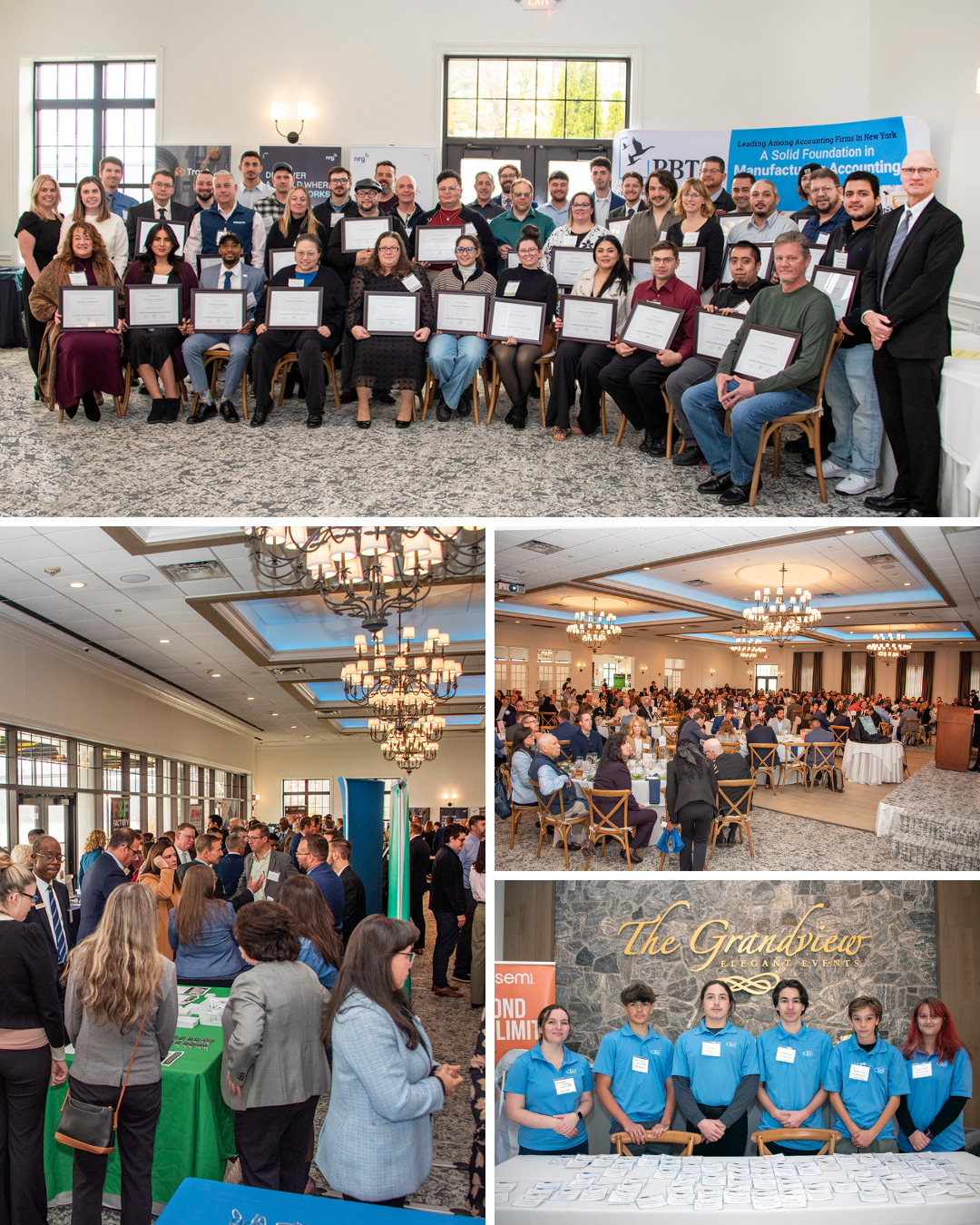
The Council of Industry's 2026 Annual Luncheon & Member Expo will take place on Friday, November 20, from 11:00 a.m. to 2:00 p.m. at The Grandview in Poughkeepsie.
As one of the Council's signature events, the Luncheon brings together manufacturers, associate members, community partners, educators, and industry leaders from across the Hudson Valley for an afternoon of networking, collaboration, and celebration.
The event begins with the Member Expo, where attendees can connect with fellow members, discover new products and services, and strengthen relationships with businesses that support manufacturing throughout the region.
Following the expo, guests will enjoy lunch, the Council's annual program, and the recognition of graduates from the Certificate in Manufacturing Leadership program.
This year's keynote speaker, Neal Moriarty, IBM's Innovation Studio Leader and Senior Quantum Ambassador, will provide an engaging look at one of the most important emerging technologies: quantum computing. During his presentation, he will explore the current state of quantum computing, its practical implications, and what manufacturers should know as the technology continues to evolve.
|
|
|
Certificate in Manufacturing Leadership Series in Newburgh Starts Next Week!
|
|
|
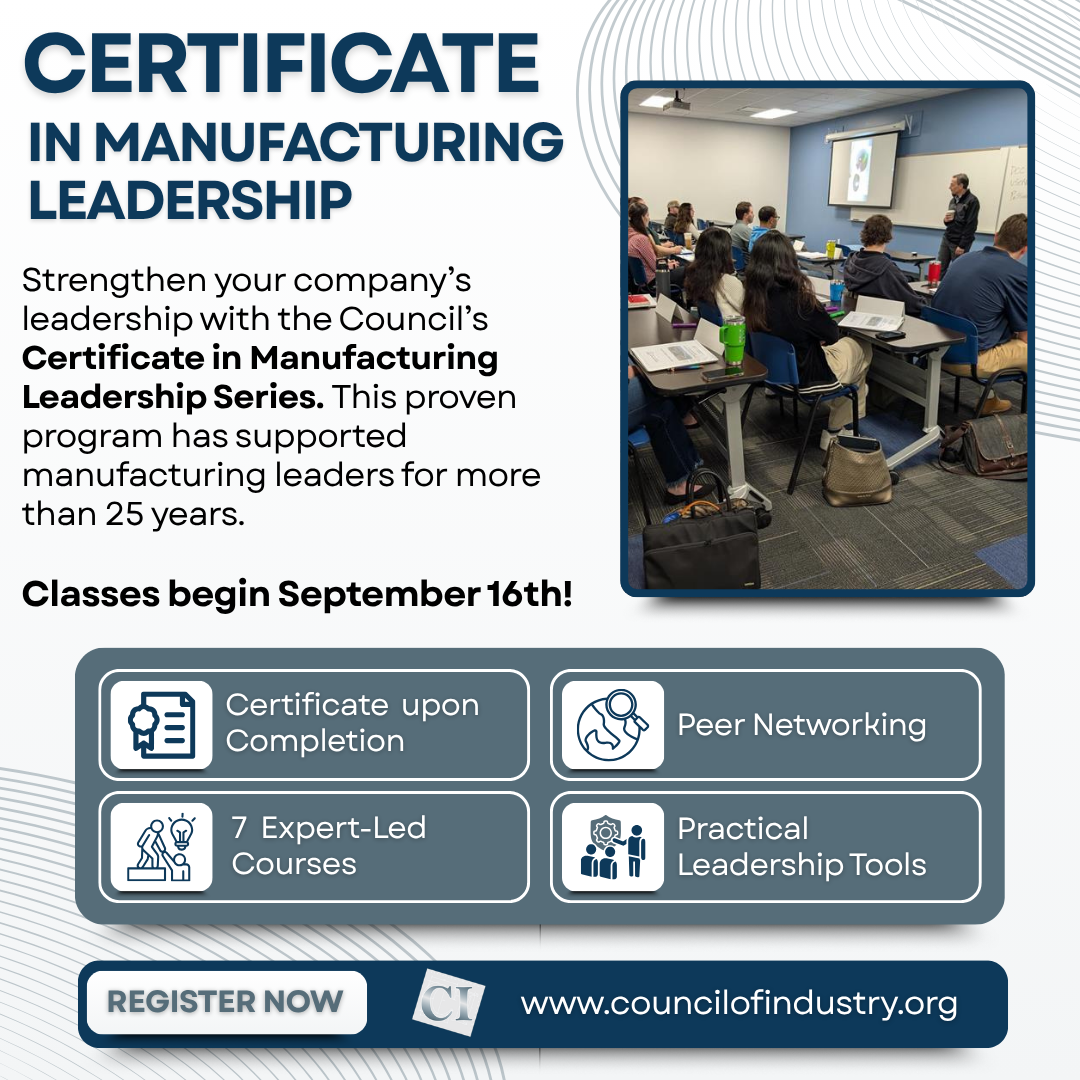
Registration is now open for the Council of Industry's September - December 2026 Certificate in Manufacturing Leadership Series, being held at SUNY Orange's Newburgh Campus.
Through this series, participants will gain practical skills in leadership, communication, coaching, human resources, lean manufacturing, financial performance, safety, and more.
Whether you're preparing a new supervisor or investing in an experienced leader, this series is an investment in the long-term success of your people and your business.
Secure your spot today!
|
|
|
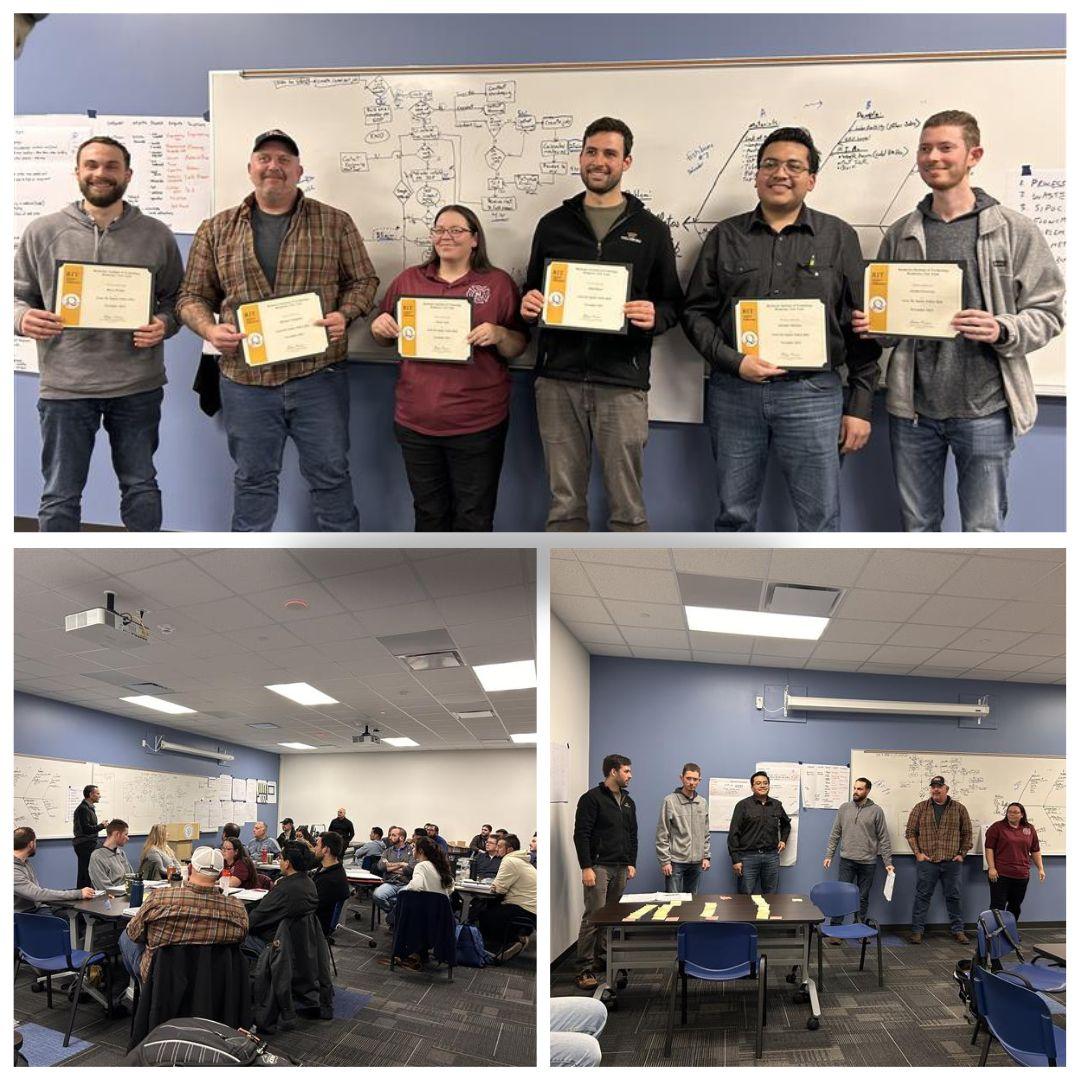
Council of Industry, DCC and RIT Team up to Provide Lean Six Sigma Yellow Belt Training in October
|
|
|
The Council of Industry is pleased to be offering Lean Six Sigma: Yellow Belt this Fall! Attendees will be introduced to the Define, Measure, Analyze, Improve, and Control improvement process and some of the tools associated with each stage.
The following topics will be focused on during the training:
- Resistance to Change
- 5-S and Visual Controls
- Team Building
- Problem Solving Process
- Statistical Thinking
During this interactive Yellow Belt training, each group of participants will identify opportunities within their respective work areas and ways to improve those areas utilizing the taught problem-solving tools. The teams will present their identified work area opportunity and suggested solutions.
When: October 13th, 14th and 15th, 8:30 - 4:00 PM
Where: DCC @ Fishkill
|
|
|
The Council of Industry has long been a leader in consortium-based training for Mid-Hudson manufacturers. Our model of bringing a small numbers of employees from multiple companies together benefits from the diverse experiences of the participants and has proven to be very cost effective.
While we will continue to deliver training via this model we now also have the resources to deliver customized training to individual manufacturers as well.
Through collaboration with our education and consulting partners we can deliver a wide range of training courses including, but not limited to:
- Leadership
- Lean
- Project Management
- Blueprint reading
- SolidWorks and other design software
- Supply chain management
- And more!
Want to know more? Contact Harold King
|
|
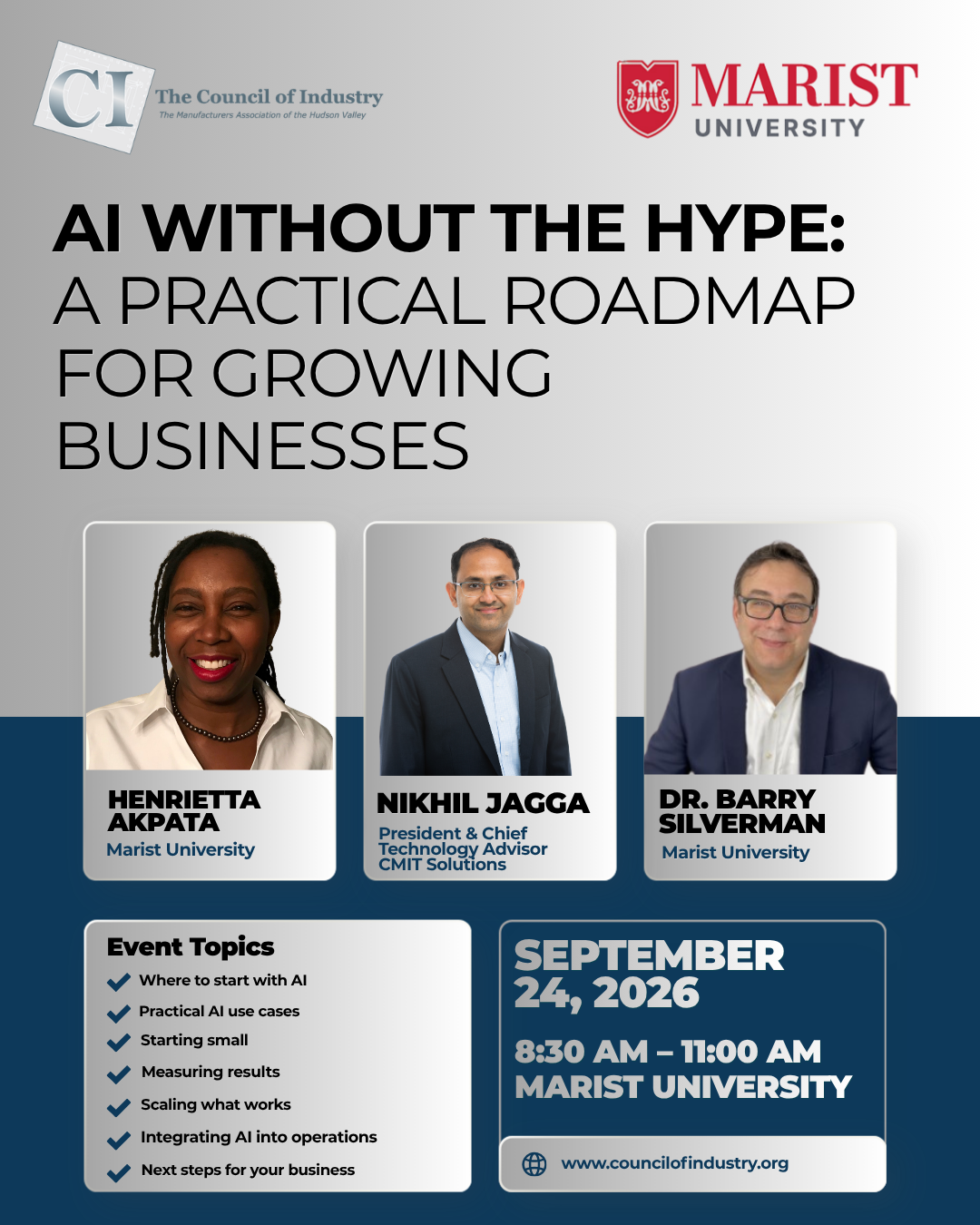
AI Without the Hype: A Practical Roadmap for Growing Businesses
|
|
|
The AI conversation is everywhere. But where should your business actually begin?
Every day brings another headline about artificial intelligence transforming business. Yet for many small and medium-sized companies, the biggest barrier isn't understanding AI — it's getting started without turning it into a six-month project that never launches.
Join fellow business owners and executives for an engaging breakfast discussion that skips the theory and focuses on what's actually working for businesses like yours right now.
Crawl: Start using AI this month. There are a handful of use cases that work for virtually any business
Walk: Measure what's working, then go wider.
Run: Build AI into your operations. Scale AI into department-specific workflows, strategic decision-making, and competitive advantage
You'll leave not with a theoretical roadmap, but with a clear picture of what to deploy first, how to evaluate results, and when it makes sense to invest in deeper discovery.
Whether you're just beginning to explore AI or looking to expand existing initiatives, this session will give you a practical starting point you can act on immediately.
Co-hosted by Marist University School of Management's Dr. Barry Silverman and Henrietta Akpata, with Featured Speaker Nikhil Jagga, President & Chief Technology Advisor, CMIT Solutions — White Plains, NY
|
|
Project Manager Apprentice Trade Addresses New Realities in the Manufacturing Workplace
|
|
|
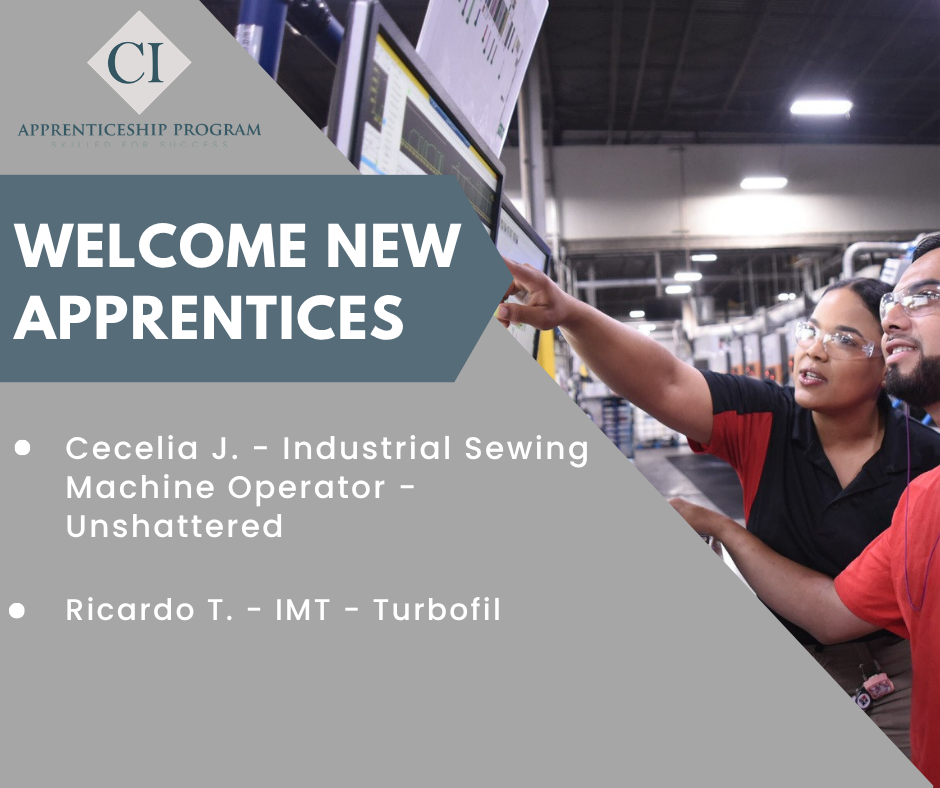
The Council of Industry sponsors 8 manufacturing trades through The Manufacturers Intermediary Apprenticeship Program (MIAP.) These are New York State Department of Labor approved trades ranging in length from 12 months to 4 years. These apprenticeships consists of two pieces: On-the-Job Training (OJT) and Related Instruction (RI).
OJT allows an apprentice to learn firsthand from a skilled craftsperson who will demonstrate and share their experience in the field
In RI, apprentices will learn the theory - and knowledge - based components of the craft. They must complete 144 hours of classroom or online training each year.
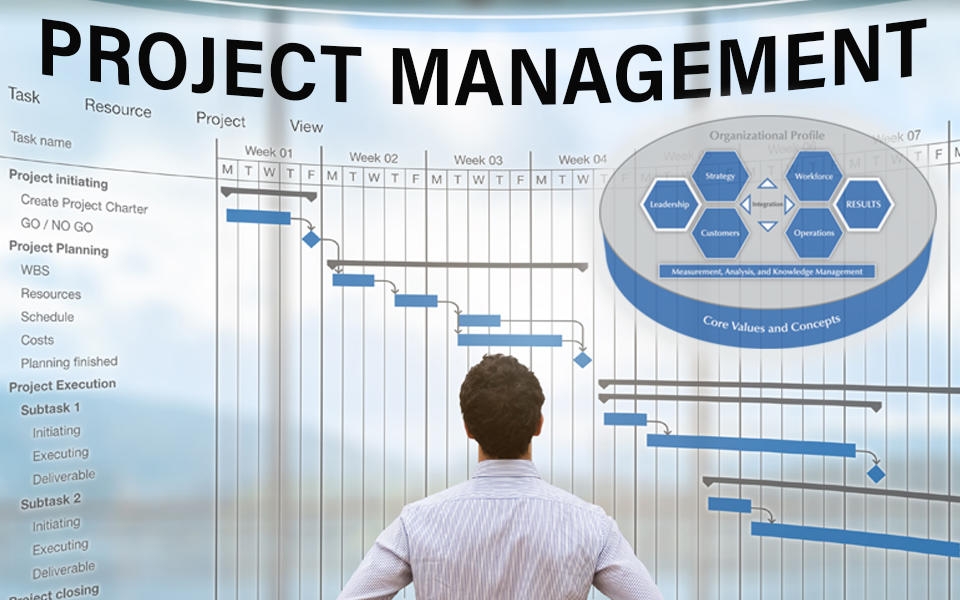
The Project Management Trade is critical in manufacturing for a number of reasons. It helps to optimize production processes and utilization of available resources, which can lead to improved product quality, reduced costs, and delivering products on time. Every project, from initial design to final production, requires meticulous planning and execution. The Project manager is the key to project success, and this trade provides the skills the Project Manager needs to be successful.
Work Processes (Skills learned on the Job) Approximate Hours for Industrial Manufacturing Technician (IMT):
Initiating Projects: 500 hours
Planning Projects: 500 hours
Executing Projects: 300 hours
Controlling Projects: 250 hours
Closing Projects: 250 hours
Additional Project Management Topics: 60 hours
Total Hours: 2,000
Minimum of 144 Hours of Related Instruction (Classroom Learning) Required for Each Apprentice for Each Year:
Safety, Health and the Workplace
· General Workplace Safety
· Right-to-Know/ Safety Data Sheets (SDS)
· Sexual Harassment Prevention Training– must comply with Section 201-g of the Labor Law
Project Management Components
· Project Management Professional qualification (PMP) or equivalent
· Project Management (PM) techniques, methods and proficiency with PM tools (MS Project or other related tools)
· Leadership and Team Building Skills
· Multi-task contracts and/or subcontracts of various types, and complexity
· Project Financial Management
· Project Problem, Issue, Dependency and Risk Management
· Resource Management
· Critical thinking and problem solving
· Contract negotiation
· Conflict resolution
· Microsoft Office, including Microsoft Word, Excel, PowerPoint and Outlook.
Professional Development
· Project Administration and Management Fundamentals
· Effective Communications
· Advanced Project Management
· Team and Supervisor Communication Skills
· Customer and Personal Service Fundamentals
· Industry recognized credentials/certifications pertaining to the field
If you want to know more about this trade and if it might be right you’re your company contact Emma Olivet
Learn more about The Council of Industry’s Apprentice Program
|
|
|
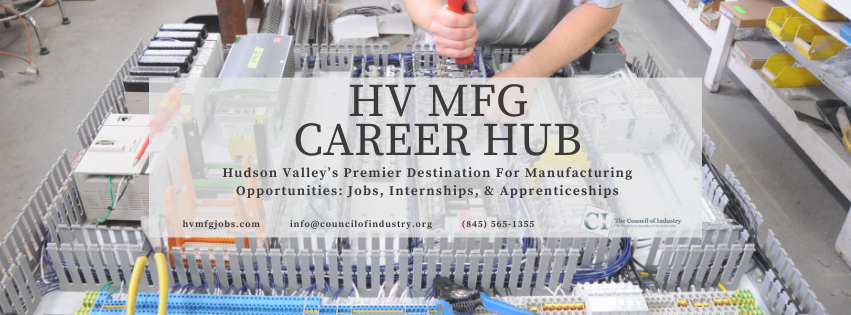
Subscribers to the Manufacturing Career Hub can view candidate resumes and contact information by searching the Candidate ID Number in the iCIMS platform.
Not yet a participant of the Career Hub? Contact Emma Olivet directly for additional candidate details or to learn more about the recruiting initiative.
|
|
|
Candidate ID: 44889
Position Interest: Industrial Maintenance / Maintenance Technician / Advanced Manufacturing / Manufacturing Technician / Manufacturing Operations
Level: Entry-Level / Full-Time
Skills: Mechanical and electronic assembly; hand and power tools; basic electrical circuits; equipment installation; troubleshooting; measurement and layout; technical documentation; work instructions; root-cause analysis; equipment inspection; quality checks; inventory accuracy; electronics; vehicle maintenance; safety awareness; process improvement; cross-functional collaboration
Education: Mesa Community College - Automated Industrial Technology Coursework, August 2026–Present
Current coursework: AIT 123 and AIT 125
Arizona State University - Bachelor of Science in Psychology, May 2010
Universal Technical Institute - Automotive Technology Coursework, 2002
Availability: Open to Interviews
Location/Commute: Currently based in Tempe, AZ; relocating to the Hudson Valley, NY
Entry-level advanced manufacturing and industrial technology candidate transitioning from a 15-year career in learning and development into a hands-on technical career. Currently pursuing Automated Industrial Technology coursework at Mesa Community College, with practical experience in mechanical and electronic assembly, electrical repair, equipment installation, troubleshooting, and technical documentation. Brings strong technical aptitude and experience translating diagrams and work instructions into accurate finished work, along with a background in process improvement, root-cause analysis, quality, and safety. Recently transitioned into hands-on furniture assembly and installation work while pursuing formal industrial technology training and is seeking an entry-level opportunity to build a long-term career in manufacturing or industrial maintenance.
|
|
|
News for HR and Workforce Professionals
|
|
|
iCIMS August Insights – Employer Demand Continues to Grow, Manufacturing Job Openings Jump
|
|
|
Job openings in the US closed July 17% above the July 2025 baseline while hires ended the month flat at 0% growth. On its own, a healthy climb in job postings signals confidence but the tension is in the gap. Openings are accelerating while conversion into hires has stalled, leaving recruiting teams to work through more requisitions without more people landing in seats.
- Manufacturing has been the standout growth story of the year. Job openings have held above the July 2025 baseline for months and extended that run in July, closing 29% above the baseline.
- Unfortunately, hiring has not matched that intensity. Hires briefly moved above baseline in May and June before reversing in July, ending the month -6% below baseline in the same period job openings hit their peak.
- Application volume weakened through the second quarter as well before recovering slightly to 4% above baseline in July, still well short of what job openings demand.
- ICIMS applicant data shows manufacturing's pool has changed over the past year. Manufacturing candidates under 45 rose from a 79% share of the industry's applicants in July 2025 to 85% in July 2026, with the largest gains coming from the 25-34 and 35-44 brackets . The 45-54 bracket saw the steepest decline, falling from a 12% to 9% share of the pool.
- That shift stands apart from who is currently employed in the sector. Data from the Bureau of Labor Statistics shows the 2025 annual average, an 11-month figure BLS notes is not strictly comparable to prior years, shows workers 45+ make up close to 47% of manufacturing's workforce, compared with just 15% of ICIMS applicants in that range this year.
Read the Report
Learn more about the Council of Industry’s Manufacturing Career Hub Driven By iCIMS
Check out the MIAP Apprentice Program
|
|
|
U.S. Firms Plan To Increase Employee Base Salary Budgets By An Average 3.3% In 2027
|
|
|
Despite the current economic turbulence, most employees in a majority of companies will be getting a base salary increase for 2027, according to a large survey by Korn Ferry. Almost half (47%) of the 5,512 participating employers said they expect to provide salary hikes to at least 95% of their employees, while 79% expect to do so for at least 80% of employees. Only 2% said they are planning no increases for anyone. U.S. organizations expect to boost overall base-salary budgets next year by an average of 3.3% and a median of 3%. The median increase for U.S. executive and senior management is also anticipated to come in at 3.0%. The survey was conducted in June of this year.
Meanwhile, the survey also inquired about the impact of economic uncertainty on talent and rewards programs over the previous 12 months and the following 12 months. The highest-impact area was increased use of artificial intelligence, with 74% of survey respondents reporting an increase. “AI is no longer a technology issue for rewards — it is a new operating context for pay, skills, mobility and job architecture, and organizations that treat it as a side topic will quickly find their reward models obsolete,” Korn Ferry wrote.
Read more at HR Dive
|
|
|
Why More Young Workers Are Saying ‘No Thanks’ To Becoming Managers
|
|
A recent study by Robert Walters found that nearly 60% of Gen Z employees surveyed prefer to stay as individual contributors rather than moving into middle management. Similarly, Robert Half research reports that 40% of Gen Zers would only take a promotion if it meant they didn’t have to manage a team. Why are workers so resistant to managing today? Technology is one factor, says Ryan Starks, vice president of workplace and AI & transformation at AI-powered team performance platform Rising Team.
“Gen Z grew up with tech that lets them multiply their own output solo, so building and leading a team isn’t the default instinct it used to be,” he says. Equally influential is the burnout individual contributors are witnessing among middle management, particularly as organizations slash middle-management layers to operate more leanly, leaving those who are left worried about job security while struggling to keep up with bigger workloads. One recent study found that more half of managers report experiencing burnout. “ICs are watching senior leaders get buried in constant org change and some are deciding people leadership just looks like a headache,” Starks says.
Read more at HR Executive
|
|
Employers Offer Loan Repayment, ‘Re-Recruiting’ To Attract Skilled Labor
|
|
The rapid expansion of data centers across the U.S. is creating demand for electricians, pipefitters, plumbers, welders and other skilled workers, pushing contractors and other employers to rethink how they recruit, develop and retain talent, executives from Turner Construction, Clayco and DPR Construction said month during a Construction Dive virtual event. Employers are expanding beyond traditional pay and benefits to attract workers to large projects, particularly those in remote locations. DPR Construction offers workers participating in its mobility program living allowances, project incentives, mobilization bonuses, travel stipends and increased pay.
Retaining workers requires employers to focus on career development, workplace culture and quality of life as well as compensation, panelists said. Building local pipelines through apprenticeships, trade partners and community relationships will also be critical to meeting long-term labor needs, including the workers needed to operate and maintain facilities after construction is complete. Developing a larger labor pool will also require companies to look beyond competition for existing skilled workers. Contractors need to bring additional people into construction through apprenticeships, technical education and other workforce development programs. They must also make the industry’s career paths more visible to younger workers.
Read more at HR Dive
|
|
|
Workers Are Turning More Critical Of AI, And Leadership Is Part Of The Problem
|
|
|
New Glassdoor data suggests that employee discussion of AI has moved from largely positive to predominantly negative since 2019. The change comes as public distrust of prominent AI executives has increasingly intensified, particularly among younger adults. Glassdoor’s economic research team reported that AI mentions in U.S. employee reviews increased 240% from May 2025 to May 2026. The tone of those references has deteriorated just as quickly. In 2019, 81% of reviews mentioning AI were positive. By 2026, just 43% were positive, while 53% were negative or listed AI as a con.
The analysis’ negative comments skated around different angles, but fear of replacement was the most common concern, appearing in 20% of critical AI comments. Other recurring complaints included being required to use AI tools, concern that AI was distracting the company from its core business and workplace-surveillance concerns. The data also links AI criticism to broader workforce strain. Employees raising negative AI concerns in reviews were 3.7 times more likely to mention burnout or job insecurity and six times more likely to mention layoffs than other reviewers. One-quarter of reviews that listed AI as a con also referenced layoffs directly.
Read more at Glassdoor
|
|
|
AI Speeds Hiring, But Who Gets Missed?
|
|
|
A new study reports that while recruiters using AI resume screening are getting hours added back to their workweek, many are questioning if the tech is screening out qualified talent. The report from Paylocity finds that of the 1,000 HR and recruitment leaders surveyed, their top recruiting concern is missing qualified candidates. “Recruiting automation is surfacing better candidates from the pool it sees,” researchers write, “but leaders aren’t fully confident without knowing who isn’t making it into the pool.” Another study from MyPerfectResume echoes that concern. In that research, nearly half of business leaders surveyed say AI has rejected candidates who would have moved forward if a human was the first to see the application.
“Finding better candidates and worrying about missed ones aren’t mutually exclusive,” researchers write. “Automated screening doesn’t fail by surfacing bad candidates. It fails because it never surfaces certain good ones.” Treat AI as a “decision-support tool,” add researchers in the MyPerfectResume report, not a replacement for human judgment. “As adoption grows,” they say, “the central question will no longer be whether employers use AI. It will depend on whether they use it responsibly and effectively.”
Read more at HR Executive
|
|
|
If Safety Can’t Speak Business, Safety Won’t Influence Business
|
|
|
The safety profession has historically communicated through the language of compliance. For decades, safety leaders were expected to understand regulations, interpret standards, investigate incidents, and maintain programs intended to reduce injuries and protect workers. Compliance remains foundational, but most organizations do not make strategic decisions based solely on compliance language. Leadership teams evaluate priorities through the lens of operational impact, workforce stability, financial exposure and organizational resilience. Safety professionals who are unable to connect their work with those broader organizational drivers may struggle to gain influence, secure resources or sustain leadership engagement.
For example, a traditional safety statement might read: “We need to improve PPE compliance in this area.” While technically correct, executive leadership may hear that as another compliance-related expense or enforcement initiative. Reframed through a business lens, the same concern becomes: “We need stronger exposure controls in this area to reduce injury potential, preserve workforce capacity and minimize operational disruption.” Safety professionals frequently communicate training needs by saying: “Employees need refresher training to remain OSHA compliant.” A business-centered reframe might instead state: “Additional training will help improve process consistency, reduce error potential and strengthen operational reliability.”
Read more at EHS Today
|
|
|
‘Next Play:’ What the New York Knicks Can Teach Corporate Leaders
|
|
|
Anyone who watched the New York Knicks this season saw something that goes well beyond basketball. They saw team members pass up their own shot when a teammate had a better one. They pulled each other off the floor after mistakes instead of pointing fingers. That had a star player walk away from millions in contract value so the organization could build a winning roster. They saw what most corporate teams claim to want but rarely build. A culture that actually motivates people to give everything they have, not just manage what is expected of them.
The biggest threats to organizations usually come from inside. The way people make decisions, share information, and build trust under pressure. The Knicks just spent an entire championship run showing exactly what happens when an organization gets all three right. Most organizations evaluate performance once a year, talk about culture at the annual offsite, and wonder why neither changes. The highest-performing organizations treat both as living systems. Feedback is continuous. Learning is expected. Culture is reinforced in hundreds of small moments, long before it is ever measured. That is what “next play” represents. It is the visible expression of an invisible system. When a player stumbles, the team instinctively lifts him up because they practiced that response daily. Trust is a habit. The next play matters more than the last one because everyone believes improvement is always possible.
Read more at Fast Company
|
|
|
The Council of Industry focuses on advancing manufacturing excellence, workforce innovation, advocacy, and strategically positioning its members within the Hudson Valley region and beyond. It is the premier manufacturers' association for Southeastern New York, representing over 160 member firms. Grow, Train, and Succeed with the Council of Industry.
Council of Industry - www.councilofindustry.org - (845) 565-1355
If you’re part of a Council of Industry member company and not yet subscribed, email us. If you’re not a Council member, become one today
|
|
|
|
|