|
The Monthly Newsletter of the Council of Industry
August 18th, 2026
|
|
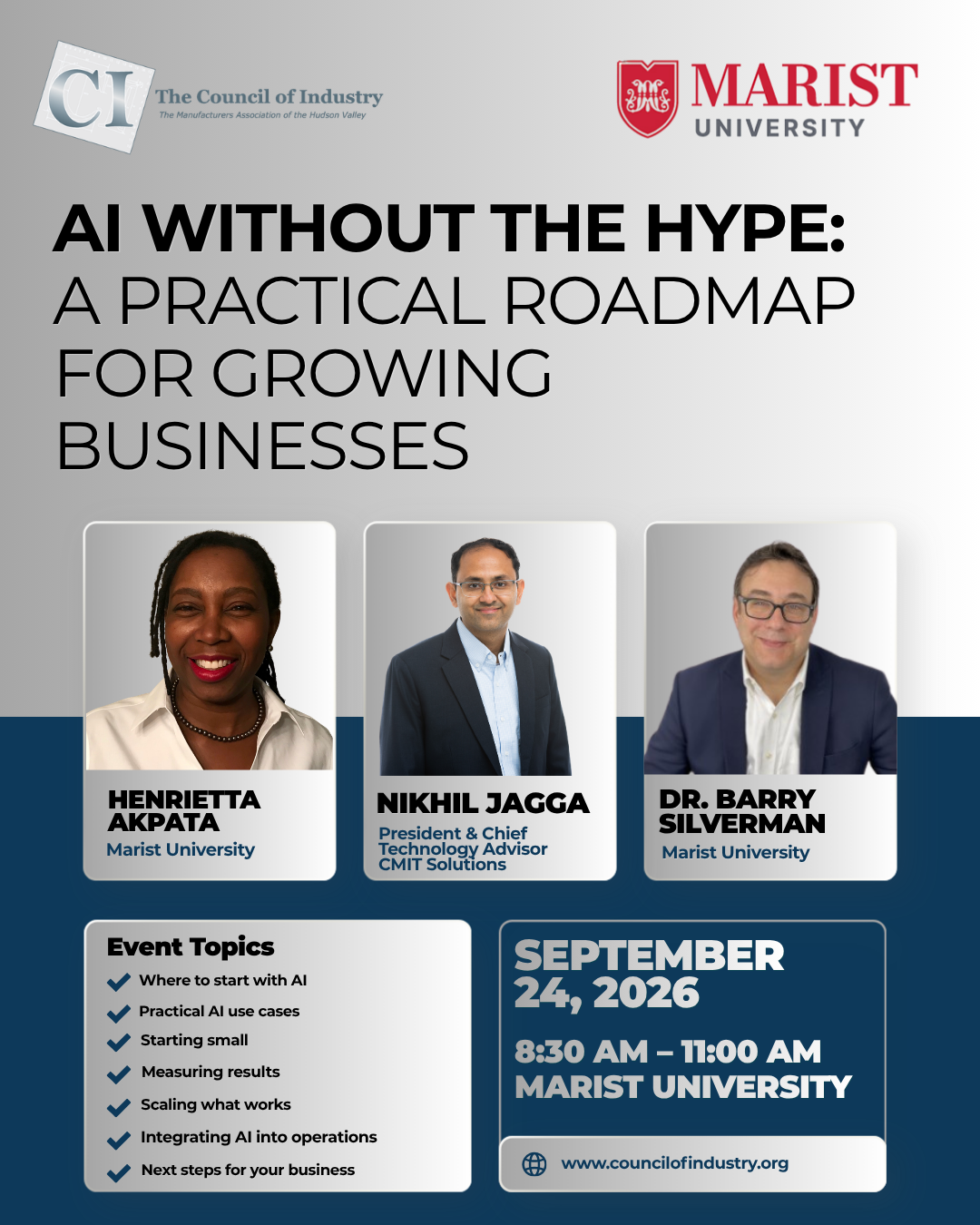
AI Without the Hype: A Practical Roadmap for Growing Businesses, Co-Hosted with Marist University
|
|
|
The AI conversation is everywhere. But where should your business actually begin?
Every day brings another headline about artificial intelligence transforming business. Yet for many small and medium-sized companies, the biggest barrier isn't understanding AI — it's getting started without turning it into a six-month project that never launches.
Join fellow business owners and executives for an engaging breakfast discussion that skips the theory and focuses on what's actually working for businesses like yours right now.
Crawl. Walk. Run.
The companies seeing real results from AI aren't the ones with the most ambitious strategies. They're the ones that started small, proved value fast, and expanded deliberately.
- Crawl: Start using AI this month. There are a handful of use cases that work for virtually any business
- Walk: Measure what's working, then go wider.
- Run: Build AI into your operations. Scale AI into department-specific workflows, strategic decision-making, and competitive advantage
You'll leave not with a theoretical roadmap, but with a clear picture of what to deploy first, how to evaluate results, and when it makes sense to invest in deeper discovery.
Whether you're just beginning to explore AI or looking to expand existing initiatives, this session will give you a practical starting point you can act on immediately.
When: September 24, 8:30 - 11:00 am
Where: Marist University
Learn more here
|
|
|
FuzeHub Product Development Event, Co-Sponsored By the Council of Industry, Draws Entrepreneurs to SUNY New Paltz
|
|
|
On August 12, FuzeHub hosted a Product Development Workshop at SUNY New Paltz, in partnership with the Hudson Valley Venture Hub and the Additive Manufacturing Center at SUNY New Paltz.
The event brought together innovators and entrepreneurs looking to advance their products from concept toward commercialization.
The workshop provided participants with practical guidance and resources across key stages of the product development journey, including product development, prototyping, manufacturing, and commercialization strategies.
Attendees gained tools to help evaluate their ideas, address development challenges, and define actionable next steps for moving their products forward.
Thank you to FuzeHub, the Hudson Valley Venture Hub, the Additive Manufacturing Center at SUNY New Paltz, and everyone who participated in making the workshop a valuable opportunity to learn, connect, and support innovation and product development in the Hudson Valley and across New York State.
|
|
|
Annual Luncheon November 20th to Feature Keynote From IBM’s Neal Moriarty on Quantum Computing
|
|
|
The Council of Industry is pleased to announce that Neal Moriarty, IBM's Innovation Studio Leader, will be the Keynote Speaker at our 2026 Annual Luncheon on Friday, November 20, at the Grandview in Poughkeepsie.
Neal Moriarty is a technology strategist with expertise in emerging technologies, artificial intelligence, cybersecurity, and quantum computing. Throughout his career, he has worked with organizations to better understand the practical applications of new technologies and their potential impact on business and industry.
At this year's luncheon, Neal Moriarty will discuss the current state of quantum computing and what manufacturers should know as the technology continues to develop.
Join us for the Council of Industry's Annual Luncheon & Member/Associate Member Expo, one of our signature events bringing manufacturers and industry partners together to connect, network, and celebrate.
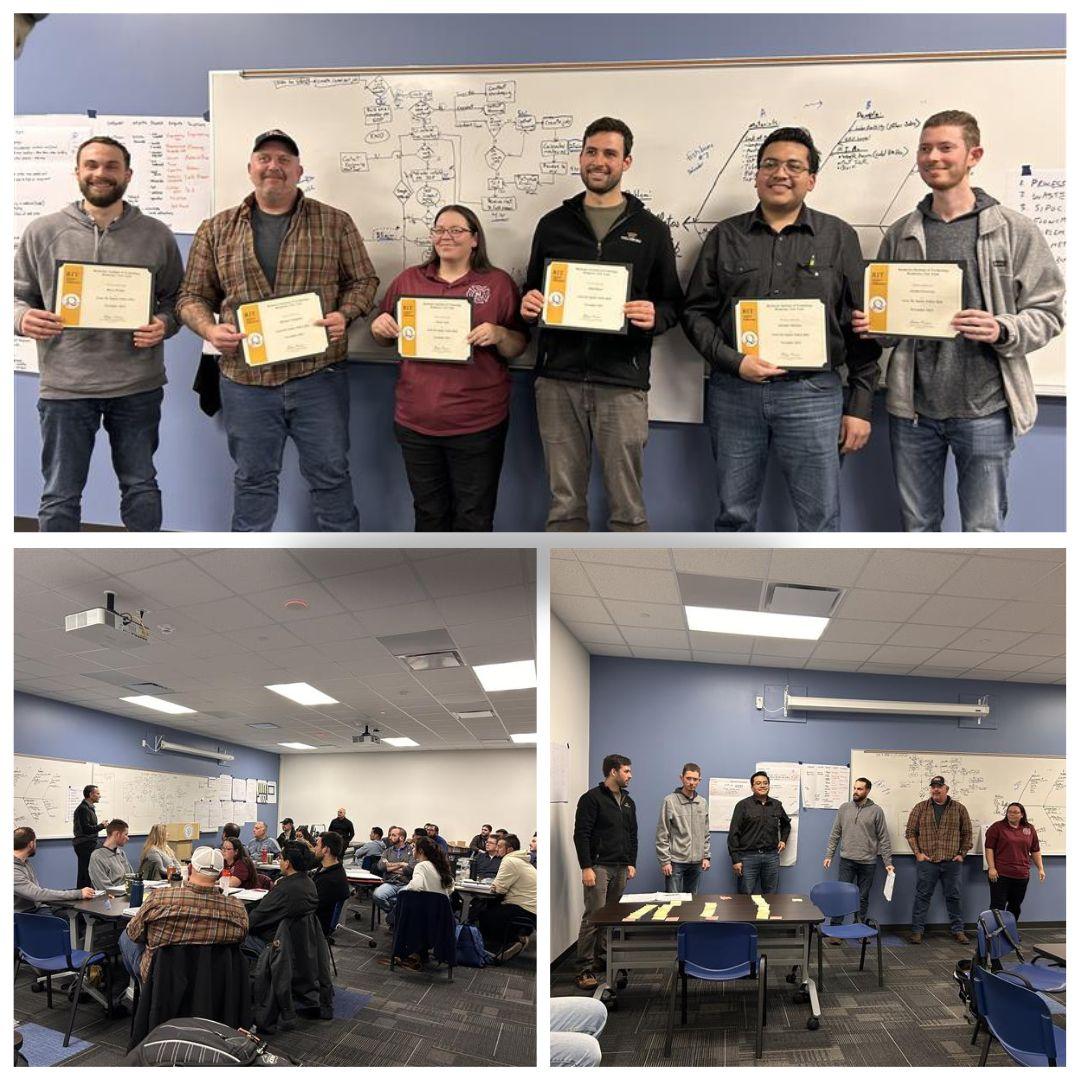
The event features our Member/Associate Member Expo, along with the recognition of our 2026 graduates of our Certificate in Manufacturing Leadership Series. Expo participation is complimentary with the purchase of two luncheon seats.
Learn more here
|
|
|
Certificate in Manufacturing Leadership Series in Newburgh begins September 16th
|
|
|
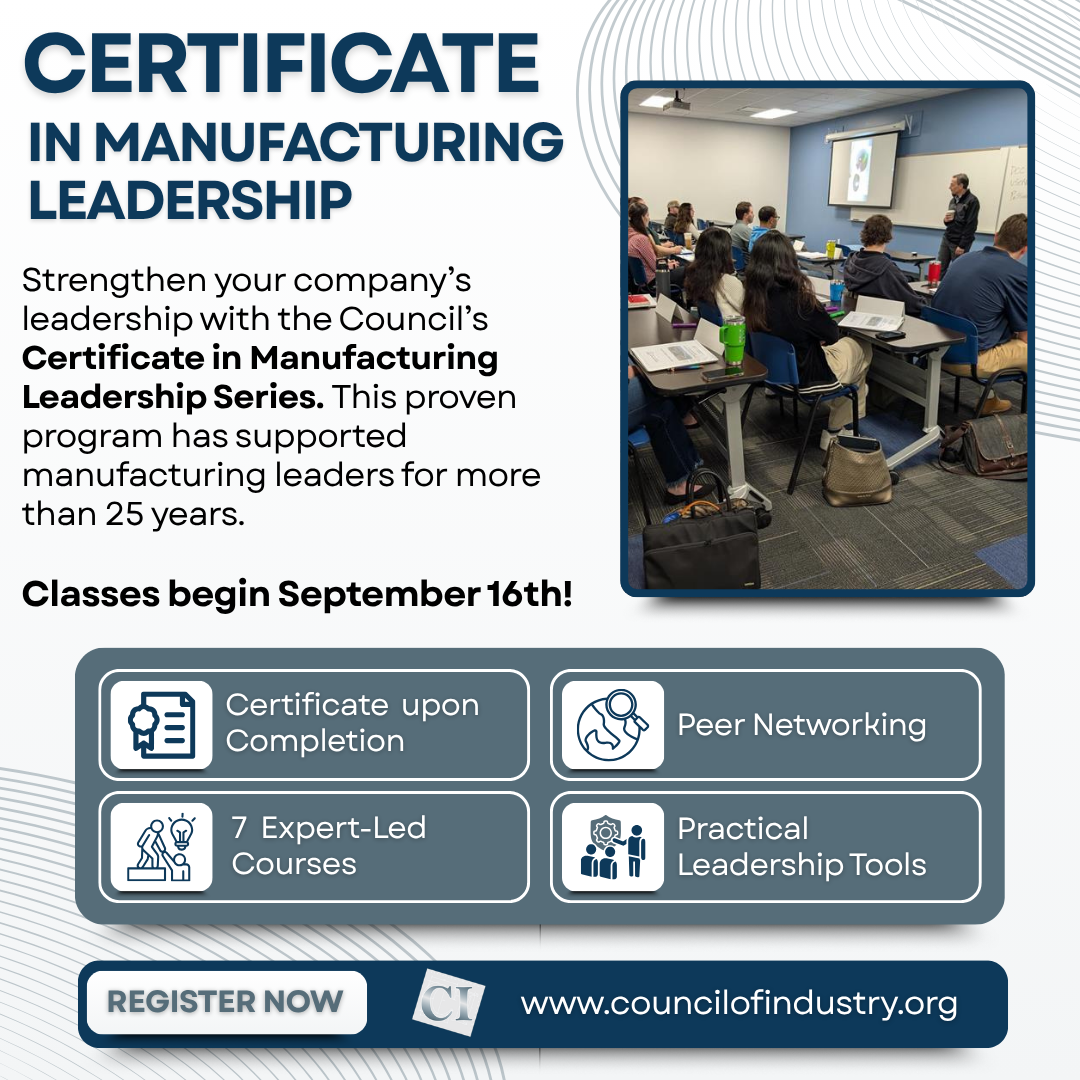
Strong supervisors are essential to a successful manufacturing operation. The Council of Industry’s Certificate in Manufacturing Leadership Series helps current and emerging leaders build the practical skills they need to manage people, communicate effectively, improve operations, and lead with confidence.
Running September 16 through December 9 at SUNY Orange’s Newburgh Campus, the series covers leadership fundamentals, HR issues, business communication, manufacturing profitability, Lean, risk management, and strategies for motivating, coaching, and managing employees.
Participants who complete the program requirements earn the Council of Industry’s Certificate in Manufacturing Leadership.
Invest in your next generation of manufacturing leaders. Space is limited.
Secure your spot here
|
|
|
Council of Industry, DCC and RIT Team up to Provide Lean Six Sigma Yellow Belt Training in October
|
|
The Council of Industry is pleased to be offering Lean Six Sigma: Yellow Belt this Fall! Attendees will be introduced to the Define, Measure, Analyze, Improve, and Control improvement process and some of the tools associated with each stage.
The following topics will be focused on during the training:
- Resistance to Change
- 5-S and Visual Controls
- Team Building
- Problem Solving Process
- Statistical Thinking
During this interactive Yellow Belt training, each group of participants will identify opportunities within their respective work areas and ways to improve those areas utilizing the taught problem-solving tools. The teams will present their identified work area opportunity and suggested solutions.
When: October 13th, 14th and 15th, 8:30 - 4:00 PM
Where: DCC @ Fishkill
Contact Emma Olivet for more information.
|
|
The Council of Industry has long been a leader in consortium-based training for Mid-Hudson manufacturers. Our model of bringing a small numbers of employees from multiple companies together benefits from the diverse experiences of the participants and has proven to be very cost effective.
While we will continue to deliver training via this model we now also have the resources to deliver customized training to individual manufacturers as well.
Through collaboration with our education and consulting partners we can deliver a wide range of training courses including, but not limited to:
- Leadership
- Lean
- Project Management
- Blueprint reading
- SolidWorks and other design software
- Supply chain management
- And more!
Want to know more? Contact Harold King
|
|
ESD’s Global New York Step Program: New & Existing Funding To Help Your Company Enter The Global Marketplace - A new cycle of funding is available for the State Trade Expansion Program (STEP 13). This is an opportunity for eligible companies to secure support for upcoming export initiatives. To review the eligibility requirements and submit a formal application, please visit the ESD website. Meanwhile, limited funding is still available for the Global NY State Trade Expansion Program (STEP 12, the 2025-2026 cycle). To qualify, all proposed activities must be completed by September 28, 2026. For more information on the above activities, please reach out to the Global NY team in your region or email us at globalny@esd.ny.gov.
The Semiconductor Manufacturing Workforce Training Incentive Program is designed to help New York build a robust, highly skilled talent pipeline to support the growing chip industry and other advanced manufacturers statewide. The program provides a 75% refundable tax credit on eligible training costs - up to $25,000 per employee trained - to advanced manufacturers and semiconductor manufacturing business that invest in training their workforce. Qualified costs include wages during training and "wrap-around" expenses to ensure successful training completion. Learn more at ESD
Need help navigating the spiderweb of development grants? Contact the Council of Industry
|
|
Upcoming CI Trainings & Events
|
|
Manufacturing Industry News
|
|
Smart Industrial Innovation Is Commoditizing Faster Than You Think
|
|
Industrial companies are investing aggressively in AI, automation, IIoT, advanced analytics, digital twins and visualization platforms. Many of these technologies still feel new. The problem is that they don’t stay new for long. A capability that appears highly differentiated today can become expected functionality within months. Open-source models, cloud infrastructure, reusable software components and lower computing costs make it easier for competitors to copy, combine or improve digital offerings. The pace of commoditization is accelerating, and the monetization window is shrinking.
The commoditization of technology is not new. Hardware experienced it first. Software followed. Now AI and smart industrial capabilities are moving through the same cycle at much greater speed. Predictive maintenance, machine vision, remote monitoring, energy optimization and digital work instructions once looked highly differentiated. Many buyers now expect them to be embedded in the offer. What was previously sold as an innovation can quickly become part of the standard product, service contract or platform subscription. This shows that the hype curve is compressing.
Read more at Smart Industry
|
|
Successful Change Requires Going Where the Work Happens – Lessons from a WWII Fighter Plane Factory
|
|
Most transformations fail not because the strategy is wrong, but because the cockpit is. The issue is not what to do, but how to do it. Very often, employees know what needs to be done, but feel the system is fighting them. Goals and deadlines are established by executives, sometimes without an appreciation for how complex and time-consuming they will be to achieve. The organization’s structure doesn’t encourage timely decision-making or productive collaboration. The metrics and incentives for different teams can contradict each other. In meetings, people devote more time to reviewing what has been done than to preparing for upcoming work or providing help to achieve the next level of performance.
Successful change isn't about forcing new behaviors on people. It’s about building environments that through a combination of design, incentives and nudges naturally lead to the desired behaviors. It requires leaders to go where the work happens and understand what prevents people from behaving in ways that leaders expect. Companies thrive when they design workplaces for the ways people behave, feel and think.
Read more at IndustryWeek
|
|
|
From Reactive To Predictive: Why AI's Biggest Value May Be Quality
|
|
|
For many industrial manufacturers, the cost of poor quality represents between 15% and 20% of total sales revenue. More importantly, over 60% of quality issues originate during engineering and design, where decisions about materials, components, manufacturability, compliance, and product architecture shape everything that follows. By the time a defect is discovered during production—or worse, after a product reaches the field—the cost and complexity of correcting it has increased dramatically.
This changes how manufacturers should think about quality. For years, many quality programs have focused on finding defects as efficiently as possible. Inspection remains essential, but inspection alone cannot prevent problems that were introduced months earlier during product development. Manufacturers seeing the greatest value from AI are using it to help identify potential risks before they become problems. That shift—from reactive quality management to predictive quality management—is where AI has the potential to make a meaningful difference.
Read more at Smart Industry
|
|
|
Middle Managers Get a Bad Rap. They Just Need Help to Lead in the Age of AI
|
|
|
Companies of all sizes are talking about using AI to flatten their organizations—and eliminating an entire layer of middle management in the process. Gartner projects that 20% of companies will cut more than half of their middle managers by the end of the year. But that might be throwing the baby out with the bathwater. A far better approach is to keep middle managers as the important link between leadership and frontline employees that they’ve been for decades. The key is to also ensure they have the AI skills they need to drive better business outcomes in this new AI-enabled era.
What might they now need to augment their skills? First and foremost, they need to be trained on what AI can and cannot do. Middle managers cannot tell their teams to “use AI to work smarter” if they themselves don’t have a baseline understanding of what AI tools currently exist and how they can be deployed within their particular industry.
A second important skill is having the business acumen to identify the right use cases for AI within a business line, department or division. What are you actually trying to achieve? Revenue growth? Cost reductions? Productivity enhancements? Customer retention? Faster time to market?
To effectively coach their teams towards quality outputs, middle managers themselves need solid skills in prompt engineering—knowing how to set the right parameters and refine inputs to get the best results.
Read more at IndustryWeek
|
|
|
The Silver Tsunami Is Coming for American Manufacturing: A Data Driven View
|
|
|
American manufacturing is entering the largest ownership transition in its history, and most of the companies involved are not prepared for it. Large stretches of the American industrial base, particularly job shops, machine shops, tool-and-die operations, and small contract manufacturers, were founded during the postwar industrial boom and the entrepreneurial wave that followed it through the 1970s and 1980s. Those companies were typically started by a single founder, grown on relationships and reputation rather than outside capital, and never restructured under private equity or public ownership. That history is exactly what makes manufacturing more exposed to a succession crunch than sectors built on more recent, more institutionally financed ownership models.
The Numbers Behind the Shift
- 52.3% of all U.S. employer-businesses are owned by someone 55 or older, according to a Gallup analysis of U.S. Census Bureau data (Gallup, 2025).
- More than 58% of Baby Boomer business owners have no documented succession or transition plan in place (InCorp, 2026).
According to MNI, complier and publisher of the industrial data that powers IndustrySelect:
- The average U.S. manufacturer in the IndustrySelect database is 47.3 years old, with a median founding year of roughly 1985.
- Nearly 89% of manufacturers in the database are more than 20 years old, and a third have been operating for more than half a century.
- Private, closely held ownership structures, including private corporations, LLCs, S-corps, and sole ownership, account for roughly 87% of the database.
- 71% of manufacturers operate from a single location, with no parent company layered above them in a corporate family tree.
Read more at Industry Select
Contact Johnnieanne Hansen to learn more about The Council’s Succession Planning resources
|
|
|
Inside GM’s $4.5B Strategy To Bulletproof Its Automotive Supply Chain
|
|
|
One of the great innovations in manufacturing over the past decades has been lean six sigma and just-in-time delivery. But if anything, the fact that we’ve dialed in the supply chain so tightly, has left very little to no flexibility if and when we need it. This truth may be most evident in the world of vehicle manufacturing. During COVID, the supply chain shock created a shortage of microchips, which then had the unintended consequence of a shortage of new vehicles. Since then, we’ve seen wave after wave So how are automakers compensating for this new world, to work to insulate their operations from future supply chain shocks?
So how are automakers compensating for this new world, to work to insulate their operations from future supply chain shocks? Well, the best example may be General Motors, who clearly has a strategy to do so. Last week GM announced it is setting up a $4.5 billion safety net designed to keep critical components flowing through their supply-chain. The automaker aims to avoid future parts crunches by securing supplies of high-risk components through a financing arrangement where it pre-funds the purchase of essential parts. Under this new deal, supply-chain management firm Procura will receive funding through a bank syndicate led by JPMorgan Chase and Santander. Procura will prepay certain suppliers on GM’s behalf, giving them capital required to make and store inventory set aside for the Detroit automaker. GM said the deal aims to lock down parts in the event of a range of events, from cyberattacks to demand spikes to natural disasters.
Read more at CBT News
|
|
|
Five Internal Controls Every Manufacturer Should Assess Frequently
|
|
|
Strong internal controls do more than prevent fraud. They help manufacturers protect inventory, improve operational efficiency, strengthen financial reporting and reduce costly errors. Regularly evaluating key controls is essential to maintaining profitability and minimizing risk. Here are five controls that deserve particular attention.
Segregation of Duties - First, segregation of duties ensures no employee has complete control over a transaction. This is one of the most important internal controls, as it separates key responsibilities among multiple employees.
Three-Way Match - Implement a three-way match by comparing the purchase order, receiving report and vendor invoice before payment is processed. This confirms that the quantity, pricing and items ordered, received and billed all agree before funds are released.
Inventory Records vs. Physical Counts - Warehouse access should be restricted to authorized personnel, and inventory movements should be documented to maintain accurate records. This will help improve accountability and provide a clear audit trail when discrepancies arise. Periodic cycle counts and reconciliations help identify any issues early.
IT Access Controls - Maintain strong IT access controls. Employees should only have access to the systems and functions necessary for their job responsibilities. Manufacturers should also implement multi-factor authentication, promptly remove access for terminated employees and periodically review user permissions. ERP systems with audit trails further strengthen accountability by documenting key system activities and changes.
Management Review Controls - Management review controls provide an important layer of oversight by identifying unusual transactions or trends that automated controls may not detect. Regularly reviewing inventory adjustments, purchase price variances, gross margin fluctuations and exception reports allows management to investigate anomalies before they become larger operational or financial issues.
Read more at Dannible & McKee CPAs
|
|
|
China Builds Robots That Can Do Backflips – But Can They Make Money?
|
|
|
As retail excitement around the listing of China’s best-known humanoid maker, Unitree Robotics, reaches fever pitch, skeptics are questioning how long it will take before these robots can move beyond running and acrobatics to perform genuinely useful work. The Hangzhou-based startup priced its IPO at 150.8 yuan ($22.4) a share, raising $900 million and valuing the company at 61 billion yuan, or about $9 billion. Celebrated for throwing kung fu kicks and bouncing back from knockdowns, Unitree’s robots still face questions over whether the technology can scale commercially, with AI and software constraints unresolved.
“For these humanoid robots, to be honest, they’re fascinating. They can dance and all that – but never seen them doing any real housework,” said Hao Hong, managing partner of Lotus Asset Management. Lower-cost manufacturing has helped China pull ahead of global rivals in robotics. Lower-cost manufacturing has helped China pull ahead of global rivals in robotics.
Wood Mackenzie expects the global humanoid robot fleet to grow more than 90% annually through 2035 to surpass 10 million units.
Annual shipments are projected to top 4 million by then.
China is already the dominant player, accounting for more than 70% of global industrial robot installations and nearly 90% of all humanoids deployed last year, according to the research firm.
Average humanoid robot prices have plunged 93% between 2020 and 2025 to $58,000, according to Wood Mackenzie. The firm projects that Unitree’s $16,000 flagship G1 model costs just $82 a year in electricity to run for eight hours a day, but says wider adoption could add pressure to electricity systems already stretched by AI data centers.
Read more at CNBC
|
|
|
Maps Show US Forecast for Fall as El Niño Strengthens
|
|
|
El Niño is expected to reshape weather patterns across the United States this fall, bringing a mix of heavier rainfall, drought changes, warmer temperatures and varying risks of flooding and tornadoes, according to AccuWeather forecasts. The outlet’s meteorologists say the fall outlook is being largely shaped by a strengthening El Niño, which can alter precipitation patterns and drought prospects across the U.S.
Wetter-than-normal conditions are highlighted across much of the Southwest, including parts of California, Nevada, Arizona, Utah and New Mexico, while another broad zone of increased rainfall is shown from the western Gulf Coast through the lower Mississippi Valley and into the Southeast, including areas around Houston, Mobile and Atlanta. In contrast, the Pacific Northwest is marked for less snow and rain, and a drier pattern is also forecast from parts of the Great Lakes into the Northeast. Warmer-than-average conditions are projected across a wide stretch of the northern Plains and upper Midwest, with another warm area shown along the Southeast coast and Florida.
Read more, see the maps at Newsweek
|
|
|
Business Energy Census Points to a More Strategic Role for Energy
|
|
|
Findings from the 2026 Business Energy Census suggest energy is playing a more strategic role in customer decision-making. According to the report, developed by ENGIE with Energy Research Consulting Group (ERCG), 48% of respondents said energy has become more strategic for their customers over the past year, up from 38% in 2025.
That shift points to a more complex environment where pricing pressure, volatility, infrastructure constraints, and sustainability goals are increasingly influencing broader business planning. For many organizations, energy decisions now intersect with finance, operations, risk management, and long-term growth.Based on 132 survey responses from energy aggregators, brokers, and consultants (ABCs) who work directly with customers across competitive energy markets, the annual report offers a data-backed view into how customer priorities are evolving.
Read more at Engie
See NRG’s New York Energy Market Webinar
Learn more about the Council of Industry’s energy consortium (where you can lock in a fixed price to avoid price spikes)
|
|
|
Top 7 biggest Machines: From Mining Giants To Particle Accelerators
|
|
|
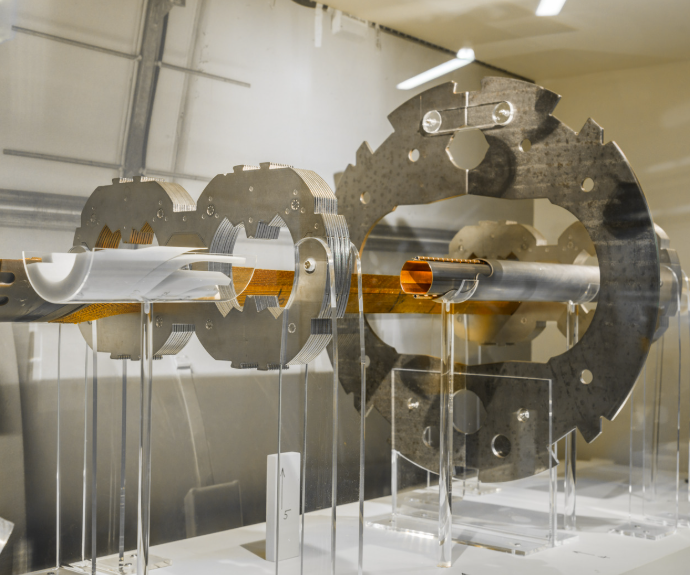
Some machines are so large that describing them as “vehicles” or “equipment” almost feels inadequate. They can stretch for hundreds of meters, weigh thousands of tons, or operate on a scale normally associated with entire industrial facilities. From a 14,196-tonne excavator that crawls through open-pit mines to a giant particle accelerator, these are seven of the biggest machines ever built. Rather than simply ranking them by one measurement, this list considers overall physical scale, mass and engineering significance.
1. Large Hadron Collider – CERN
2. Bagger 293 – Germany
3. Pioneering Spirit – Offshore construction vessel
4. F60 Overburden Conveyor Bridge – Germany
5. NASA Crawler-Transporter 2 – United States
6. Big Muskie – United States
7. Caterpillar 6090 FS – Mining shovel
Read more at Interesting Engineering
|
|
|
Insight Exchange: Expert-Led Video Series for Manufacturers
The Insight Exchange is a new video series from the Council of Industry, offering manufacturers expert insights and strategies—accessible anytime. Each session features industry professionals covering key topics like workforce development, regulatory updates, and emerging technologies.
|
|
|
In this episode of Insight Exchange, Steve Gross, Orange County Director of Economic Development and Foreign Trade Zone Administrator, provides an overview of Orange County Foreign Trade Zone No. 37 and how manufacturers and other businesses can use the program to reduce the costs associated with importing goods and materials.
He explains how foreign trade zones work, why they have become increasingly relevant amid changing tariffs, and the potential benefits for companies, including duty elimination, reduction and deferral, as well as streamlined customs and direct delivery options.
The discussion also covers which businesses may benefit most from participating in a foreign trade zone, the costs and requirements involved, and how the program can be scaled to accommodate different operations.
About Orange County Economic Development
The Orange County Office of Economic Development works with our economic development and community partners to smartly grow our economy to create employment opportunities and jobs for all. We stand with our business community by promoting and supporting commerce and industry.
Under the guidance of County Executive Steven M. Neuhaus, the Economic Development Office works to attract, retain and expand commercial and industrial tax bases. The Office supports business attraction efforts, business assistance, bridges the gap between business and government, facilitates entrepreneurial development, film and video location, tourism and international trade promotion.
Learn More
Orange County Economic Development: www.orangecountyny.gov/812/Economic-Development
For more info, visit www.councilofindustry.org
|
|
|
The Council of Industry focuses on advancing manufacturing excellence, workforce innovation, advocacy, and strategically positioning its members within the Hudson Valley region and beyond. It is the premier manufacturers' association for Southeastern New York, representing over 160 member firms. Grow, Train, and Succeed with the Council of Industry.
|
|
|
If you’re part of a Council of Industry member company and not yet subscribed, email us. If you’re not a Council member, become one today
|
|
|
|
|