|
The HR Newsletter of the Council of Industry
December 4, 2025
|
|
|
Council Celebrates Certificate in Manufacturing Leadership Graduates at 2025 Annual Luncheon
|
|
|
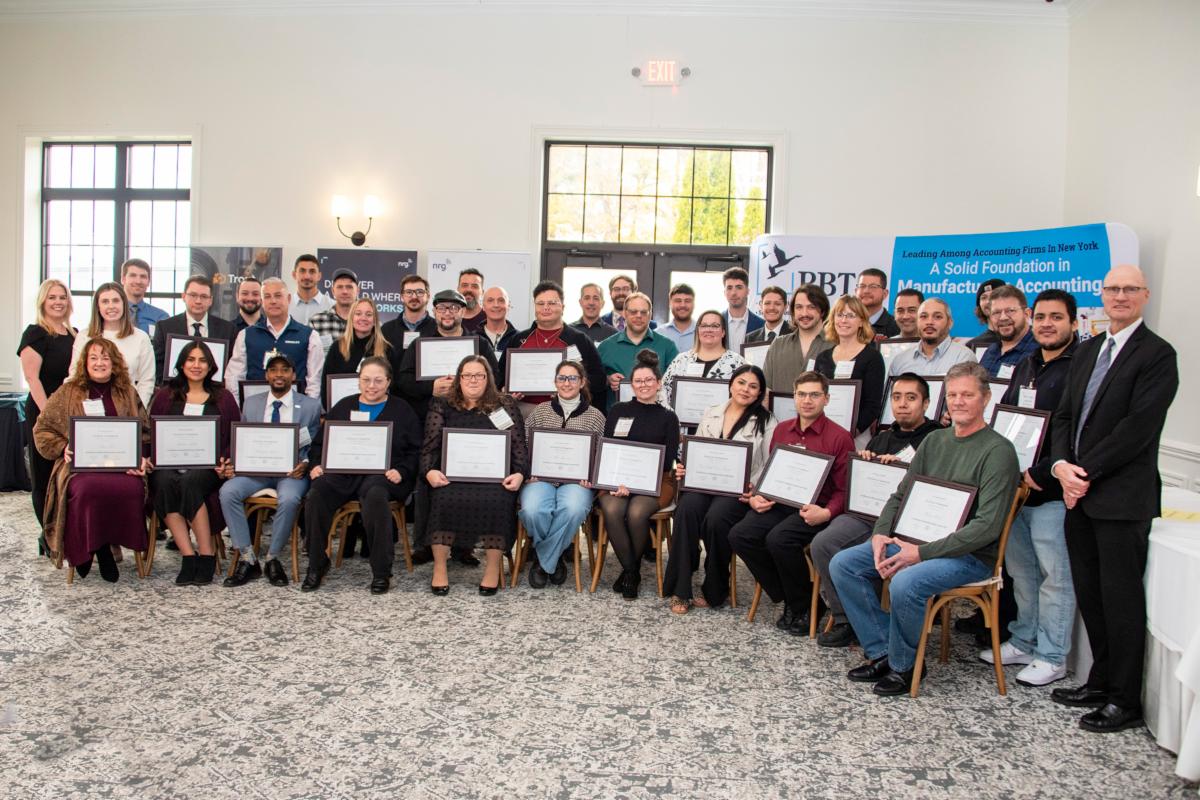
Each year, at the Annual Luncheon & Member Expo, the Council takes the time to celebrate those who have fully completed the Certificate in Manufacturing Leadership Series from the past year.
The Council saw a record number of Certificate in Manufacturing Leadership graduates from 2024 and 2025, with more than 60 employees from over 20 companies completing the series.
For over 25 years, the Certificate in Manufacturing Leadership program has offered attendees a range of leadership skills through a series of concentrated courses. It has also proven to be a great way for companies to upscale their talent.
"Ametek Rotron relies of The Council of Industry’s Certificate in Manufacturing Leadership – to give our front-line supervisors the leadership skills they need to be successful in their roles," said Chris Rodrigue, director of operations at AMETEK. "Completing the training is a significant accomplishment and the acknowledgement and recognition they receive at the November Luncheon cements the importance of the achievement.”
Congratulations to all of the 2024 & 2025 graduates!
As we head into 2026, the Council will be undergoing its online Certificate in Manufacturing Leadership Series, beginning on January 6.
Online Leadership Dates:
Fundamentals of Leadership including DiSC Profile - 1/6, 1/7 & 1/13
Making a Profit in Manufacturing - 1/20 & 1/21
Human Resources Management Issues - 2/3 & 2/4
Effective Business Communication - 2/17 & 2/18
Risk Management | Environmental Health and Safety - 2/24 & 2/25
Lean Overview & Simulation - 3/3 & 3/4
Strategies for Motivation, Coaching, & Managing Difficult People- 3/10 & 3/11
|
|
|
THANK YOU TO OUR LUNCHEON SPONSORS!
|
|
|
Council Consortium Model Delivers Quality Training to Members
Multiple Lean Six Sigma Trainings and Leadership Courses Scheduled for Early 2026
|
|
It’s difficult for companies of any size to build and deliver consistent training. For decades the Council's consortium model has provided guided, manufacturing-specific programs that help upskill employees and develop leaders—while also benchmarking best practices from others in the industry.
"These classes continue to evolve because they’re built in partnership with manufacturers and shaped by the needs of today’s workforce," said Johnnieanne Hansen, CEO.
"Our online Certificate in Manufacturing Leadership classes are very popular because they offer a flexible option for employees outside our geographical footprint, those with transportation challenges, or those who cannot be out of the facility for a full day," d she continued. "They are intentionally interactive—not passive—so participants gain the full value of the material without the disruption of traveling off site."
|
|
The Council is pleased to announce that it will be holding multiple Manufacturing driven and focused trainings in 2026.
We will be offering our virtual Certificate in Manufacturing Leadership Series in January - designed to address the unique challenges of the manufacturing industry, the program equips employees to improve productivity, foster an innovative culture and drive organizational success.
In March, the Council will be offering two more Lean Six Sigma trainings: Lean Six Sigma: Yellow Belt and Lean Six Sigma: Green Belt, in partnership with Dutchess Community College, taught by RIT's Vin Buonomo.
These courses will introduce participants to the Define, Measure, Analyze, Improve, and Control improvement process and some of the tools associated with each stage, along with providing provides individuals with the tools necessary to:
- clearly define a problem
- gather and analyze data and information
- implement improvements that can be sustained
Lean Six Sigma has become a significant force within organizations in all sectors to optimize processes and drive out waste.
The results have been outstanding, with many organizations reporting significant financial benefits, enhanced customer satisfaction, and reduced costs. In addition, participants are required to utilize the tools learned in the training on a project specific to their organization.
|
HR Manufacturing Sub Council Meeting - January 14th
|
|
Space is limited - contact us to register.
The HR Manufacturing Sub-Council brings together HR professionals from across our manufacturing member companies to connect, collaborate, and exchange ideas in a dedicated, industry-specific setting.
This sub-council is open to Manfuacturing Member HR professionals, business owners, and anyone managing HR responsibilities within manufacturing member companies. The January meeting will be held on the 14th at 8:30am at Selux Corporation in Highland.
(If you're an associate member or part of our extended network, reach out to Johnnieanne Hansen to discuss ways to join the conversation.)
Learn more (Manufacturing Members only please)
|
Prioritizing Health & Safety: Why Participation in the Health & Safety Sub-Council Matters
|
|
In today’s manufacturing environment, health and safety are more than compliance requirements—they are strategic priorities that directly influence productivity, workforce morale, and long-term business success. A strong safety culture reduces downtime, prevents costly incidents, and reinforces a company’s reputation as an employer of choice. For manufacturers facing constant change—new technologies, evolving regulations, and shifting workforce dynamics—staying ahead requires collaboration, shared expertise, and continuous learning.
That’s where the Council of Industry’s Health & Safety Sub-Council plays a vital role. This network brings together all those from member firms who are responsible for, or interested in, managing safety and health in the workplace to exchange best practices, discuss regulatory updates, and address real-world challenges unique to our region and industry. Whether it’s navigating OSHA requirements, implementing new training programs, or adopting innovative safety technologies, the Sub-Council provides a trusted forum for practical insight and peer support.
Participation strengthens not just individual companies, but also the manufacturing community as a whole. When firms collaborate, safety standards rise collectively—and everyone benefits. For those responsible for keeping workers safe, the Health & Safety Sub-Council is an invaluable resource and a powerful way to stay informed, connected, and prepared.
Learn more about the Health & Safety Sub-Council
|
|
|
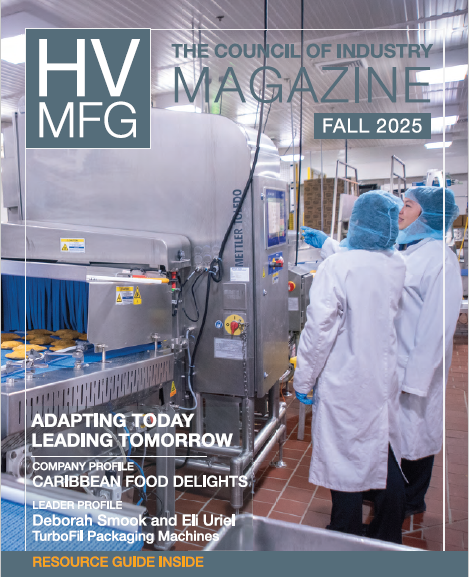
The Fall 2025 HVMFG is AVAILABLE NOW!
|
|
Adapting Today, Leading Tomorrow.
These are uncertain times for manufacturers across the globe and here in the Hudson Valley. Trade tensions and tariffs grab the headlines, but other forces—automation, cybersecurity, and artificial intelligence—are reshaping long-standing business models, processes, and even products.
In this edition of HV MFG, we brought together a small group of member executives for a roundtable discussion on the risks and opportunities shaping their businesses today. Their insights reflect the collaboration and shared purpose that define the Council of Industry — a community where manufacturers connect, learn, and strengthen one another.
Other features include a profile of Caribbean Food Delights, a Rockland County–based manufacturer of authentic Jamaican patties and other delicacies, and a Leader Q&A with Deborah Smook and Eli Uriel, the husband-and-wife team behind Mt. Vernon–based TurboFil Packaging, who share how innovation and determination fuel their success.
We’ve also included a wide range of insights for manufacturers across the region.
Finally, we want to sincerely thank the many organizations who placed advertisements in this editon of HV Mfg. Your support of the Hudson Valley manufacturing, Council of Industry and this publication is greatly appreciated.
Read the full version here.
|
|
Upskill Your Workforce With CNC Machinist Apprentice Trade
|
|
|
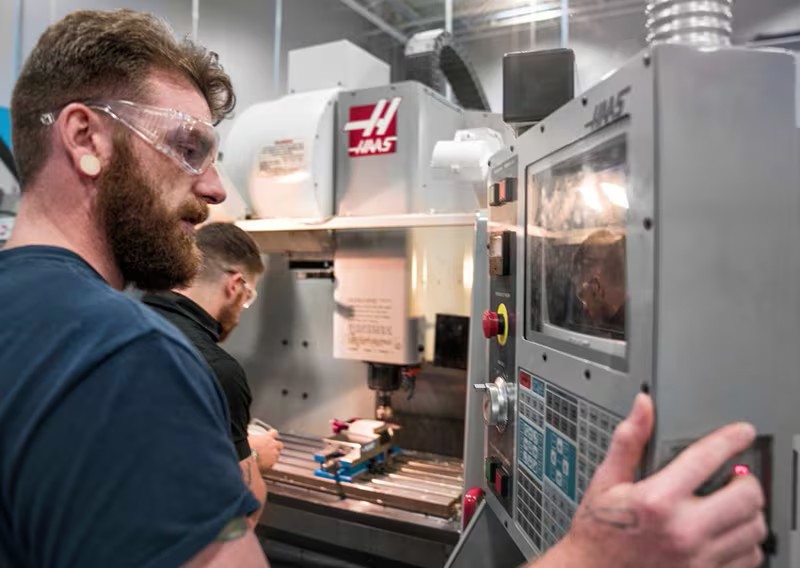
The Council of Industry sponsors 7 manufacturing trades through The Manufacturers Intermediary Apprenticeship Program (MIAP.) These are New York State Department of Labor approved trades ranging in length from 16 months to 4 years. These apprenticeships consist of two pieces: On-the-Job Training (OJT) and Related Instruction (RI).
Machinists use machine tools, such as lathes, milling machines, and grinders, to produce precision metal parts.
· OJT allows an apprentice to learn firsthand from a skilled craftsperson who will demonstrate and share their experience in the field
· In RI, apprentices will learn the theory - and knowledge - based components of the craft. They must complete 144 hours of classroom or online training each year.
CNC machinists must be able to use both manual and CNC machinery. CNC machines control the cutting tool speed and do all necessary cuts to create a part. The machinist determines the cutting path, the speed of the cut, and the feed rate by programming instructions into the CNC machine.
Work Processes (Skills learned on the Job) Approximate Hours for CNC Machinist:
- Foundations of Machining: 2,000 hours
- Principles of CNC Machining: 250 hours
- General Operation CNC Mills/Lathes / Millturns / Grinders: 1,250 hours
- Supervised Setup Mills / Lathes / Millturns / Grinders: 1,500 hours
- CNC Setup and Operate CNC Mills / Lathes / Millturns / Grinders: 2,000 hours
- Writing Basic Programs: 1,000 hours
Total Hours: 8,000
Minimum of 144 Hours of Related Instruction (Classroom Learning) Required for Each Apprentice for Each Year:
- Safety
- Blueprint Reading and Drawing
- Mathematics
- Sexual Harassment Prevention Training
- Trade Theory and Science
- NC/CNC Programming
- Computer Software
- Communications
If you want to know more about this trade and if it might be right you’re your company contact Emma Olivet
|
|
|
Subscribers to the Manufacturing Career Hub can view candidate resumes and contact information by searching the Candidate ID Number in the iCIMS platform.
Not yet a participant of the Career Hub? Contact Emma Olivet directly for additional candidate details or to learn more about the recruiting initiative.
|
|
|
Candidate ID: 35663
Position Interest: Mechanical Engineer Summer 2026 Internship
Level: Entry Level
Skills: Certified as a HAAS Basic Mill Operator, Proficient in CAD software (AutoCAD, Fusion360, and OnShape), Experience in manufacturing (3D printing, laser cutting, manual and CNC machining), Experience in programming (MATLAB, Arduino, JavaScript), Certified as a Universal Robotic Arm Operator
Related Projects: Built an AI-powered robot for use in the 2024 Odyssey of the Mind World Tournament, Designed and manufactured functional trophies outfitted with an internal gear mechanism for the Hudson Valley Council of Industry’s Champions of Manufacturing awards ceremony, Participated in NASA’s HUNCH program by machining parts to be used on the International Space Station
Education: Bachelor of Science; Mechanical Engineering Major with American Sign Language Minor Expected 2028
Availability: Open to Interviews
Location/Commute: Resides in Circleville, NY.
This eager and motivated candidate has hands-on experience as a CNC and manual machinist, working on precision parts for live events and Broadway productions. They’ve developed strong communication and teamwork skills in a fast-paced fine dining setting. Certified as a HAAS Basic Mill and Universal Robotic Arm Operator, they are proficient in CAD software, 3D printing, and programming (MATLAB, Arduino, JavaScript). Notable achievements include designing trophies for a manufacturing awards ceremony, building an AI-powered robot for an international competition, and machining parts for NASA’s HUNCH program.
|
|
Candidate ID: 40892
Position Interest: Finance Intern / Entry-Level Finance or Business Roles
Skills: Finance student seeking internship opportunities with experience in futures trading, small business operations, and customer service. Skilled in financial and technical analysis, risk management, scheduling, and social media content creation. Earned seed funding through an entrepreneurship competition and proficient in Microsoft Office, Google Workspace, Canva, Python, and major social media platforms.
Education: Currently pursuing a BBA in Finance with an expected graduation date of May 2028. Participated in an entrepreneurship competition and received seed funding for a business pitch. Graduated high school in 2024.
Experience: Experience includes independent futures trading with focus on market sessions, technical analysis, and risk management; managing scheduling, invoicing, and service operations for an automotive and marine detailing service; and working in food service roles handling order preparation, payment processing, and routine operational tasks. Volunteer work includes assisting with meal preparation and food distribution in a community setting.
Availability: Open to Interviews
Location/Commute: Nanuet, NY
Finance student with experience in market analysis, small business operations, and service-based roles. Background includes independent futures trading, managing day-to-day functions for a detailing service, and supporting operational tasks in food service environments. Earned seed funding through an entrepreneurship competition and is seeking opportunities to gain practical experience in finance and business settings.
|
|
|
News for HR and Workforce Professionals
|
|
|
Take the NYS Department of Labor Employers Survey
|
|
|
This will be the fifth year in which The Business Council has teamed up with the New York State Department of Labor, Empire State Development, and now the State University of New York, to survey thousands of businesses on their real-time needs and challenges in the workforce. Results from this survey will be used to address regional workforce and business needs and develop a strategy that will shape future workforce development practices and policies for education and training providers across New York State. First conducted during the pandemic year of 2020 the surveys has provided valuable insights from thousands of businesses from every region and industry statewide. Your input helps the NYSDOL respond to the evolving needs of businesses, the workforce, and the economy. Council members are encouraged to take the survey.
The Business Survey will ask employers about what they are experiencing in the economy and their use of emerging technology, including artificial intelligence, to gain greater insight into their needs. The survey results will be shared with leaders in education, workforce development, business associations, training providers and much more.
Take the survey here
|
|
|
Holiday Stress | Employer Tips to Help Your Employee’s Season Be a Little Brighter
|
|
We all feel stressed from time to time, but the holidays bring unique strains that pervade into the workplace and reduce productivity. Managers and HR supervisors should understand how to help identify and address issues stemming from employees’ holiday stress in the workplace. Employers are becoming increasingly focused on the physical, financial and emotional well-being of their workforce. Guiding employees to services available through your benefits program is an opportunity to connect them to the resources they may need to help them through the holiday season.
· Enhance Well-Being Programs. Incorporate wellness breaks to enable employees to refocus, such as encouraging a walk outside or granting access to meditation and yoga.
· Support Time Off and Flexible Working Arrangements. Many employees may need increased flexibility during the holidays. This could take the form of work-from-home arrangements, alternative work schedules and encouraging employees to seek work/life balance, including time away.
· Create Internal Networking Groups. Motivate employees to work together as a team to share the workload, connect with one another, share ideas and receive peer-to-peer support.
· Lean on Your Employee Assistance Program (EAP). Often an under-promoted and under-utilized benefit, your EAP can offer meaningful support to employees concerned with their emotional well-being during this stressful time of year.
· Reinforce Mental Health and Substance Abuse Coverage. If needs extend beyond what your EAP can provide, be sure employees understand benefits coverage for mental health and substance use disorder services for those enrolled in your medical plan.
Read more at Brown & Brown
|
|
IndustryWeek’s 2025 Salary Survey: Manufacturing Wages Recover Following Turbulent
|
|
Salaries have bounced back in a major way after wages took a tumble in 2024. Most notably, supply chain/logistics workers saw a massive 37.9% jump in wages. Results from our 2025 IndustryWeek Salary Survey of manufacturing management revealed a shrinking gender wage gap, though substantial disparities between men and women in the industry persist. Also, the unhappiest employees continue to earn the highest salaries.
The average salary reported by our readers in the salary survey hit $135,525. That is 13.1% higher than the 2024 figure of $119,785 and 1.1% higher than the average of $133,997 in 2023. Last year’s results likely reflected an increase in younger manufacturing workers as opposed to salary cuts for experienced employees, but data from this year showed dramatic wage increases across every age group besides 60-plus.
Read more at IndustryWeek
|
|
The Future Of Compensation Is Flexible, Fair And Fast
|
|
|
Despite 93% of U.S. employers implementing pay increases this year, many workers still struggle to meet their basic needs. Though the majority of employers delivered on pay raises this year, Mercer’s recent QuickPulse U.S. Compensation Planning Survey found that the average merit increase was just 3.2%, which fell slightly below projections. Because of this, some HR leaders, researchers and payroll experts argue that compensation strategies must evolve.
From living wage thresholds to same-day pay to financial coaching, CHROs are exploring how to treat pay as a system of resilience, not just a budget line. Some firms are considering same day pay. Dayforce has its own Wallet product, and Paychex Flex Perks, Chime Workplace and Salt Labs—all of which offer some earned wage access—were designated Top HR Products of the Year by HR Executive recently. Additionally, payroll systems are increasingly pressed to support same-day pay and predictive scheduling, while meeting IRS compliance standards that shape how employees understand and manage their earnings.
Read more at HR Executive
|
|
New York Employers Face Increases in Wage Requirements in 2026
|
|
|
The minimum wage in New York State is set to increase to $17.00 in New York City, Long Island, and Westchester County and to $16.00 for employees in the rest of the state, beginning January 1, 2026, along with several other wage credit adjustments affecting employers. After 2026, the minimum wage will adjust for inflation based on the Consumer Price Index for Urban Wage Earners and Clerical Workers (CPI-W) for the Northeast Region. Since January 1, 2024, the minimum wage rate for non-tipped fast food workers at chain restaurants (those with more than thirty locations nationally) has been the same as that of other non-tipped workers.
Employees who work in an “[e]xecutive” or “administrative” capacity and who are paid a “salary” not less than the thresholds set by state regulations may be exempt from the state’s overtime pay requirements. The thresholds are again set to increase for both downstate and upstate employees, under a three-year increase set by the New York Department of Labor. Effective January 1, the thresholds will increase:
New York City, Long Island (Nassau and Suffolk Counties), and Westchester County: $1,275.00 ($66,300 per year), up from the current $1,237.50 per week
Remainder of New York State: $1,199.10 per week ($62,353.20 per year), up from $1,161.65 per week
Read more at Ogletree Deakins
|
|
|
Gartner Says 40% Of Enterprises Will Experience ‘Shadow AI’ Breaches By 2030 — Educating Staff Is The Key To Avoiding Disaster
|
|
|
Analysis from Gartner shows 40% of businesses could fall foul of unauthorized AI usage as employees continue to use tools not monitored or cleared by security teams. The findings from Gartner come in the wake of a survey of cybersecurity leaders which underlined growing concerns about the rise of shadow AI. More than two-thirds (69%) of respondents said their organization either suspects – or has evidence to prove – that employees are using prohibited tools.
These tools, the consultancy said, can increase the risk of IP loss and data exposure, as well as causing other security and compliance issues. Gartner said the trend will require a concerted effort to educate staff on the use of these tools, clearer guidelines, and more detailed monitoring. Organizations should adopt a comprehensive approach to tackling the problem which combines policy development, employee education, and technological oversight. Policies should cover all aspects of AI use, from data input to output, and be flexible enough to respond to advancements in AI technology and regulatory changes.
Read more at IT Pro
|
|
|
Most Americans Don’t See Value Of 4-Year College Degree: Survey
|
|
|
An NBC News survey found 63 percent of people saying a bachelor’s degree is “not worth the cost because people often graduate without specific job skills and with a large amount of debt to pay off,” while 33 percent of survey participants said a four-year college degree is “worth the cost because people have a better chance to get a good job and earn more money over their lifetime.”
The new sentiments have impacted college enrollment at four-year universities. The student population at community colleges is steadily increasing as economic circumstances drive more students into vocational programs and others have begun taking college-level courses earlier with dual-enrollment programs in high school. The National Student Clearinghouse Research Center recently found undergraduate enrollment up increased for the third year in a row, with bumps across all sectors. Community college enrollment increased 4 percent, while public four-year school enrollment rose by 1.9 percent and private nonprofit institutions had a 0.9 percent bump.
Read more at The Hill
|
|
|
Unused PTO: A Red Flag That Employees Are About To Bolt?
|
|
|
Research from FlexJobs highlights the scope of the issue of unused PTO: Almost a quarter of employees the organization surveyed didn’t take a day off in 2024, while more than 20% took fewer than five days. This is despite the vast majority—more than 80%—having access to paid time off. Even if employees are allowed to roll some unused PTO into the next calendar year, widespread resistance to taking time regularly isn’t a “policy problem,” says Curtis Forbes, founder and CEO of employee engagement platform MustardHub. Instead, Forbes says, “it’s a cultural signal that people believe rest comes with a penalty.”
While about one-third of those who avoided taking time off cite not having enough days saved up, a larger share (43%) blame their workload, saying it’s too heavy to justify time away. Similarly, nearly a third are worried about falling behind, and almost as many say they feel guilt and pressure to demonstrate a commitment to their work. HR is at the helm of helping employees, managers and executives understand the personal and organizational risks of avoiding PTO and leading the cultural transformation to change the story. HR also needs to ensure leadership is bought into the reality: Unused PTO is not a “vacation metric” but rather a strong “predictive indicator of burnout, productivity loss and eventual turnover,” Forbes says.
Read more at HR Executive
|
|
|
Front-Line Workers Are More Difficult To Find, Train And Retain, Study Says
|
|
|
Front-line workers make up 70% of the U.S. workforce, but they are increasingly difficult to find, train and retain, according to an analysis by HR advisory firm The Josh Bersin Co. in collaboration with UKG. Three-quarters of front-line workers feel burned out, and 51% say they “feel like a number, not a person,” fueling their sense of feeling overworked, underappreciated and disconnected, the Nov. 5 report found.
Additionally, employers are increasingly realizing that essential workers — including those in logistics, healthcare and leisure — cannot be hired or replaced with ease due to various economic pressures, the report said. The report urged CHROs to embrace and prioritize the needs of front-line workers and consider revisiting HR systems traditionally designed for office-based staff. For example, by standardizing its workforce management processes, a major hotel chain enabled front-line workers to share and trade shifts easily, Josh Bersin said.
Read more at Supply Chain Dive
|
|
|
iCIMS November Labor Market Insights – Manufacturing Hiring Slows as Skills Mismatch Grows
|
|
|
In the overall labor market applicants per opening (APO) rose from 30 to 33 year over year, showing steady growth in job seeker activity since last October, while Time to fill (TTF) held flat at 39 days. This suggests employers remain cautious and deliberate in their decision making. While APO remains elevated year over year, recent months have seen a dip in application activity — a likely sign that employer caution may be tempering candidate engagement. The manufacturing sector is feeling a sharper talent squeeze than the broader market. Applications per opening are rising, yet time to fill has barely moved as openings climb and hiring slows year over year.
- Manufacturing APO rose from 41 in October 2024 to 47 in October 2025, reflecting growing candidate interest year over year.
- Applicant activity appears to be tracking employer demand. APO peaked midyear alongside hiring growth and has eased in recent months as hiring momentum slowed.
- TTF increased from 40 to 42 in the past 12 months, suggesting employers are making slower hiring decisions in a cautious market. But moving too slow could mean losing critical hires.
- Midcareer and older candidates remain steady, suggesting stability and — perhaps reading the labor market tea leaves — a desire to stay put.
- APO for computer and math jobs in manufacturing grew from 65 to 83, a 27% increase year over year.
- Applicants for architecture and engineering roles in manufacturing jumped 24% year over year, reflecting a convergence of infrastructure/plant build out, growing use of automation and widening access to these roles via skills-based hiring.
- The data points to process friction, not pipeline scarcity. Candidates are applying, but few are moving through efficiently. For manufacturing recruiters, the edge will go to those who treat hiring like production: measure throughput, eliminate bottlenecks and keep talent moving.
Read the Report
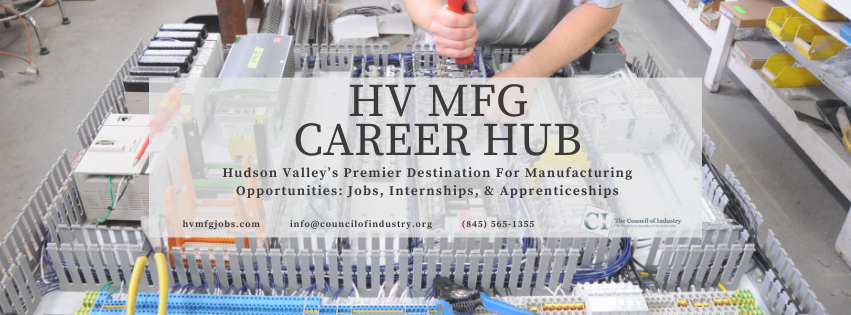
Learn more about the Council of Industry’s Manufacturing Career Hub Driven By iCIMS
Check out the MIAP Apprentice Program
|
|
|
Manufacturing Matters Podcast
Sponsored by PKF O'Connor Davies
|
|
|
We’re excited to feature Dr. Allison Buckley on this episode of the Council of Industry Podcast. Dr. Buckley shares her inspiring journey from labor historian to community college president and highlights the vital role SUNY Ulster plays in providing accessible, affordable education to a wide range of students.
During our conversation, Dr. Buckley discusses the unique mission of community colleges to serve diverse learners—whether they’re returning students, first-generation collegegoers, or career changers—and the importance of flexibility in today’s education landscape. She also explores how SUNY Ulster’s innovative programs, including SUNY Reconnect, are helping students build meaningful career pathways and meet regional workforce needs, especially in fields like manufacturing.
Key topics include:
🔹 Dr. Buckley’s personal story and career path
🔹 The mission and impact of community colleges
🔹 Flexible education pathways that meet students where they are
🔹 Workforce training programs and regional partnerships
🔹 Helping students discover their strengths and career goals
|
|
|
If you’re part of a Council of Industry member company and not yet subscribed, email us. If you’re not a Council member, become one today
|
|
|
|
|