|
The HR Newsletter of the Council of Industry
June 9th, 2026
|
|
|
Selux Holds Open House for SUNY New Paltz Engineering Students
|
|
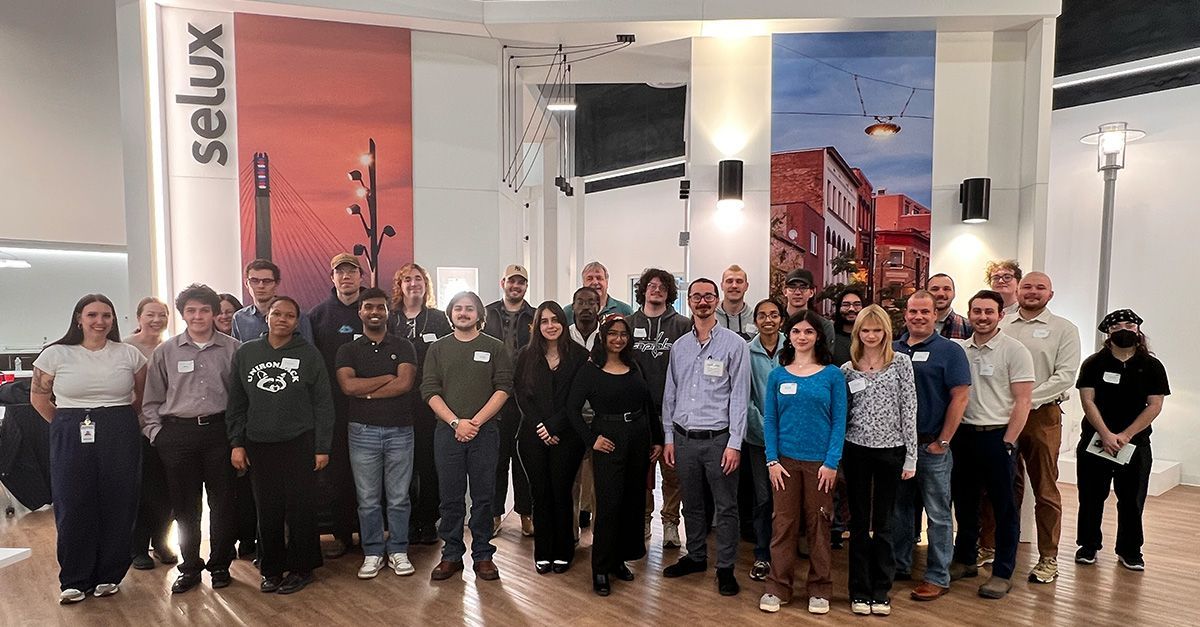
The Council of Industry recently joined SUNY New Paltz engineering students for a behind-the-scenes tour of Highland based Selux Corporation, giving future engineers an up-close look at innovation in action.
Students met with Selux engineers, explored products in the company's Innovation Center, toured the facility, and learned about the many career paths that support modern manufacturing. The visit concluded with a Q&A panel featuring leaders from engineering, manufacturing, and human resources, who shared advice on internships, career development, and entering the workforce.
The experience sparked plenty of enthusiasm, with many students expressing interest in internship opportunities.
Interested in Hosting a Student Open House?
The Council of Industry is seeking manufacturers interested in hosting facility tours and open houses for prospective interns and graduates. These events are a great way to showcase your company, connect with emerging talent, and help build the future manufacturing workforce.
To learn more about hosting an open house or finding interns, reach out to Emma Olivet.
|
|
|
Not Too Late to Hire An Intern for the Summer or Start Planning for the Fall
|
|
|
The Council of Industry is supporting SUNY in their effort to provide workplace learning opportunities for all their students. If you are interested in hiring a student for a summer internship (or just want to learn more) please contact Emma Olivet.
We can discuss candidates, best practices, project ideas and more. If it is too late for the summer we can help you plan for a fall – or even spring semester intern.
|
|
|
HR Sub-Council Meeting - July 23rd
This Sub-Council is open to business owners, HR professionals, and individuals managing HR responsibilities from manufacturing member companies.
The July meeting will focus on Intern program best practices. From recruitment to project design and engaging your team learn how to build and manage an effective program that brings value and builds a talent pipeline.
Location TBD.
If you are an associate member or part of our extended community, please reach out to Johnnieanne Hansen to discuss possible engagment opportunities.
Register Here
|
|
|
Annual Golf Outing is August 24th
|
|
|
The Council of Industry will hold its Annual Golf Outing on the last Monday in August at the Powelton Club in Newburgh. The Powelton is a beautiful course conveniently located just off of Route 9W in Newburgh, NY.
Last year’s event drew 112 golfers from manufacturing firms throughout the Hudson Valley.
Registration and lunch will begin at 11:30 followed by a shotgun start at 12:30. Cocktails and a light dinner will follow at approximately 5:15 p.m.
The fee includes lunch, golf, cart, cocktails, hors-d'oeuvres, dinner, prizes and giveaways. Dinner only option for non-golfers. Sponsorships are available!
Spots are filling up quick! Secure your single golfer or foursome today.
Register Here
|
|
|
Council Organizes DOL Visits With More than 30 Apprentices in Three Mid-Hudson Counties in One day
|
|
|
The Council of Industry Leads the Manufacturing Intermediary Apprenticeship Program (MIAP) in the Hudson Valley. MIAP is an employer-led program designed to help manufacturers upskill their workforce through New York State Department of Labor–registered manufacturing apprenticeship trades.
The most recent DOL review was part of a requirement of the NYS apprenticeship program. The Department of Labor may conduct reviews once or twice a year, and this most recent one took place in late May.
The day consisted of six stops across our members, including Elna Magnetics, Sono-Tek, Selux, Schatz Bearing, Dorsey Metrology, Ditron, onsemi, GAP, Fair-Rite Products, Reelex, and Pratt & Whitney. In total, the review oversaw more than 30 apprentices across three different shifts in three different counties.
It was a valuable opportunity to connect with apprentices and their supervisors, and to take a moment to recognize the work they are doing.
Learn more about apprenticeships
|
|
|
Companies With Registered Apprentices Are Eligible For Substantial Tax Credits
|
|
|
To encourage participation in Registered Apprentice Programs and to mitigate some of the costs associated with managing apprentices, New York State provides tax credits of up to $8,000 per apprentice.
To be eligible for the credit apprentices need to be
registered as of June 30th (the registration process can take 3-4 weeks).
Interested in registering an apprentice or learning more about the program? Contact Emma Olivet
|
|
Upskill Your Workforce With CNC Machinist Apprentice Trade
|
|
|
The Council of Industry sponsors 9 manufacturing trades through The Manufacturers Intermediary Apprenticeship Program (MIAP.) These are New York State Department of Labor approved trades ranging in length from 12 months to 4 years. These apprenticeships consist of two pieces: On-the-Job Training (OJT) and Related Instruction (RI).
· OJT allows an apprentice to learn firsthand from a skilled craftsperson who will demonstrate and share their experience in the field
· In RI, apprentices will learn the theory - and knowledge - based components of the craft. They must complete 144 hours of classroom or online training each year.
CNC Machinists use machine tools, such as lathes, milling machines, and grinders, to produce precision metal parts. CNC machinists must be able to use both manual and CNC machinery. CNC machines control the cutting tool speed and do all necessary cuts to create a part. The machinist determines the cutting path, the speed of the cut, and the feed rate by programming instructions into the CNC machine.
Work Processes (Skills learned on the Job) Approximate Hours for CNC Machinist:
- Foundations of Machining: 2,000 hours
- Principles of CNC Machining: 250 hours
- General Operation CNC Mills/Lathes / Millturns / Grinders: 1,250 hours
- Supervised Setup Mills / Lathes / Millturns / Grinders: 1,500 hours
- CNC Setup and Operate CNC Mills / Lathes / Millturns / Grinders: 2,000 hours
- Writing Basic Programs: 1,000 hours
Total Hours: 8,000
Minimum of 144 Hours of Related Instruction (Classroom Learning) Required for Each Apprentice for Each Year:
- Safety
- Blueprint Reading and Drawing
- Mathematics
- Sexual Harassment Prevention Training
- Trade Theory and Science
- NC/CNC Programming
- Computer Software
- Communications
If you want to know more about this trade and if it might be right you’re your company contact Emma Olivet
Learn more about The Council of Industry’s Apprentice Program
|
|
|
Subscribers to the Manufacturing Career Hub can view candidate resumes and contact information by searching the Candidate ID Number in the iCIMS platform.
Not yet a participant of the Career Hub? Contact Emma Olivet directly for additional candidate details or to learn more about the recruiting initiative.
|
|
|
Candidate ID: 43615
Position Interest: Operations / Supply Chain / Consulting / Strategic Management
Skills: Financial Modeling; CAPEX/NPV Analysis; Business Case Development; ERP Systems; Power BI; Excel; VBA; SQL; R; Tableau; KPI Tracking; Demand Planning; Inventory Management; Procurement; Data Analysis; Process Optimization
Education:
Syracuse University, Whitman School of Management, Syracuse, NY — Master of Business Administration (MBA), Supply Chain & Sustainability (May 2026), GPA: 3.8/4.0
State University of New York at New Paltz, New Paltz, NY — Bachelor of Science (BS), Management & Marketing (Dec. 2021), GPA: 3.5/4.0
Dutchess Community College, Poughkeepsie, NY — Associate of Science (AS), Business Administration (Dec. 2018), GPA: 3.4/4.0
Availability: Open to Interviews
Location/Commute: Resides in Hudson Valley, NY
Summary: MBA graduate specializing in Supply Chain and Sustainability with experience in manufacturing operations, financial analysis, and process improvement. Led analysis identifying $600K in duty drawback recovery and $250K in pricing discrepancies through ERP data analysis. Built forecasting and dashboard tools to improve demand planning and operational decision-making, contributing to a 97% on-time fulfillment rate. Skilled in financial modeling, data analytics, and business intelligence tools including Power BI and Excel. Seeking opportunities in operations, consulting, or strategy.
|
|
|
Candidate ID: 43383
Position Interest: Chemical Engineering / Process Sciences
Level: Entry-Level / Full-Time
Skills: Chromatography process development (AKTA); HPLC operation and analysis; experimental design; statistical data analysis; laboratory techniques and general lab operations; GMP documentation, protocols, and SOPs; tech transfer and process scale-up; Microsoft Excel, Word, JMP, and LIMS; effective communication; accountability; time management
Education: Rensselaer Polytechnic Institute, Troy, NY — Bachelor of Science in Chemical Engineering (May 2024)
Availability: Open to Interviews
Location/Commute: Resides in the Capital Region, NY (Willing to relocate)
Chemical Engineering graduate with experience in GMP-regulated process sciences supporting downstream chromatography purification studies for monoclonal antibodies (mAbs). Skilled in chromatography process development, HPLC analysis, statistical data analysis, laboratory operations, GMP documentation, and operation of AKTA systems and related instrumentation. Experience includes resin lifetime studies, process characterization, protocol and SOP development, and cross-functional technical support. Strong foundation in chemical engineering principles through coursework, undergraduate research, and capstone design projects, with additional leadership and time management experience gained through NCAA Division III athletics.
|
|
|
News for HR and Workforce Professionals
|
|
|
iCIMS May Insights – Employer Demand Is Rising
|
|
|
The latest data reveals a stark disconnect between employer demand and talent supply. In April 2026, job openings surged, hitting a 13-month peak of 15% above baseline (March 2025). However, candidate activity is moving in the exact opposite direction. After a brief spike in January, application volume has declined to 10% below the baseline.
The makeup of the applicant pool is shifting. Over the last 12 months, the youngest demographic of job seekers (18-24) has seen their share of total applications drop from a dominant 44% in April 2025 down to 40% in April 2026.
Meanwhile, seasoned professionals are making their move. The 35-44 age bracket grew its footprint from 12% to 15% of all applicants over the same period. Older talent is highly competitive as well, with candidates 45 and older comprising 21% of the total applicant pool in April 2026. Driven by a tough market and delayed retirement plans, older generations are staying in the labor market longer and actively searching for better compensation and stability.
Gen Z wants seamless applications and strong brands, but older workers prioritize salary transparency, robust benefits and career growth to protect their financial future.
When evaluating candidates from four different generations for the same open roles, relying on years of experience is an outdated metric. Shift your focus to skills-based hiring to level the playing field and identify the best fit for your organization regardless of age.
Read the Report
Learn more about the Council of Industry’s Manufacturing Career Hub Driven By iCIMS
Check out the MIAP Apprentice Program
|
|
|
Many Companies Are Hiring New CHROs To Lead Them Through AI Transformation
|
|
|
Companies are going through lots of changes, starting in the C-suite. The majority of global CHRO appointments (56%) were external hires in Q1 2026, up from 46% in Q1 2025, according to new research from leadership advisory firm Russell Reynolds Associates (RRA). And, in the S&P 500, external CHRO appointments hit 67% last quarter, up from 30% YoY. Many CHRO changes are happening on the heels of new CEO appointments, Ted Moore, managing director and global lead of the HR practice at RRA, told HR Brew. There were 77 CEO appointments globally in Q1 2026, RRA’s research found, the highest number since the firm started tracking this data in 2018.
“What’s happening is a new CEO looks around, and one of the first things they need to do is say, if they think of the triumvirate, me leading the business, CFO in charge of the dollars and the finances, CHRO in charge of the people,” Moore said. “Sometimes there’s a sense of, ‘I need new blood,’ and…there isn’t a blueprint on how to do this AI version.” Newly minted CEOs also want CHROs who can help them navigate some of the biggest workforce challenges caused by AI, he said. Just as their skills developed to lead workers through the pandemic, CHROs will need to develop other skills in anticipation of organizational needs, and design a workforce that meets those needs today and in the future.
Read more at HR Brew
|
|
|
Your Teams Are Using AI Whether You're Ready Or Not
|
|
Generative AI use is already a majority behavior for working-age Americans. The latest Real-Time Population Survey data show that by August 2025, 54.6% of adults aged 18 to 64 had used generative AI, up from 44.6% a year earlier, with work use rising from 33.3% to 37.4% and nonwork use rising from 36.0% to 48.7%. Three years after launch, this adoption rate is far ahead of that of personal computers and the early commercial internet at comparable points in their rollouts.
What’s next is less about whether generative AI works and more about how firms convert scattered time savings into durable performance. Global modeling from McKinsey estimates that recent advances in generative AI have raised the share of work hours that are technically automatable from about 50% to as much as 60% to 70% and could add 0.1 to 0.6 percentage points to annual productivity growth between 2023 and 2040, within a broader automation range of 0.5 to 3.4 percentage points. Those gains only materialize if organizations actually redesign workflows so that freed-up hours are redeployed into high-value activities rather than drowned in meetings and email.
Read more at SmartBrief
|
|
Study: Remote Work Leaves Younger Workers Sidelined
|
|
According to a study by the Federal Reserve Bank of New York, the rise in remote work since the pandemic has been the key driver of higher unemployment rates among recent college graduates. The report compared occupations that can be done remotely – like software development – with those that are done in person, such as nursing, and found that the unemployment rate among young college graduates in “remotable” jobs rose by about 1 percentage point from 2017-2019 to 2022-2024. The study, led by New York Fed research economist Natalia Emanuel, concludes that businesses are reluctant to hire new college grads for remote work because it is harder to train and mentor them when they work outside the office.
All in all, remote work is responsible for nearly two-thirds of the rise in the unemployment rate for young college graduates since the pandemic. “Employers may not want to hire fresh graduates onto distributed teams because it is more difficult to teach them the requisite skills from afar,” the study says. By contrast, in non-remotable jobs, young graduates’ relative unemployment rate ticked up in 2020 but returned to baseline soon afterward.
Read more at Fast Company
|
|
|
23% Of The US Workforce Is 55 Or Older: The Retirement Wave Is Coming
|
|
|
A new analysis focused on Bureau of Labor Statistics (BLS) data reveals that older workers are reshaping the labor market, with some occupations nearing large-scale retirement turnover—potentially creating a formidable challenge for employers nationwide. The Workforce Aging Report from MyPerfectResume, a resume-building service, found that data from the BLS’ Current Population Survey (CPS) reveals a major demographic shift that is reshaping retirement patterns, labor supply and workforce stability across industries and employers.
Among the findings in the report:
· Workers aged 55+ make up 23.2% of the U.S. workforce.
· Older workforce growth outpaces total employment growth: Workers aged 55+ grew by 17.3% since 2014, compared with 11.7% overall.
· Workers 65+ and older increased by more than 40% over the past decade.
· Some occupations have 30% to 50% of workers nearing retirement age.
· Certain jobs are aging rapidly; multiple occupations saw 5 to 10+ percentage-point increases in older workers.
Read more at HR Executive
|
|
|
Reskilling Is A Top Priority -- But Workers Hate It
|
|
|
Somewhere right now, an employee is watching a video about active listening at 1.75x speed. Another is clicking through a fire safety module they completed last year and can’t remember anything about. Corporate learning has become a paradox in modern business where companies invest billions annually, but the people they’re investing in actively dread it. Learning still feels like a punishment. Most corporate learning platforms were designed for distribution rather than engagement. Standardised formats, linear modules, and passive consumption make rollout fast and simple, but they rarely make knowledge stick.
The Research Institute of America found that employees retain only 10-20% of information after traditional corporate training. The companies that build a genuine learning culture, where employees actively participate rather than grudgingly comply, will have an advantage as the future of work continues to adapt in the age of AI. This changing landscape is an opportunity to turn learning on its head, and the technology exists to actually do it. AI can make every employee’s learning as individual as they are, at a scale no team of designers ever could. Until the default shifts away from mandatory one-size-fits-all training, we will see the same outcomes: boxes ticked, knowledge not retained, and learning opportunities quietly fading.
Read more at Training Journal
|
|
|
World Cup Roster Cuts By Email? What HR Leaders Can Learn
|
|
|
A U.S. soccer coach is defending himself to the sports press for delivering hard news in writing instead of picking up the phone. Mauricio Pochettino announced the final 26-man U.S. men’s national team roster for the 2026 World Cup this week, and the players who didn’t make it found out by email. Former U.S. international Herculez Gomez called the move “diabolical” and said Pochettino should “face your players and give them the respect they deserve,” according to LinkedIn News. However, Pochettino pushed back. He said his approach was consistent and personal, noting that when he was cut from Argentina’s national team in 1994 and 1998, he didn’t want his coach to call him.
Pochettino’s argument is not without merit, and HR practitioners who work in high-volume or geographically distributed environments often utilize similar approaches. A written message gives the recipient time to process before responding and removes the pressure of a live conversation neither party is fully ready to have. However, that stance contrasts with much of the expert guidance, which tends to prioritize live, person‑to‑person communication for terminations and layoffs and warns that email‑only notices can erode trust if they are perceived as cold or abrupt.
Read more at HR Executive
|
|
|
3 Things To Do (And Avoid) When Employee Morale Craters
|
|
|
The problem is that low morale is like a virus—it spreads quickly and can be difficult to contain once it takes hold. Additionally, once morale is low, there’s little incentive to be engaged or do one’s best work. Productivity suffers, potentially exacerbating problems within the organization and creating a negative feedback loop of employee dissatisfaction and poor output. One of the most common leadership mistakes in these situations is treating the problem like a technical challenge. Technical challenges are those with known solutions. This might look like fixing a broken process or implementing a system to solve a recurring issue. Unfortunately, these scenarios are not technical in nature; they are adaptive challenges. Fortunately, researchers have offered a roadmap for navigating situations where a clear solution may not exist.
Pause - Resist the urge to make changes immediately. There is power in the pause. Remedying complex adaptive challenges in the workplace takes time.
Empower the people - Adaptive challenges are best solved by the people living them, not by leaders acting on them. One of the best things a leader can do is create an environment with psychological safety, where employees feel comfortable expressing their views.
Sit with the ick - Sorting through the different facets of a problem can feel deeply uncomfortable. However, it’s a mistake for leaders to start throwing solutions at the problem before it’s been properly understood and diagnosed.
Read more at Psychology Today
|
|
|
Insight Exchange: Expert-Led Video Series for Manufacturers
|
|
|
Insight Exchange: Expert-Led Video Series for Manufacturers
The Insight Exchange is a new video series from the Council of Industry, offering manufacturers expert insights and strategies—accessible anytime. Each session features industry professionals covering key topics like workforce development, regulatory updates, and emerging technologies.
|
|
|
|
C3PAO's Perspective
Key Aspects of Your Compliance Journey
- Presented by Nick DeLena, PKF O'Connor Davies
|
|
|
In this episode of Insight Exchange, Nick DeLena, Partner of PKF O’Connor Davies, provides an overview of CMMC and what it means for manufacturers and contractors handling sensitive government information. He explains how the framework builds on existing requirements while introducing third-party certification, outlines the different CMMC levels, and breaks down what organizations need to know about protecting CUI.
The discussion also covers the rollout timeline, common challenges companies face in achieving compliance, the risks of falling short, and the key steps organizations can take to prepare—from documentation to cloud and emerging technology considerations.
About PKF O'Connor Davies
PKF O’Connor Davies is a top-tier accounting, tax and advisory practice with a long history of serving domestic and international clients. “Know Greater Value” speaks to the confidence and guidance that our clients realize when they work with us. It reinforces our commitment to delivering the highest levels of value, expertise and service in everything we do.
Learn More
PKF O'Connor Davies: www.pkfod.com
For more info, visit www.councilofindustry.org
|
|
|
The Council of Industry focuses on advancing manufacturing excellence, workforce innovation, advocacy, and strategically positioning its members within the Hudson Valley region and beyond. It is the premier manufacturers' association for Southeastern New York, representing over 160 member firms. Grow, Train, and Succeed with the Council of Industry.
Council of Industry - www.councilofindustry.org - (845) 565-1355
If you’re part of a Council of Industry member company and not yet subscribed, email us. If you’re not a Council member, become one today
|
|
|
|
|